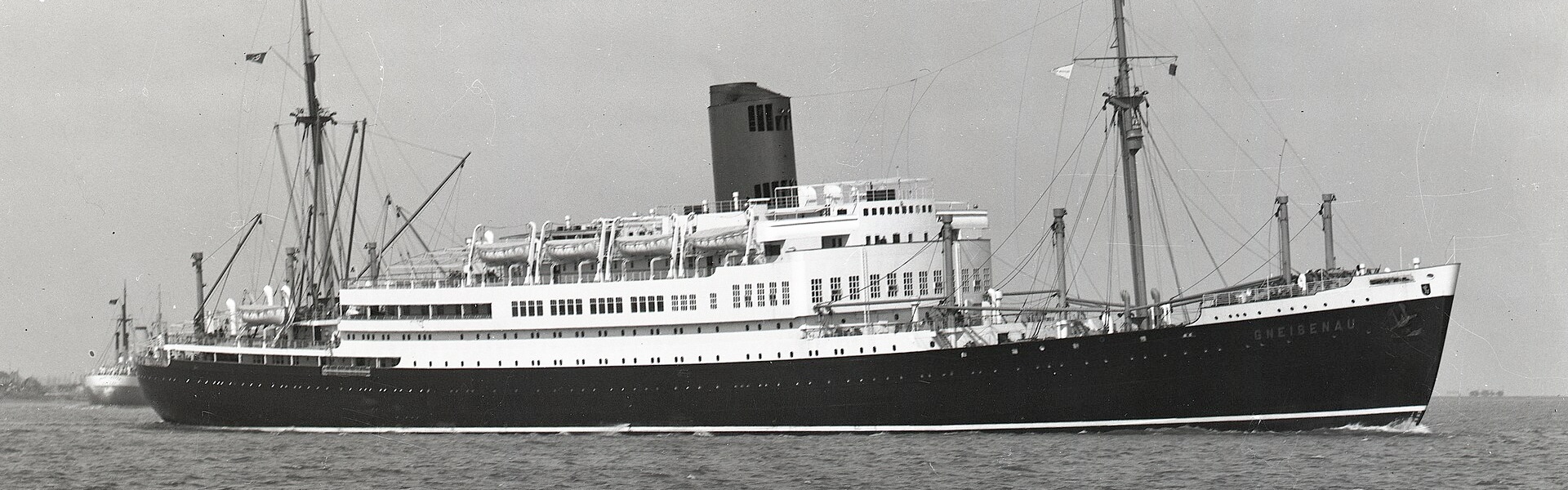
SS Gneisenau
Norddeutscher Lloyd · 1935 · Ship Guide
Overview
SS Gneisenau was one of Norddeutscher Lloyd’s fast new East Asia liners of the mid-1930s, built at AG Weser in Bremen for the long route from Germany through the Mediterranean and Suez to ports in South and East Asia. Her current guide previously placed her launch in December 1934 and her wartime loss at Shanghai; both points were wrong. Gneisenau was launched on 17 May 1935, began her maiden voyage on 3 January 1936, and was lost after striking a mine off Gedser in the Baltic on 2 May 1943.
Her short life is historically useful because it joins three very different stories: the final flowering of German interwar Far East passenger service, wartime requisition as a transport, and an unrealized 1942 proposal to convert the liner into an auxiliary aircraft carrier under the projected name Jade.
Key Facts
Built for the East Asia Express Service
Gneisenau belonged to a route system very different from the North Atlantic speed contest. Norddeutscher Lloyd needed ships capable of maintaining a long, prestigious service through European and Mediterranean ports, the Suez Canal, Colombo, Southeast Asia, China, and Japan. Speed still mattered, but so did range, cargo capacity, reliability, and comfortable accommodation over voyages measured in weeks rather than days.
The ship is usually discussed with Scharnhorst and Potsdam, but the three were not mechanically identical. Gneisenau used geared turbines, making machinery comparison within the group part of the story rather than a reason to treat the ships as interchangeable sisters.
Passenger Service, 1936–1939
After her January 1936 maiden voyage, Gneisenau worked Norddeutscher Lloyd’s Far East express service until the outbreak of the Second World War. At roughly 21 knots she ranked among the faster passenger ships on the route. Brochures, labels, menus, passenger lists, and port photographs from these years therefore belong to a highly specific Europe–Asia travel world rather than to generic German liner history.
The China route also acquired a darker historical importance in the late 1930s as Shanghai became one of the few destinations accessible to Jewish refugees fleeing Nazi persecution without the normal entry-visa barriers. Ship-specific passenger evidence should still be treated voyage by voyage, but the wider route context matters when interpreting late-1930s material.
War, Troop Transport, and Project Jade
Normal Far East liner service ended with the war. Gneisenau was taken into German military transport use in 1940. In 1942 the Kriegsmarine considered converting her into an auxiliary aircraft carrier, with the projected name Jade. The proposal required substantial stability changes and was abandoned on 25 November 1942 before conversion work began.
That distinction matters: Gneisenau was not completed, commissioned, or operated as an aircraft carrier. References to Jade belong to a canceled design project, not to a second operational ship identity.
Loss and Postwar Disposal
Returned to transport duties, Gneisenau struck a mine near Gedser on 2 May 1943 and sank in the Baltic. This corrects the earlier guide’s Shanghai-loss narrative. The wreck remained until it was raised on 12 July 1950 and subsequently broken up in Denmark.
Her loss is therefore best understood as part of the wartime Baltic transport system, not as the destruction of a stranded Far East liner in China.
Interpreting Surviving Material
Because Gneisenau had only a short peacetime career, civilian artifacts can be disproportionately scarce compared with wartime references and later retrospective material. That scarcity can make the military years seem more central than they were to the ship’s original purpose. Dated passenger lists, sailing notices, baggage labels, menus, and travel brochures are especially valuable because they reconnect the hull to the route system for which it was actually built.
Name confusion is another recurring problem. Naval history is dominated by the German battleship Gneisenau, while passenger-ship references may also use the name without a year. For cataloging, “Norddeutscher Lloyd,” East Asia route context, yard no. 893, and the 1935–43 chronology are stronger identifiers than the name alone. Likewise, the projected name Jade should never be presented as if it appeared on normal passenger material or represented an operational renaming.
Why Gneisenau Matters
Gneisenau is a compact case study in how quickly a modern interwar passenger network could disappear. A ship launched to compress the distance between Europe and East Asia had barely three and a half years of peacetime service before war erased the commercial system for which she had been designed.
For curatorial work, the most important discipline is phase separation: prewar Norddeutscher Lloyd material, wartime transport records, the unrealized Jade project, and the 1943 wreck should not be blended into one undifferentiated narrative.
Evidence-first ship guideSources (Selected)