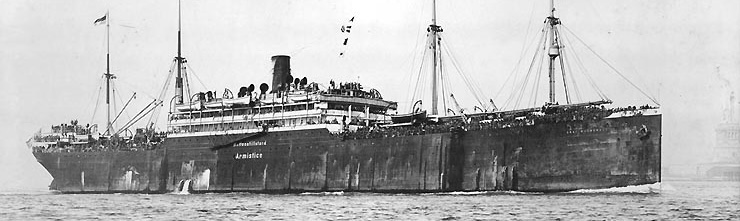
SS Graf Waldersee
Hamburg-Amerika Line · 1898 · Ship Guide
Overview
SS Graf Waldersee was a large German passenger and cargo liner built by Blohm & Voss at Hamburg for the Hamburg-Amerika Line. Launched in December 1898 and entering service in April 1899, she was the third completed member of the company’s Pennsylvania class, a group of high-capacity emigrant steamships designed for the Hamburg–New York trade.
Her commercial importance lay in scale rather than speed. With room for more than two thousand third-class passengers in later configurations, Graf Waldersee became part of the infrastructure of mass European migration before the First World War. After remaining in Germany during the conflict, she was surrendered to the United States, briefly served the U.S. Navy as a troop-repatriation transport, and then passed to British control.
This page treats Graf Waldersee as the Hamburg-Amerika Line liner launched in 1898. The name honors German Field Marshal Alfred von Waldersee and may appear in military, biographical, and non-maritime contexts; builder, date, dimensions, and operator should therefore be checked before attribution.
Key Facts
Note on tonnage: the ship appears under several closely related gross-tonnage figures. These differences may reflect rebuilding, remeasurement, or the particular registry and date represented by the source.
Design & Construction Context
Graf Waldersee belonged to a class designed around capacity, economy, and commercial flexibility. Her single funnel, four masts, broad hull, and moderate speed distinguished her from the faster twin- and four-funnel express liners that received greater publicity at the turn of the century.
The design supported large freight loads and an unusually high number of third-class passengers while retaining smaller first- and second-class sections. This made the ship particularly useful on routes where migration and cargo produced dependable revenue across the year.
Hamburg–New York Service
The liner began her maiden voyage from Hamburg to New York by way of Boulogne on April 2, 1899. She remained closely associated with the Hamburg–New York trade during her active German career, with intermediate calls varying according to schedule and season.
Her sailings belonged to a carefully organized network of rail connections, emigrant processing facilities, port agents, feeder services, and transatlantic departures. The ship was therefore only one visible component of a much larger migration system.
Passenger & Migration Evidence
Passenger lists are among the most valuable surviving records connected with Graf Waldersee. They can document names, ages, occupations, nationality, last residence, destination, relatives, and class of travel. A 1910 manifest, for example, records a voyage from Hamburg by way of Cuxhaven and Boulogne-sur-Mer to New York.
These records should be interpreted with attention to spelling and transcription. German names, Eastern European place-names, and handwritten entries can vary considerably, and the original manifest image should be consulted whenever a precise identification depends on a single detail.
Class & Passenger Experience
The social experience aboard Graf Waldersee differed sharply by class. First- and second-class travelers had access to more private accommodations and formal public rooms, while the much larger third-class population occupied denser spaces shaped by economy, regulation, and the practical demands of mass transport.
Because promotional material generally favored cabin spaces, it can create a distorted picture if used alone. Manifests, inspection records, emigrant-station photographs, and personal accounts are necessary to recover the experience of the majority of those carried.
First World War
When the First World War began in August 1914, Graf Waldersee remained in Germany and did not resume ordinary transatlantic service. She spent the conflict laid up rather than being interned in a neutral or enemy port.
The postwar surrender of the German merchant fleet ended her Hamburg-Amerika Line career. Her transfer was part of the larger redistribution of German tonnage used to meet Allied transport needs and compensate for wartime shipping losses.
USS Graf Waldersee
The United States Navy commissioned the ship at Spithead, England, on March 28, 1919 as USS Graf Waldersee (ID-4040). She was assigned to the Cruiser and Transport Force and used to return American military personnel from Europe after the Armistice.
Across three repatriation voyages, the transport returned 5,634 troops, civilians, and other passengers from Europe to the United States. Her naval career was short, but it created a distinct body of official photographs and records separate from her HAPAG service.
The June 1919 Collision
On the night of 11–12 June 1919, while again crossing the Atlantic, Graf Waldersee was rammed by the cargo ship Redondo in fog roughly 86 nautical miles off Sandy Hook. The collision opened serious flooding in the former liner’s engine-room area.
Her sister transport USS Patricia answered the wireless distress call, removed the passengers and roughly half the crew, and assisted while Graf Waldersee was taken toward safety. The damaged ship was beached on a Long Island sandbar, refloated on 14 June, and towed to Brooklyn Navy Yard for repair.
Why Graf Waldersee Matters
Graf Waldersee combines the mass migration system of prewar HAPAG with the rapid postwar repurposing of German merchant tonnage. The 1919 collision adds a rare episode in which two former German P-class sisters—now under U.S. control—intersected directly in the troop-repatriation story.
British Control & Disposal
USS Graf Waldersee was decommissioned in November 1919 and transferred through the United States Shipping Board to the British Shipping Controller. She was operated under British management during the difficult postwar transition in merchant shipping.
The aging liner did not secure a long second commercial career. She was sold to British shipbreakers in 1921 and was broken up in Germany by 1922.
Collecting Profile
Surviving material may include postcards, passenger lists, cabin documents, sailing schedules, photographs, advertisements, immigration records, and U.S. Navy images. Institutional collections also preserve commercial postcards showing the liner under HAPAG colors.
Generic Pennsylvania-class photographs require caution because the sisters shared a similar single-funnel, four-masted profile. A reliable identification should use a printed caption, dated voyage, builder’s information, or visual details confirmed against securely identified images.
Interpretive Notes
Graf Waldersee is most important as a migration ship rather than a technological celebrity. Her large third-class capacity, repeated Atlantic crossings, and surviving manifests place her directly within the movement of people from Europe to North America during one of the most consequential migration periods in modern history.
Her short postwar naval career also shows how quickly an ocean liner’s institutional identity could change. The same hull that had carried European emigrants under the German flag returned American soldiers under U.S. naval command, then passed into British custody before disposal.
Evidence-first ship guideSources (Selected)
This list is intentionally conservative.
- Ocean Liner Curator — Sources (master bibliography)
- Norway Heritage — S/S Graf Waldersee, Hamburg America Line
- Naval History and Heritage Command — Graf Waldersee (ID-4040)
- GG Archives — SS Graf Waldersee archival collection
- Immigrant Ships Transcribers Guild — 1910 SS Graf Waldersee manifest
- National Museums Liverpool — postcard of SS Graf Waldersee