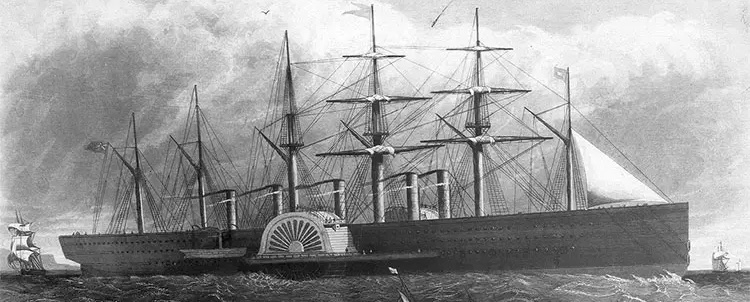
SS Great Eastern
Eastern Steam Navigation Co. · 1858 · Ship Guide
Overview
SS Great Eastern was Isambard Kingdom Brunel’s audacious attempt to build a ship so large that long-distance steam travel could be made routine without dependence on coaling stops. Launched in 1858 and completed the following year, she was an iron-hulled hybrid—paddle wheels and a screw propeller—on a scale no one else could yet match. For a time, she was simply “the biggest object that moved.”
In practical terms, Great Eastern is important for two reasons that pull in opposite directions: she demonstrated what industrial shipbuilding could do, and she showed how difficult it was to operate (and profit from) a ship that outgrew existing ports, markets, and business assumptions. Her passenger career was limited—but her second life, as a cable-laying ship, helped change global communications.
Evidence-first note: Great Eastern is heavily mythologized. When publishing numbers (tonnage, horsepower, passenger capacity) or “first/only” claims, anchor them to a register entry, a contemporary technical description, or an institutional record rather than a retelling.
Key Facts
Design & Construction (Context)
Brunel’s central idea was blunt and (on paper) elegant: build a ship large enough to carry fuel, cargo, and passengers for very long routes with fewer operational constraints. Great Eastern was therefore not just “large”—she was a systems bet on range, redundancy, and stability. That logic produced distinctive engineering choices, including the highly unusual combination of paddles and screw propulsion.
But scale cuts both ways. Building and launching the ship strained contemporary infrastructure and finances, and operating her meant confronting the fact that ports, docks, and demand were not yet shaped for a vessel of her size. In curator terms: she is a case study in the gap between engineering possibility and commercial fit.
Service History (Summary)
1854–1859: A troubled build on an unprecedented scale. Construction began in 1854 at Millwall. The launch (1858) and completion (1859) were surrounded by technical difficulty, delay, and public scrutiny. Brunel’s health declined during the project, and he died in 1859 shortly after Great Eastern’s early trials—one reason the ship can read as both triumph and elegy.
1860–early 1860s: Limited passenger service and operational setbacks. Great Eastern did make Atlantic crossings, but she never became the profit engine her promoters imagined. She suffered notable incidents (including striking rocks off the U.S. coast in 1862) that reinforced the perception of a ship that was difficult to “normalize” into routine service.
1865–1866: Cable ship—her most consequential work. The ship’s enormous hull, originally intended to hold coal and passengers, proved ideal for carrying and paying out thousands of miles of telegraph cable. In 1865 an attempt to lay a new transatlantic cable failed after the cable broke and was lost. In 1866 Great Eastern successfully laid a lasting cable to Heart’s Content, Newfoundland—and also recovered and completed the broken 1865 cable in the same season, a remarkable operational achievement.
Late career and end. After her cable-laying peak, Great Eastern drifted through changing roles and ownership contexts and was ultimately sold for breakup, scrapped in 1889–1890.
Scale Before the Market Was Ready
Great Eastern was designed around a powerful idea: a ship large enough to carry the coal required for extremely long voyages without depending on intermediate coaling stations. Her iron double-bottomed hull, paddle wheels, screw propeller, and vast dimensions pushed nineteenth-century shipbuilding well beyond contemporary commercial norms.
Royal Museums Greenwich notes that at about 692 feet long and roughly 18,915 tons, she remained unsurpassed in length until the White Star Oceanic of 1899. Yet scale alone did not create a viable passenger business.
From Commercial Failure to Cable Ship
After her passenger career failed commercially, the ship found the work for which her extraordinary internal volume was uniquely suited: carrying immense continuous lengths of submarine telegraph cable.
In 1865 an Atlantic cable attempt aboard Great Eastern failed after the cable broke, but the 1866 expedition succeeded. The ship then helped recover the lost 1865 cable and continued cable-laying work on other routes.
Why the Cable Career Matters
The cable work transformed Great Eastern's historical meaning. A ship that had been economically premature as a passenger liner became a crucial tool in building global communications infrastructure.
Her history therefore resists a simple success-or-failure label: the original business case failed, but the engineering scale that caused many of those commercial problems later made the vessel unusually valuable for a new technology.
Interpretive Notes
Great Eastern is often described as “ahead of her time,” and that is a useful shorthand—but it can also become a lazy explanation. What she really shows is that shipping is an ecosystem: ships are constrained not only by engines and iron, but by coaling networks, port geometry, capital markets, passenger demand, and political/telegraphic priorities. Her story makes that visible.
For collecting and attribution, she is unusually fertile. The ship’s notoriety produced medals, pamphlets, engravings, and commemoratives, and her cable-laying work intersects with philatelic and telegraph-history material. Because “Great Eastern” became a symbol, verify ship-specific claims with date/route context, printer marks, and (where possible) institutional holdings or contemporary documentation.
Evidence-first ship guideSources (Selected)
Use these as a starting index and corroborate publish-ready details (register entries, launch/sea-trial chronology, cable expedition logs) with primary or institutional sources where possible.
- Ocean Liner Curator — Sources (master bibliography)
- Royal Museums Greenwich — object note on Great Eastern and cable-laying conversion
- Encyclopaedia Britannica — Great Eastern (overview)
- Atlantic-Cable.com — Cable ship Great Eastern (technical and expedition context)
- Wikipedia — SS Great Eastern (starting index; corroborate key facts)
- Wikipedia — Transatlantic telegraph cable (1865–1866 expeditions summary; corroborate with primary accounts)
- Royal Museums Greenwich — Great Eastern passenger-liner model and service overview
- Royal Museums Greenwich — Telegraph Construction and Maintenance Company records and Great Eastern cable work