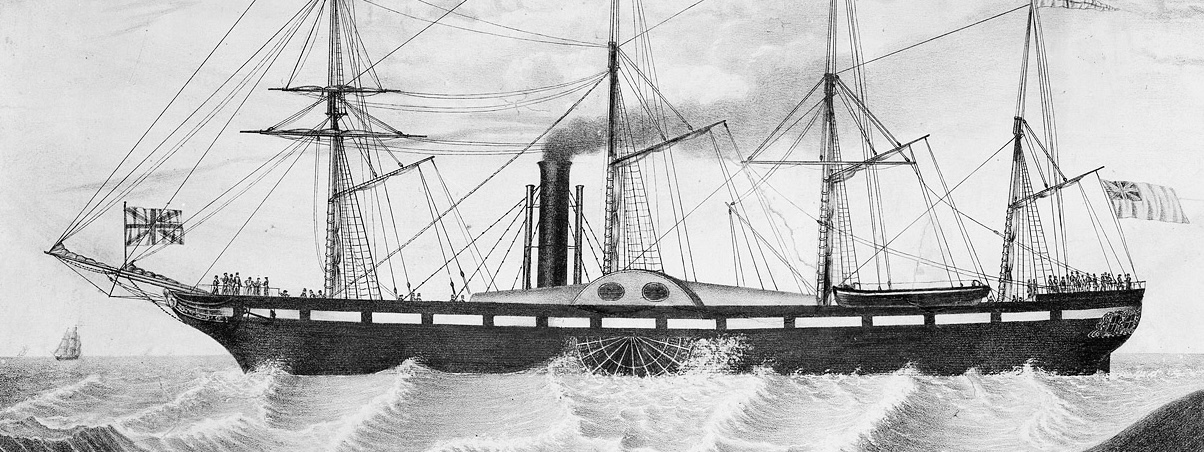
SS Great Western
Great Western Steamship Company · 1838 · Ship Guide
Overview
SS Great Western was the pioneering steamship purpose-built for regular transatlantic passenger service and one of the foundational vessels in ocean-liner history. Designed by Isambard Kingdom Brunel for the Great Western Steamship Company, she belonged to the formative early-steam era before the later standardized express-liner world of the later nineteenth century. Her importance lies not only in technical innovation, but in proving that scheduled Atlantic passenger service by steam could be commercially and operationally viable.
In collecting and interpretation, Great Western is best divided into three major phases: the original Bristol–New York pioneering service, later Royal Mail Steam Packet Company service, and final government troop transport use during the Crimean War. Material from those phases should be cataloged carefully rather than treated as a single undifferentiated ship identity.
Key Facts
Published dimensions and tonnage can vary because sources may use displacement, registered tonnage, or post-lengthening measurements. For cataloging purposes, preserve the exact wording and unit system used by the source or artifact being cited.
Design & Construction Context
Great Western was conceived as a practical demonstration of Brunel’s belief that a larger steamship could cross the Atlantic more efficiently than a smaller one. This principle was central to her design and helps explain why she occupies such an important place in liner history. She was not simply an experimental steam vessel, but a ship intended from the beginning for regular transatlantic passenger service.
Her oak hull, paddle-wheel propulsion, and four masts place her firmly within the transitional early-steam world, when marine engineering had not yet settled into the later iron screw-steamer model. In that sense, Great Western should be understood as both a breakthrough and a transitional ship.
Service History (Summary)
1836–1838 construction and preparation: Built at Bristol for the Great Western Steamship Company, Great Western was laid down in June 1836, launched in July 1837, and completed in March 1838. She was designed specifically for Atlantic service rather than adapted from a shorter-route steamer.
8 April 1838 maiden voyage: She left Bristol for New York on her maiden voyage and arrived fifteen days later. This crossing demonstrated that scheduled transatlantic steamship service was viable and established the ship’s historic reputation.
Pioneering Bristol–New York service: In her original role she worked the Atlantic route for the Great Western Steamship Company. This is the correct interpretive frame for route ephemera, early steam-navigation publicity, and material emphasizing Brunel’s transatlantic vision.
Operational significance: Although later steamships would become larger, faster, and more standardized, Great Western served as a model for successful wooden Atlantic paddle steamers. Her importance therefore goes beyond a single famous voyage.
1847 transfer: After the Great Western Steamship Company failed, the ship was sold to the Royal Mail Steam Packet Company. At this point her identity shifted away from pioneering Atlantic liner toward ordinary commercial service under new ownership.
Later service and government use: Under Royal Mail ownership she served on Southampton–West Indies routes and later saw government service as a troopship during the Crimean War. This phase belongs to a different operational world from the ship’s original Bristol–New York identity.
1856 end of career: After troop transport employment during the Crimean War, she was broken up in 1856. Her end was therefore practical rather than spectacular, but by then her historical significance had already been secured.
The 1838 Atlantic Demonstration
Great Western's first Atlantic voyage became historically important because it demonstrated that a purpose-built large steamship could make the crossing reliably and with enough fuel margin to sustain regular service. She left Bristol on 8 April 1838 and reached New York on 23 April, arriving shortly after the smaller Sirius, which had departed earlier.
The comparison was revealing. Sirius achieved the symbolic first arrival, but Great Western demonstrated the stronger commercial model: a much larger ship, purpose-designed for the route, with the scale and fuel capacity needed for repeated scheduled crossings rather than a one-off proof of possibility.
Regularity as the Real Breakthrough
The ship's importance is therefore not reducible to a race for first arrival. Over years of Bristol–New York service she demonstrated that steam could support a repeatable passenger business across the Atlantic. That operational regularity is what makes Great Western foundational to ocean-liner history.
Her later sale to the Royal Mail Steam Packet Company and final use as a Crimean War troop transport also show how quickly an innovative passenger ship could be absorbed into more conventional commercial and government service once newer designs surpassed her.
Interpretive Notes
This is a foundational transatlantic steamship: Great Western should be understood first and foremost as a pioneering purpose-built Atlantic steamer, not simply as an early paddle ship among many others.
Brunel context matters deeply: the ship is inseparable from Brunel’s design logic and from the larger story of how scheduled steam crossings became practical.
The Bristol–New York phase is the core identity: later Royal Mail and troopship service matter, but they should not overshadow the ship’s central historical role in opening regular transatlantic steam service.
This is an early-steam transitional vessel: paddle wheels, auxiliary sail, and wooden construction all place her in a different technological world from later iron and steel express liners.
Later service should be cataloged separately: material tied to Royal Mail or Crimean War use belongs to a distinct interpretive phase and should not be merged casually with the pioneering Atlantic period.
Evidence-first ship guideSources (Selected)
- Ocean Liner Curator — Sources (master bibliography)
- SS Great Western — overview chronology, technical particulars, and later service
- Britannica — summary of the ship’s pioneering Atlantic significance
- Great Western Steamship Company — company context for the ship’s creation
- GG Archives — contemporary historical account of Great Western