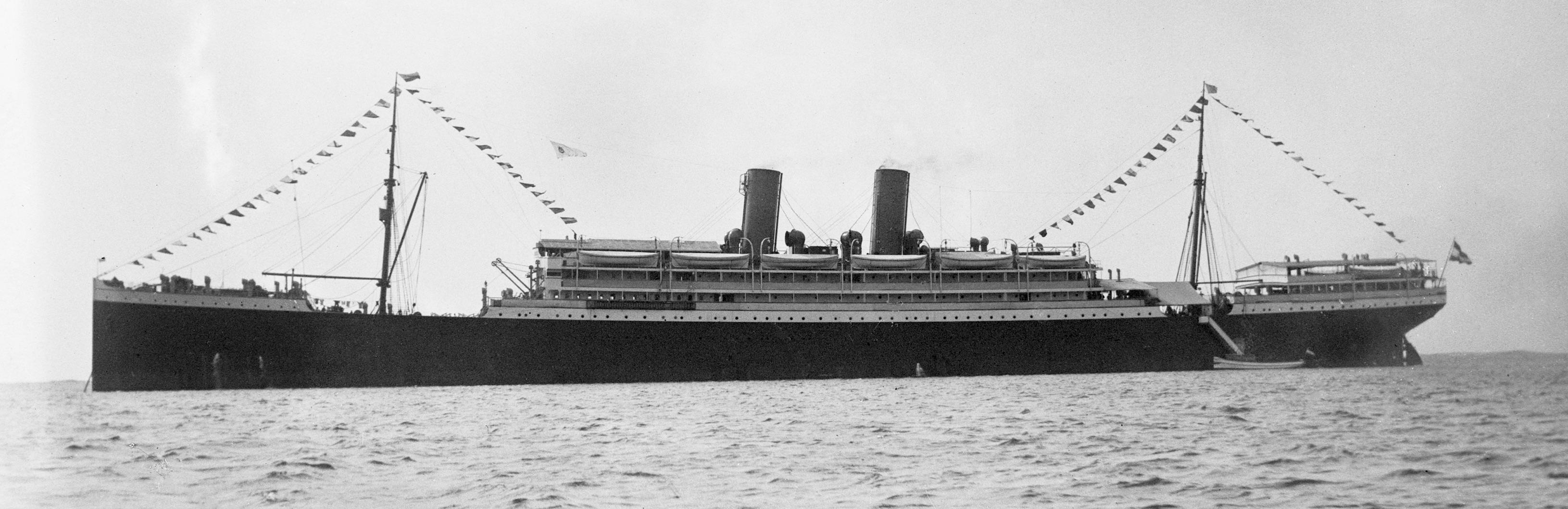
SS Grosser Kurfürst
Norddeutscher Lloyd · launched 1899 · Ship Guide
Overview
SS Grosser Kurfürst was a large Norddeutscher Lloyd passenger and cargo liner built by F. Schichau at Danzig and launched in 1899. She was conceived for long-distance mail, migration, passenger, and freight service rather than for the high-speed prestige role of the company’s four-funnel express liners. At more than 13,000 gross tons, she was one of the largest ships assigned to Germany’s overseas mail routes at the turn of the century.
Her career included service to Asia and Australia, regular Bremen–New York crossings, Mediterranean sailings, rescue work during the Volturno disaster of 1913, wartime internment in New York, U.S. Navy service as USS Aeolus, and later civilian operation as Aeolus and City of Los Angeles. Few ships illustrate more clearly how a single hull could move through German imperial, transatlantic, military, South American, and Pacific passenger systems.
This page treats Grosser Kurfürst as the Norddeutscher Lloyd liner launched in 1899 and later renamed USS/SS Aeolus and SS City of Los Angeles. Her name is also written Großer Kurfürst, Grosser Kurfurst, or Grosser Kurfuerst in sources that omit German characters.
Key Facts
Design & Construction Context
Grosser Kurfürst was a steel-hulled, twin-screw combination liner with extensive cargo space and accommodations ranging from first class to steerage. Her large carrying capacity made her commercially valuable on long routes where mail, passengers, migrants, and freight all contributed to a voyage’s economics.
Although imposing in scale, she was not intended to challenge Norddeutscher Lloyd’s express liners for the Atlantic speed record. Her moderate speed, broad route utility, and large passenger capacity place her within the company’s working global network rather than its narrow field of prestige competition.
Australian & Asian Service
The ship’s first employment took her toward Asian and Australian ports. She later returned to the German imperial mail route during winter seasons, making several additional Australian voyages. Contemporary accounts regarded her as exceptionally large for that service, and for a period she was among the largest passenger ships regularly reaching Australia.
Her route through European, Mediterranean, Asian, and Australian ports created a wide documentary footprint. Port notices, passenger records, government shipping returns, mail schedules, and newspapers may therefore preserve evidence of individual voyages that does not appear in Atlantic-centered summaries.
North Atlantic Service
From 1900 until the outbreak of war in 1914, Grosser Kurfürst operated regularly between Bremen and New York, with intermediate calls varying by schedule. She also sailed from Mediterranean ports, including Genoa, toward New York, serving a passenger market that included tourists, migrants, and returning travelers.
Passenger lists survive for voyages such as the April 1909 Genoa–New York crossing and the November 1913 Bremen–New York voyage. These documents are particularly useful because they record route, class, commander, passenger names, and the ship’s active commercial context at a precise moment.
Migration Evidence
The ship’s extensive steerage capacity made her an important carrier in the age of mass migration. For many passengers, the vessel was not a symbol of luxury but the immediate environment of departure, uncertainty, family movement, and arrival in the United States.
Manifest research should account for spelling variations in the ship’s name and should preserve the sailing date, port sequence, and master. An item labeled only “Kurfürst” or “Grosser Kurfurst” requires corroboration because the title also appears in German naval and non-maritime history.
The Volturno Rescue
In October 1913, the emigrant ship SS Volturno caught fire in the North Atlantic during severe weather. Grosser Kurfürst was among the vessels that responded to the distress call and participated in the rescue effort. Contemporary reporting credited her with bringing more than one hundred survivors to New York.
Rescue totals differ in some later accounts, so exact numbers should be tied to the source being cited. The well-documented point is that the liner and her crew formed an important part of the multinational response to one of the best-known Atlantic rescue operations before the First World War.
Internment & Seizure
When war began in Europe in August 1914, Grosser Kurfürst took refuge in New York and was interned under American neutrality. After the United States entered the war on April 6, 1917, federal authorities seized her along with other German and Austro-Hungarian merchant ships.
Before leaving the vessel, members of the German crew damaged machinery in an effort to delay American use. The ship required substantial repair and conversion before she could operate as a troop transport.
USS Aeolus
The ship was commissioned by the United States Navy on August 4, 1917 under her German name and was renamed USS Aeolus on September 1. Assigned to the Cruiser and Transport Force, she completed eight wartime round voyages and carried nearly 25,000 troops to France.
Following the Armistice, Aeolus helped return more than 27,000 healthy and wounded personnel to the United States. Her naval career ended with decommissioning in September 1919, after which she passed to the United States Shipping Board.
South American & Pacific Service
After an extensive postwar refit, the ship operated as the civilian SS Aeolus for the Munson Steamship Line on routes between New York and South America. In 1922 she was assigned to the Los Angeles Steamship Company and renamed SS City of Los Angeles.
Under that name she served between Los Angeles and Honolulu, carrying passengers across the Pacific for roughly fifteen years. Her longevity in this final role contrasts sharply with the disrupted wartime transition that had ended her German career.
Collecting Profile
Surviving material may appear under three principal identities: Grosser Kurfürst, Aeolus, and City of Los Angeles. German-period material can include postcards, passenger lists, menus, sailing schedules, migration records, and rescue-related newspaper coverage. American material may include naval photographs, troop records, South American brochures, and Pacific travel ephemera.
Cataloging should preserve the name and operator in use when an item was created. A postcard of SS City of Los Angeles documents the same hull, but it belongs to a distinct Pacific phase and should not be described simply as a Norddeutscher Lloyd artifact.
Interpretive Notes
Grosser Kurfürst is valuable precisely because her career resists a single-line narrative. She served migrants and tourists, German mail and commerce, a major maritime rescue, American military transport, South American routes, and Hawaiian passenger service.
Following the physical vessel across these changes reveals how political upheaval and commercial reassignment could repeatedly redefine an ocean liner. The hull remained continuous even as its name, flag, route, purpose, and public identity changed.
A genuinely global service life: Grosser Kurfürst moved through transatlantic work, wider international routes, the Volturno rescue, U.S. Navy service as Aeolus, and later Pacific operation as City of Los Angeles. That breadth makes the ship a strong example of how one hull could migrate between companies, oceans, and national systems.
For provenance, the later names are not mere aliases. Aeolus and City of Los Angeles belong to distinct service phases with their own documentation, appearance, and operating context; attribution should preserve the name actually in use at the time.
Evidence-first ship guide