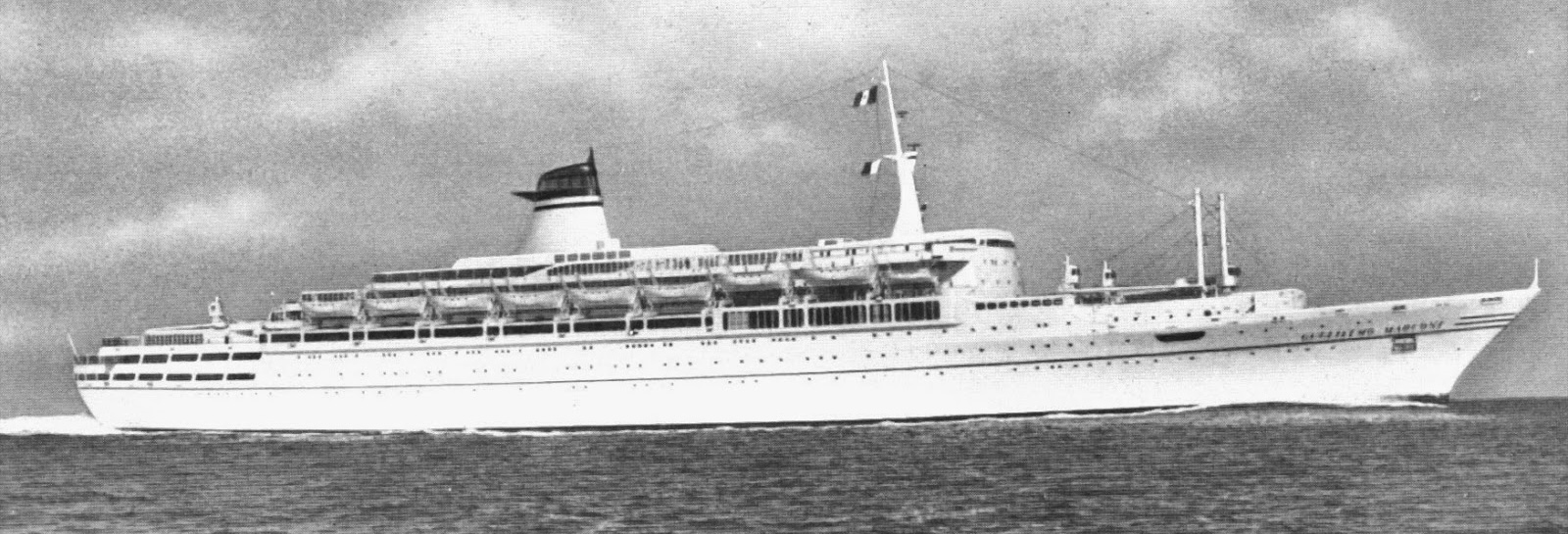
SS Guglielmo Marconi (1963)
Lloyd Triestino · entered service 1963 · Ship Guide
Overview
SS Guglielmo Marconi was one of Lloyd Triestino's final two large passenger liners and, with sister Galileo Galilei, among the last ships purpose-built for the European immigrant trade to Australia. She entered the Genoa–Sydney service in November 1963, carrying migrants and other passengers through the Mediterranean, Suez, the Indian Ocean, and Australian ports.
Unlike her sister, Marconi survived the end of liner service to enjoy a long second life under Costa. Rebuilt as Costa Riviera, she became a full-time cruise ship and remained commercially active into the twenty-first century.
Key Facts
A Final-Generation Australia Liner
In 1960 Lloyd Triestino ordered two new ships to replace the smaller Australia, Oceania, and Neptunia on the Australia route. Museums Victoria notes that the new sisters were roughly twice the size of the earlier trio and represented the company's last major passenger-ship investment.
The timing was historically significant. Guglielmo Marconi entered service at the very moment when long-distance air travel was beginning to undermine the passenger market that had justified her construction.
Maiden Voyage and the Genoa–Sydney Route
Marconi departed Genoa on her maiden voyage on 18 November 1963 and arrived in Sydney on 11 December. Her regular route linked Italy with Australia through the Mediterranean, Suez, the Red Sea, and Indian Ocean, with calls varying by voyage.
The sisters were designed to reduce travel time while carrying large numbers of migrants in Tourist Class. For many passengers the voyage was part of permanent relocation, and surviving personal objects connect the ship directly to individual migration stories.
Migration as Lived Experience
Museums Victoria preserves a souvenir spoon purchased aboard Guglielmo Marconi by Laura Mecca during her 1970 migration from Italy to Australia. Objects such as this are important because they move the history beyond fleet lists and specifications: the liner was also a temporary home during a life-changing journey.
Accommodation plans likewise show how heavily the ship was configured toward Tourist Class. Published capacities vary, but contemporary plans make clear that migrant and mass-market passengers formed the overwhelming majority of those the ship was designed to carry.
Design and Sister-Ship Identity
Marconi shared the broad architecture, machinery, and modern Italian design language of Galileo Galilei. Both were fully air-conditioned and were intended to combine high passenger capacity with the public-room standards expected of a major 1960s liner.
The pair also shared the distinctive telescopic funnel-top associated with the class, a practical attempt to improve smoke dispersal at sea without permanently altering the designers' preferred profile in port.
Changing Economics of the Australia Trade
The market deteriorated rapidly during the 1970s. Jet aviation reduced demand for weeks-long sea passages, immigration patterns changed, and the 1973 oil crisis made steam-powered liners increasingly expensive to operate.
Museums Victoria records that Marconi made her last voyage from Australia on 23 November 1974. The end of the route was therefore not simply an operational transfer; it marked the collapse of the commercial system for which the ship had been purpose-built only eleven years earlier.
South America Service
In 1976 Guglielmo Marconi moved to Italian Line's Naples–Brazil–River Plate service. This reassignment gave the ship a brief second liner role, but it did not reverse the larger decline in scheduled long-distance sea travel.
By 1979 both Marconi and Galilei had been transferred to Italia Crociere for full-time cruising. The experiment was not sufficiently successful to secure a long-term future for the pair under the same ownership.
Rebirth as Costa Riviera
Marconi was sold to Costa in 1983 and underwent a major reconstruction. She returned as Costa Riviera, transformed from a two-class migration liner into a modernized cruise ship.
The rebuild substantially changed the passenger experience while preserving the basic hull and machinery lineage of the 1963 vessel. Her later cruising included Caribbean, Alaskan, and European itineraries.
American Adventure and Final Years
In the early 1990s the ship briefly became American Adventure for a family-oriented cruise venture. The concept was short-lived, and she returned to Costa as Costa Riviera.
After nearly four decades of service, the former Guglielmo Marconi was withdrawn and sold for scrap. Under the name Liberty, she reached the breakers in 2002.
Why Guglielmo Marconi Matters
The ship matters because she links two very different passenger-shipping systems. Her first decade was rooted in mass migration to Australia; her later life belonged to the leisure-cruise industry that replaced scheduled liner travel as the dominant passenger business at sea.
Compared with Galileo Galilei, her longer survival as Costa Riviera provides an especially clear example of how a purpose-built migrant liner could be radically reworked to remain commercially useful in a different era.
Collecting Profile
Surviving material includes Lloyd Triestino brochures, accommodation plans, menus, passenger lists, sailing schedules, postcards, tickets, photographs, and migration souvenirs. Museums Victoria's holdings are particularly valuable because several objects retain direct passenger provenance.
Later Costa material should be cataloged separately from Lloyd Triestino material. Costa Riviera represented a substantially altered passenger environment and a different commercial identity, even though the underlying vessel remained the former Marconi.
Interpretive Notes
Passenger-capacity figures vary materially: contemporary accommodation plans and later reference works do not always agree, and configurations changed. This guide therefore emphasizes the first/tourist-class structure rather than presenting one number as universally applicable.
The Australia service ended before the ship's liner career did: her 1974 final Australia voyage was followed by South America liner service beginning in 1976.
Costa Riviera was extensively rebuilt: the later cruise ship was the same hull, but not the same passenger configuration or commercial product as the 1963 liner.
Evidence-first ship guideSources (Selected)
- Ocean Liner Curator — Sources (master bibliography)
- Immigration Museum / Museums Victoria — Journeys to Australia
- Museums Victoria — souvenir spoon from Guglielmo Marconi, 1970
- Museums Victoria — Guglielmo Marconi accommodation plan, circa 1963
- Museums Victoria — The Lloyd Triestino Trio
- Museo del Mare, Trieste — Lloyd section