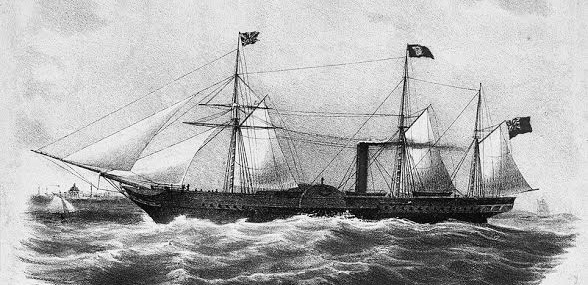
SS Hibernia (1843)
Cunard Line · Liverpool–Halifax–Boston · Ship Guide
Overview
SS Hibernia was one of the first additions to the original Cunard transatlantic mail fleet. Built of wood by Robert Steele & Son at Greenock and powered by Robert Napier side-lever engines driving paddle wheels, she entered the Liverpool–Halifax–Boston service in April 1843.
She was larger and more powerful than the four pioneering Cunard steamers of 1840–41. Together with the closely related Cambria, Hibernia represented an early step from experimental regular steam communication toward a more mature North Atlantic passenger-and-mail system.
Key Facts
Expanding Cunard's First Fleet
The original Cunard contract service began in 1840 with Britannia, Acadia, Caledonia, and Columbia. Growing traffic soon justified additional capacity. Hibernia and Cambria followed as larger ships, retaining the basic wooden paddle-steamer formula while increasing power, passenger capacity, and cargo space.
Contemporary 1843 notices advertised Hibernia as a new Royal Mail steamship of roughly 1,200 tons and 440 horsepower, scheduled to leave Liverpool on 19 April under Captain Charles H. E. Judkins. These notices place her directly inside the organized Admiralty mail timetable rather than treating her simply as an independent passenger steamer.
Wood, Sail, and Paddle Power
Hibernia belonged to the transitional generation in which ocean steamships still depended upon many practices inherited from sailing vessels. Her hull was wooden, and she carried a substantial sailing rig in addition to steam machinery. The original three-masted arrangement was later reduced, as happened with several early Cunard paddle steamers.
Her side-lever engines drove large paddle wheels amidships. At about nine knots in service she was not fast by later liner standards, but regularity mattered more than spectacular speed. The technological achievement was the ability to maintain a published transatlantic schedule through repeated Atlantic crossings.
Liverpool, Halifax, and Boston
The route joined Liverpool with Halifax and Boston, carrying passengers, freight, and government mails. Halifax was not a secondary curiosity: it formed a deliberate part of the contract network and gave British North America a regular steam connection with Britain while the ships continued onward to the United States.
For historians, this makes Hibernia useful in understanding the ocean liner before the familiar late-nineteenth-century model had fully emerged. Mail subsidy, schedule reliability, steam propulsion, and international passenger movement were already central even though the ship's construction and accommodations still belonged to an earlier technological world.
The 1849 Halifax Grounding
In August 1849 Hibernia stranded near Halifax. The ship survived and was repaired at New York. The incident is significant because a serious casualty did not automatically end the service life of an expensive early steamship; repair and return to operation could be preferable to replacement.
Accounts of early steam navigation often compress a ship's career into maiden voyage and final fate. Episodes such as the Halifax grounding show the day-to-day operational vulnerability of wooden paddle steamers working exposed North Atlantic routes.
Sale to Spain
Cunard sold Hibernia to the Spanish government in 1850. She was converted for troop transport and government mail work between Cádiz and Cuba, extending her useful life into a very different imperial and naval context.
Some later references repeat a claim that she was renamed Habanois or a similar form after the transfer. Clyde-built ship records specifically flag that reported renaming as erroneous. This guide therefore retains Hibernia unless a contemporary Spanish source demonstrates otherwise.
Why Hibernia Matters
Hibernia is important less as an isolated technical marvel than as evidence of how quickly regular transatlantic steam service expanded after 1840. Only three years separated her maiden voyage from Britannia's pioneering Cunard crossing, yet the company was already ordering larger vessels to meet demand.
Her career also illustrates the long overlap between maritime eras. She was a wooden, sail-assisted paddle steamer operating within a modern contractual mail network, then survived long enough to perform government transport work into the age when iron screw steamships were becoming increasingly common.
Interpretive Notes
Do not confuse her with later Hibernias: several British and Irish passenger vessels carried the name. This guide concerns the Cunard paddle steamer that entered service in 1843, not the London & North Western Railway steamer of 1899.
Tonnage figures require context: early nineteenth-century sources do not always use tonnage terms exactly as later registers did. Rounded contemporary figures around 1,200 tons can coexist with later fleet references giving approximately 1,422 tons.
“Cunard Line” is convenient shorthand: the company's formal contemporary name was the British and North American Royal Mail Steam Packet Company.
Evidence-first ship guide