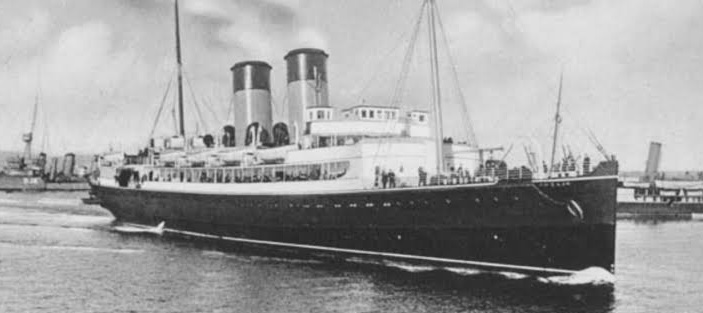
TSS Hibernia (1899)
London & North Western Railway · Holyhead–Dublin · Ship Guide
Overview
TSS Hibernia was a fast twin-screw passenger steamer built by William Denny & Brothers at Dumbarton for the London and North Western Railway. Launched in October 1899 and entering service in early 1900, she operated the short but important Irish Sea passenger route between Holyhead and Dublin.
She was not a long-haul ocean liner in the usual sense. Her historical importance instead lies in the railway-steamer network that linked sea travel directly with British and Irish rail systems. In 1914 she was requisitioned by the Admiralty, renamed HMS Tara, and converted into an armed boarding vessel. U-35 torpedoed her off the Egyptian coast in November 1915.
Key Facts
An Express Railway Steamer
Hibernia belonged to a type of passenger ship closely tied to the railway age. The London and North Western Railway used fast steamers to connect its rail network at Holyhead with Dublin, creating a through passenger route in which the sea crossing formed one leg of a larger railway journey.
Her relatively small size compared with transatlantic liners was intentional. Speed, rapid turnaround, and dependable short-sea operation mattered more than the large passenger capacities, cargo spaces, and long-endurance machinery required on ocean routes.
Design and Performance
William Denny & Brothers built Hibernia as yard number 618. Her steel hull, twin screws, and powerful triple-expansion machinery gave her a service speed of roughly 22 knots—very high for a passenger steamer of her size at the turn of the century.
Her sister Anglia, built immediately afterward as yard number 619, followed the same general design. Together they represented the LNWR's effort to offer a faster and more modern Irish Sea service.
Holyhead–Dublin Service
Hibernia entered service in January 1900 and spent most of her civilian career on the Holyhead–Dublin crossing. Contemporary railway-steamer operations emphasized schedule reliability and direct connection with trains on both sides of the Irish Sea.
By the years before the First World War she had also received newer communications equipment, including submarine signalling and wireless telegraphy, reflecting the steady modernization of short-sea passenger shipping.
Requisition and HMS Tara
The Admiralty requisitioned Hibernia in August 1914. Converted into an armed boarding steamer and fitted with three 6-pounder guns, she was commissioned as HMS Tara. Her new name avoided confusion with an existing Royal Navy vessel named Hibernia.
Her wartime duties eventually took her far from the Irish Sea into the eastern Mediterranean, where she served on patrol and boarding work along the Egyptian and North African coast.
Sinking and Captivity
On 5 November 1915, German submarine U-35 torpedoed Tara in Sollum Bay. The ship was lost, but the story did not end with the sinking. Survivors were taken by the submarine and transferred into captivity under Senussi forces in Cyrenaica.
The crew spent more than four months as prisoners in the Libyan desert. Contemporary accounts describe severe shortages of food and water. British forces eventually reached and rescued the prisoners in March 1916.
The episode became one of the most unusual afterlives of any railway passenger steamer of the period. Captain R. S. Gwatkin-Williams later published an account of the experience under the title Prisoners of the Red Desert.
Why Hibernia Matters
Hibernia broadens the archive beyond long-distance prestige liners and helps document the passenger network that connected railway systems with sea routes. Ships like her carried a different kind of traffic but were part of the same larger infrastructure of scheduled passenger movement.
Her wartime transformation also shows how quickly civilian passenger ships could acquire entirely different roles. A vessel built for a short Irish Sea crossing ended her career as an armed patrol ship off North Africa—a dramatic change in geography, function, and historical context.
Interpretive Notes
Classification matters: Hibernia was an express passenger ferry or railway steamer, not a conventional ocean liner. This guide preserves that distinction rather than retroactively broadening the term “ocean liner.”
Launch and completion dates differ: she was launched in 1899 but entered service in 1900, which is why some fleet lists classify her under 1900.
Later references may use either name: records after the 1914 requisition generally refer to the vessel as HMS Tara, while civilian histories usually retain Hibernia.
Evidence-first ship guide