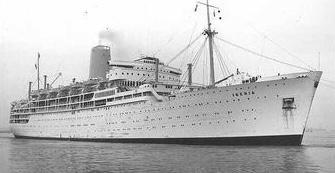
SS Iberia (1954)
P&O · entered service 1954 · Ship Guide
Overview
SS Iberia was one of P&O's major postwar passenger liners, built by Harland & Wolff at Belfast for the long Britain–Australia service. Ordered during the early-1950s rebuilding of the company's passenger fleet, she was laid down in 1952, launched on 21 January 1954, delivered that September, and departed London on her maiden voyage to Australia on 28 September 1954.
She was the near-sister of SS Arcadia, completed the same year by John Brown at Clydebank. The two ships were not yard-identical duplicates, but they were conceived for the same broad commercial purpose and were closely matched in scale, passenger capacity, machinery power, and route role. Together they represented P&O's last major conventional liner generation before Canberra and the rapid growth of long-distance jet travel.
Iberia's career also illustrates the changing geography of postwar liner service. She began on the traditional route through the Mediterranean, Suez, the Indian Ocean, and Australia, but later participated in trans-Pacific and round-the-world schedules. By the 1960s, liner voyages and cruising increasingly overlapped as P&O adapted to a passenger market in transition.
Unlike Arcadia, however, Iberia developed a reputation for operational trouble. Her career included a serious 1956 collision with the tanker Stanvec Pretoria, repeated machinery and electrical problems, fuel leaks, and stabilizer failures. She was withdrawn in 1972, becoming the first of P&O's principal postwar passenger liners to leave service.
Evidence-first note: published passenger-capacity figures vary slightly. Commonly cited totals are about 1,400 passengers, with roughly 670–680 first class and 730–735 tourist class. This guide preserves the rounded range rather than implying that one later compilation settles every configuration and counting convention.
Key Facts
Postwar P&O Design Context
Iberia belonged to the fleet-building program with which P&O restored long-distance passenger capacity after the Second World War. The company required ships capable of sustained work between Britain, the Mediterranean, South Asia, and Australasia, with enough speed to maintain competitive schedules but with far greater emphasis on endurance, climate control, cargo capacity, and passenger comfort than on record-breaking Atlantic crossings.
Her proportions reflected that purpose. At just under 30,000 gross tons and roughly 719 feet long, she was large enough to provide substantial first- and tourist-class accommodation without approaching the scale of the biggest North Atlantic prestige liners. Her machinery installation, developing about 42,500 shaft horsepower through twin screws, gave her the speed required for express long-distance scheduling while retaining the range expected of a Suez-route liner.
The ship's interiors were completed after launch at Belfast, with design work associated with McInnes, Gardner & Partners. Like other postwar P&O ships, Iberia balanced traditional liner formality with the lighter, more modern decorative language emerging during the 1950s.
Iberia and Arcadia
Iberia and Arcadia are best described as near-sisters rather than mechanically identical duplicates. They were built by different yards—Harland & Wolff and John Brown respectively—but were closely related in role, dimensions, passenger capacity, and power. Both entered service in 1954 for P&O's Britain–Australia passenger network.
Their later careers diverged markedly. Arcadia proved adaptable to a long cruise career and remained in service until 1979. Iberia, by contrast, accumulated a record of collisions, machinery failures, electrical faults, fuel leaks, and stabilizer trouble that contributed to her earlier withdrawal. The pair therefore makes an unusually useful comparison: two closely related postwar liners exposed to the same changing market but experiencing very different operational reputations and lifespans.
Maiden Voyage and Australia Service
Iberia departed London on 28 September 1954 for Australia. Her route followed the established imperial and postwar passenger corridor through the Mediterranean and Suez Canal, then across the Indian Ocean with calls that included Aden, Bombay, Colombo, Fremantle, Adelaide, Melbourne, and Sydney.
The voyage immediately demonstrated one practical reality of Suez-route liner work: navigation through the canal itself could be unforgiving. During the maiden voyage Iberia grounded in the canal and developed a pronounced list before being freed. The incident did not end the voyage, but it gave the new liner an inauspicious operational beginning.
For most of her working career, the Britain–Australia route remained the central frame for understanding the ship. Passenger lists, menus, deck plans, luggage labels, and publicity material should therefore be interpreted in relation to a weeks-long multi-port journey rather than as if they belonged to a short point-to-point crossing.
The 1956 Collision with Stanvec Pretoria
On 27 March 1956, while outward bound toward Australia off Ceylon, Iberia collided with the tanker Stanvec Pretoria. The impact opened and buckled sections of Iberia's port side around the upper decks while damaging the tanker's bow.
Neither vessel was lost. Iberia continued to Sydney, where repairs kept her out of normal service for more than two weeks before she resumed her schedule. The accident became the most visually dramatic of the incidents associated with the ship's early career and is frequently documented in photographs showing the damaged side plating and deck structure.
Trans-Pacific and Round-the-World Service
As P&O and the associated Orient Line expanded their Pacific operations, Iberia's work broadened beyond the traditional out-and-back Suez route. By the end of the 1950s she participated in itineraries that continued from Australia across the Pacific to North America and could return to Britain through the Panama Canal.
P&O promotional material from the period places Iberia among the ships linking Britain, Australia, New Zealand, and Pacific ports, while later advertising also shows her in the company's growing cruise program. Her first round-the-world voyage is commonly dated to 1959.
1961 Refit and a Changing Market
In 1961 Iberia underwent refitting at Southampton, including expanded air conditioning. Such work reflected both the practical demands of tropical-route service and rising passenger expectations in an era when air travel was becoming a serious competitor to the liner.
The commercial problem was larger than any single refit could solve. By the 1960s, passengers who once needed weeks at sea to reach Australia could increasingly fly. P&O responded by mixing scheduled transport with cruising and more elaborate round-the-world itineraries. Iberia took part in that transition, but she was less successful in adapting to it than her longer-lived near-sister.
Mechanical Problems and Withdrawal
During the later 1960s and early 1970s, Iberia's service record was repeatedly interrupted by technical problems. Contemporary and later histories describe electrical blackouts, machinery failures, fuel leaks, and stabilizer trouble. These incidents accumulated into a reputation that distinguished her from the generally more reliable Arcadia.
Iberia made her final Southampton–Australia liner voyage in 1971. She was withdrawn in 1972, earlier than the other principal members of P&O's postwar passenger fleet. After lay-up she was sold for demolition and broken up at Kaohsiung, Taiwan, in 1973.
Why Iberia Matters
Iberia is valuable precisely because she was not one of the era's uncomplicated success stories. She represents the final mature form of the traditional Britain–Australia liner just as the economic basis of that service was beginning to erode. Her career bridges the last confident years of Suez-route passenger shipping and the industry's forced move toward cruising.
She also offers an unusually useful paired comparison with Arcadia. Similar ships could have very different operating histories: one remained useful enough to survive into the late 1970s, while the other accumulated enough technical difficulties to be withdrawn years earlier.
For collecting and attribution, route and date remain essential. A 1950s Australia-service menu, a 1960s P&O-Orient cruise brochure, and a later round-the-world sailing document can all belong to Iberia, but they document different phases of a commercial system undergoing rapid change.
Interpretive Notes
Iberia is principally a Britain–Australia liner: her historical identity begins with the long Suez-route passenger service, not with cruising in isolation.
Arcadia is the key comparison ship: the two were closely related postwar P&O liners, but not strict yard-identical sisters.
The mechanical-reliability story should be handled proportionately: repeated failures clearly affected her reputation and withdrawal, but they should not erase nearly two decades of scheduled passenger work.
Round-the-world service reflects adaptation: trans-Pacific extensions and cruise work were part of P&O's response to a changing travel market rather than a separate historical afterthought.
Passenger totals vary: slight differences among published capacity figures can reflect configuration, source date, or rounding; exact numbers should retain their source context.
Evidence-first ship guideSources (Selected)
- Ocean Liner Curator — Sources (master bibliography)
- P&O Heritage Collection — Iberia at sea and launch context
- P&O Heritage Collection — 1956 Australia service publicity including Iberia
- P&O Heritage Collection — 1969 Australia and New Zealand sailing material
- P&O Heritage Collection — c.1965 Iberia cruise advertising
- P&O S.N. Co. history — SS Iberia
- SS Iberia (1954) — consolidated chronology and technical references