General arrangement · Part 1
Forward section
The first view shows the forward portion of the ship’s arrangement, including passenger decks, public rooms, circulation routes, service areas, and the forward hull structure.
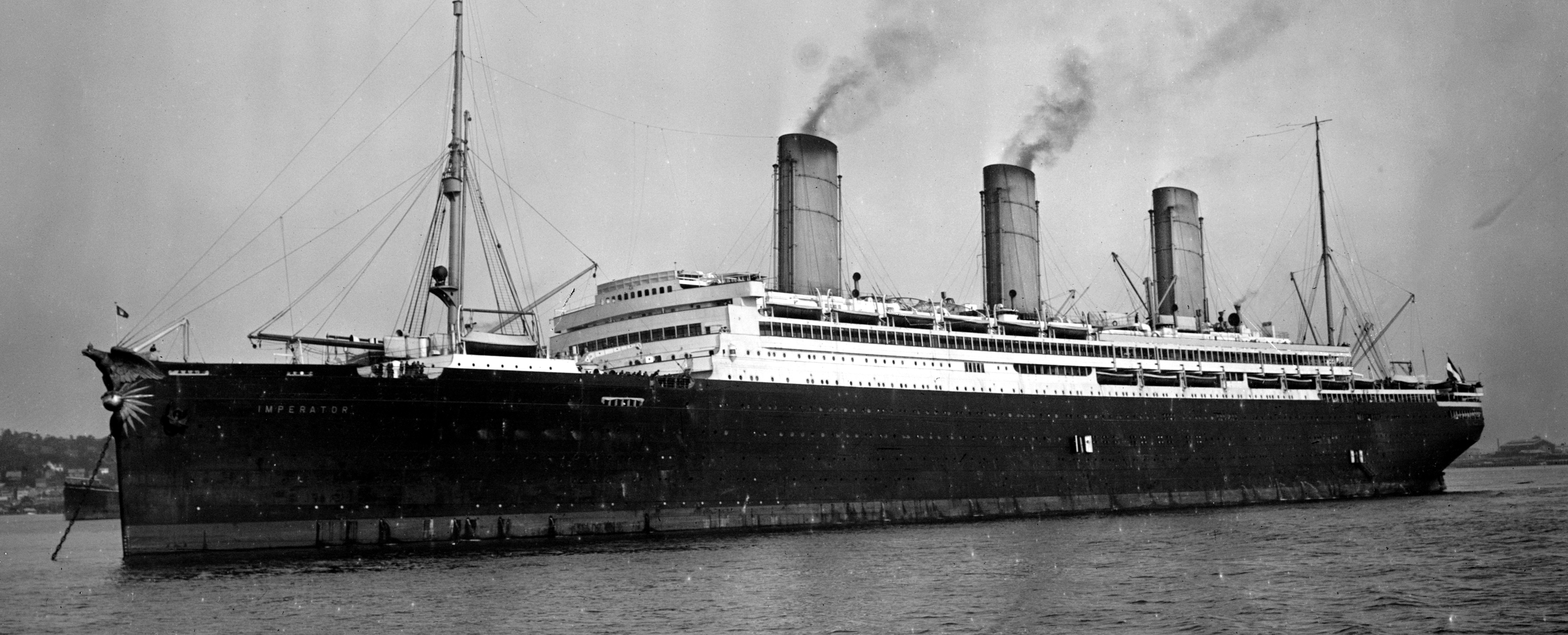
Hamburg-America Line · entered service 1913 · Ship Guide
SS Imperator was a pre–World War I German express liner built for the Hamburg America Line (HAPAG) and introduced in 1913 at a moment when “big ship” prestige was part engineering, part national statement. Her active peacetime career under the German flag was brief—roughly one transatlantic season plus a return to the yard for stability-related alterations—before the outbreak of war brought civilian service to a halt.
This guide covers Imperator from construction through early service, wartime lay-up, and postwar seizure/transfer up to the point she is handed over and renamed Berengaria. Later Cunard service belongs on the Berengaria page, not here.
Evidence-first note: early press coverage and later retellings can blur into “legend.” Where a claim is widely repeated (nicknames, superlatives, single-cause explanations), treat it as a lead to verify, not as a record by itself.
Note on tonnage and “largest” claims: measurements (and refit-era figures) vary by source and date. If you publish a single exact tonnage number, anchor it to a specific reference.
Imperator was conceived as a flagship—an answer to the era’s prestige race for size, speed, and public attention on the North Atlantic. She also sits at a hinge point in liner design: grand public rooms and amenities paired with increasingly complex machinery and systems that, in practice, demanded careful tuning and ongoing modification.
A practical research takeaway: when you are evaluating photos, deck plans, or passenger ephemera from Imperator, watch the date. Even within her brief prewar career, modifications and refits can change what “original” looks like.
These two illustrations provide a visual guide to SS Imperator’s internal arrangement and the relationship between passenger spaces, machinery, service areas, and the ship’s immense prewar hull. Select either image to open a larger, viewport-aware view.
The first view shows the forward portion of the ship’s arrangement, including passenger decks, public rooms, circulation routes, service areas, and the forward hull structure.
The second view continues through the after portion of the ship, completing the visual record of passenger spaces, machinery, service areas, and the broader internal organization of the vessel.
Curatorial note: Deck plans and sectional drawings may reflect a particular stage of Imperator’s short German career or later alterations. Treat room names, capacities, and arrangements as era-specific unless the illustration clearly identifies its date.
1913–1914: Prewar Atlantic service. Imperator entered service in June 1913 on HAPAG’s transatlantic route, sailing to New York via intermediate ports. Contemporary reporting and later summaries often emphasize early handling/stability concerns and subsequent corrective work. For an evidence-first treatment, it’s best to separate: (1) documented yard work and alterations, from (2) the colorful language attached to them in popular retellings.
1914–1918: War lay-up. With the outbreak of World War I, the ship’s civilian career effectively stopped. Imperator remained in Hamburg during the war years, inactive and increasingly worn by prolonged idleness.
1919: Seizure, transport use, and transfer. After the Armistice, the ship was taken over and used briefly as a transport in 1919. In September 1919, she was handed over to Cunard as part of postwar allocations/war reparations and renamed Berengaria. This handover is the endpoint for the present page.
Imperator is a good example of how a ship’s “identity” can be layered: the vessel people remember as Berengaria began as a German flagship with German-language fittings, German corporate branding, and a specific prewar passenger market—then moved into a wholly different national and commercial context after 1919.
For collectors, the dividing line matters. A menu, luggage label, postcard, or stationery item can sometimes be attributed “to the ship” while silently mixing eras. Pin the artifact to a date range (pre-1914 HAPAG, 1919 transport phase, or later Cunard) before you attach interpretive weight.
The ship’s very short German commercial life makes date control especially important. A photograph or plan from 1913–1914 may document stability modifications or altered fittings that later Cunard-era material no longer reflects, so “same hull” should never substitute for phase-specific attribution.
That makes early plans, photographs, and promotional literature especially sensitive to date, because even the brief German-service period contained visible and technical changes before the later Cunard conversion.
Evidence-first ship guide