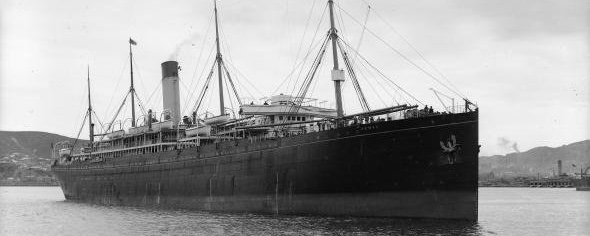
SS Ionic
White Star Line · 1903 · Ship Guide
Overview
SS Ionic was the third and last of the Athenic-class passenger-cargo liners built for White Star’s Britain–New Zealand service. Like her sisters Athenic and Corinthic, she was designed for a long imperial route rather than the North Atlantic express trade, carrying a mixed traffic of passengers, emigrants, refrigerated cargo, and general freight between Britain and New Zealand. Her career belongs to White Star’s wider dominion-service world and later extended into Shaw, Savill & Albion ownership.
In collecting and interpretation, Ionic is especially useful because she bridges several contexts: White Star’s New Zealand service, troop and requisition service in the First World War, and the final late-service transition into Shaw, Savill & Albion ownership. Surviving material should therefore be read carefully by date and operator context.
Key Facts
Some passenger totals and service details are rounded or summarized differently across quick-reference works. For cataloging purposes, retain the wording and figures used by the specific source or artifact being cited.
Design & Construction Context
Ionic was built for practical long-distance imperial service rather than prestige Atlantic competition. Like the other Athenic-class ships, she balanced respectable passenger accommodation with refrigerated cargo and freight capacity suited to the profitable New Zealand trade. Her design belongs to the same broad White Star tradition of comfortable and reliable service, but applied to a very different commercial geography from the better-known Liverpool–New York route.
By the time Ionic entered service, White Star’s dominion-route program was already established. She therefore represents the mature form of the Athenic-class concept rather than an experimental first step. That gives her interpretive value as a ship that shows the settled working pattern of White Star’s New Zealand service.
Service History (Summary)
1902–1903: Built at Belfast, launched in May 1902, completed in December, and entered service in January 1903 on the London–Wellington route. She was the second White Star ship to bear the name Ionic.
Early service: Operated on the Britain–New Zealand route, carrying passengers, emigrants, and refrigerated cargo. She belonged firmly to the dominion-service side of White Star operations rather than the publicity-rich Atlantic express trade.
1909: Became notable in route history as one of the first ships in the New Zealand service to receive wireless apparatus, reflecting the steady modernization of the trade.
First World War: Requisitioned as a troop ship for New Zealand Expeditionary Force service. During wartime operation she reportedly narrowly escaped torpedo attack in the Mediterranean, illustrating the changed risk profile faced by passenger liners in military use.
Postwar service: Returned to her New Zealand passenger role and continued in service through the 1920s. Later voyage patterns also reflected changing route infrastructure, including postwar Panama Canal usage.
1929–1934: Refit and accommodation changes reflected a contracting passenger market. After the Cunard–White Star merger in 1934, Ionic passed to Shaw, Savill & Albion while retaining her name.
1936: Withdrawn and scrapped in Osaka, bringing to an end more than three decades of dominion-route service.
Wartime Transport and the 1915 Near Miss
At the beginning of the First World War, Ionic was requisitioned for New Zealand Expeditionary Force transport. During Mediterranean service in 1915 she narrowly escaped a torpedo, reportedly passing within roughly 15 yards of the ship. The episode belongs specifically to the troopship phase and should not be used to characterize her peacetime operating risk.
The 1927 Daisy Rescue
In 1927, Ionic assisted the crew of the French fishing vessel Daisy after the vessel grounded on the Grand Banks. The rescue is a useful counterpoint to the more dramatic wartime material and demonstrates the routine humanitarian obligations of passenger ships at sea.
1929 Refit and Final Ownership
A 1929 refit converted Ionic to cabin-class and third-class accommodation. In 1934, after the Cunard–White Star merger, she was sold to Shaw, Savill & Albion while retaining the name Ionic. She was withdrawn and scrapped at Osaka in 1936; her bell survives in the collection of Auckland War Memorial Museum.
Why Ionic Matters
Ionic represents the mature White Star New Zealand-service model: refrigerated cargo, migration, wireless modernization, wartime troop transport, interwar refit, and finally direct Shaw Savill ownership. Her history is strongest when those phases remain distinct rather than collapsed into a single long “White Star” career.
Interpretive Notes
This is a New Zealand-route White Star ship first and foremost: Ionic should be interpreted through dominion-route, migration, and cargo-service frameworks rather than through the more glamorous Atlantic-liner narrative usually associated with White Star.
Operator identity may shift in later material: White Star and Shaw, Savill & Albion contexts can both appear in surviving records and ephemera. Cataloging should preserve the exact operator and date context shown on the object.
Late-service alterations matter: because Ionic survived into the depressed interwar years and passed through refits and ownership change, early-service, wartime, and late-service material should not be casually merged into a single undifferentiated interpretive phase.
Evidence-first ship guideSources (Selected)
- Ocean Liner Curator — Sources (master bibliography)
- Norway Heritage — SS Ionic particulars and service summary
- SS Ionic (1902) — overview chronology and specifications
- Athenic-class ocean liner — class and route context
- Great Ships — SS Ionic service overview
- GG Archives — SS Ionic archival reference material