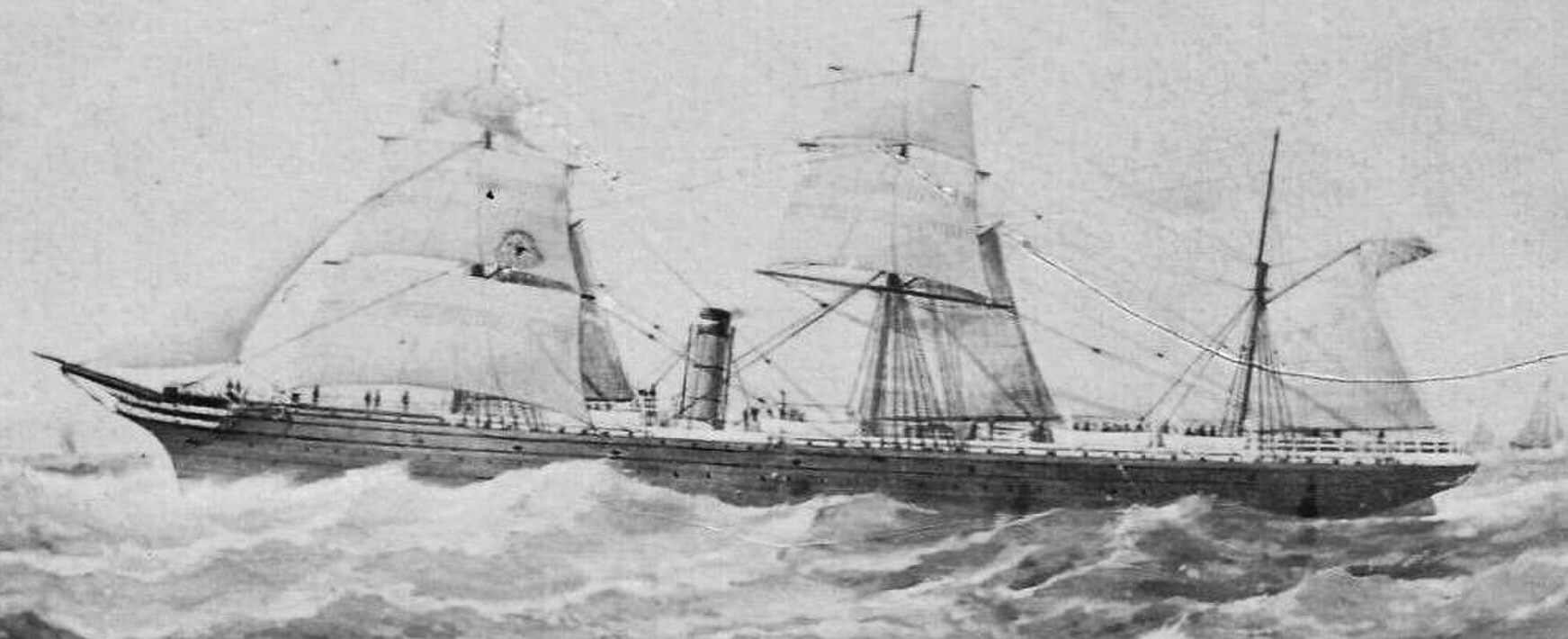
SS Java
Cunard Line · 1865 · Ship Guide
Overview
SS Java was a mid-Victorian Cunard steamship built at Glasgow by J. & G. Thomson and launched in 1865. She belongs to the iron, single-screw generation of North Atlantic steamers that came between the earliest mail-packet tradition and the larger, more heavily promoted express liners of the later nineteenth century.
In Cunard service, Java worked the Liverpool–Queenstown–New York route and represented a practical, working form of transatlantic transport: mails, passengers, luggage, freight, and migration traffic carried by a scheduled steamship rather than by a later “floating palace.” Her later career under other names also makes her useful for showing how nineteenth-century liners could pass from one owner, registry, and commercial role to another.
This page treats Java as the Cunard Line steamship launched in 1865, later renamed Zeeland, Electrique, and Lord Spencer. The name “Java” appears in other maritime contexts, so builder, route, date, and ownership should always be checked before attributing material.
Key Facts
Note on dates: some compiled fleet summaries give November 21, 1865 for the maiden voyage, while Norway Heritage gives October 21, 1865. This page uses the Norway Heritage sailing chronology and preserves the discrepancy as a caution for researchers.
Design & Construction Context
Java was an iron-hulled, single-screw steamship with masts and a funnel, a form that still visibly bridged steam and sail traditions. Her clipper-bow profile and modest passenger scale place her well before the grand public-room era associated with later Cunard flagships. She should therefore be interpreted as a working North Atlantic steamer, not as a luxury showpiece.
Her Glasgow builder, J. & G. Thomson, was central to Cunard’s mid-nineteenth-century fleet development. In that setting, Java is best understood as part of a technical and commercial transition: iron hulls, screw propulsion, greater route regularity, and the gradual improvement of marine engines.
Service History (Summary)
After her 1865 launch, Java entered Cunard’s Liverpool–Queenstown–New York service. Dated sailing entries place her in regular North Atlantic use through the early 1870s, including recorded arrivals at New York in 1871 and 1873.
A serious incident occurred in August 1871, when Java ran down and sank the Norwegian bark Anette of Moss. Such events are important for interpretation because they show the ship not only as a transport vessel, but as an actor within the hazards of crowded nineteenth-century ocean navigation.
In 1877, Java was re-engined with compound engines. The following year she passed out of Cunard’s fleet and became Zeeland for Red Star Line. Her later names and roles—Electrique and Lord Spencer—belong to her post-Cunard career and should be cataloged separately when interpreting artifacts.
Passenger Lists & Migration Evidence
Java appears in passenger-list and sailing-list contexts, where the value lies in documentation rather than glamour. A manifest, arrival notice, or passenger reference can tie the ship to a precise voyage, route, master, and group of travelers. For nineteenth-century liners, this kind of record often gives the clearest evidence of the ship’s actual work.
When cataloging passenger material, preserve the original document language. Route phrasing such as Liverpool–Queenstown–New York, the date of arrival, the master’s name, and the vessel’s tonnage wording may all help distinguish this Cunard Java from another vessel or from her later identities.
Later Career & Name Changes
The later life of Java is a useful caution in ship identification. After leaving Cunard, she became Zeeland for Red Star Line, then passed to later owners under the names Electrique and Lord Spencer. A single physical vessel can therefore appear under several names across different records, flags, companies, and commercial uses.
For research purposes, this means an artifact marked Zeeland may relate to the same hull as Cunard’s Java, but not necessarily to Cunard service. The safest wording is usually “the former Cunard Java” when discussing post-1878 material.
Loss and Attribution Caution
Java’s final fate belongs to her later career rather than her Cunard period. Compiled accounts describe the vessel as lost or missing in 1895 under a later name, with some accounts connecting the loss to the fully rigged ship Prince Oscar.
Any item claimed to be from the loss should be treated cautiously. A credible wreck- or loss-related attribution would need dated newspaper evidence, institutional documentation, ownership history, or another verifiable chain of custody. It is safer to describe such material as “associated with the later career of the former Java” unless stronger proof exists.
1871 Collision with Anette
In August 1871, Java collided with and sank the Norwegian bark Anette of Moss. The episode belongs to the ordinary navigational hazards of a busy Atlantic trade and is best documented through contemporary casualty reporting rather than later anecdote.
Re-engining and Red Star Transfer
The 1877 replacement of Java’s machinery with compound engines created an important technical breakpoint. In 1878 the ship left Cunard and became Zeeland for Red Star Line on the Antwerp–New York route. Those changes should be treated together: the post-refit ship entered a different company and route system almost immediately.
The 1895 Disappearance
By 1892 the former Cunarder was trading as Lord Spencer. She disappeared in 1895 while bound from San Francisco to New York. Contemporary reporting suspected that she had collided with the fully rigged ship Prince Oscar on 13 July, but the loss was never observed directly enough to justify turning that theory into certainty.
Why Java Matters
Java shows how a mid-Victorian liner could survive by repeated technical and commercial reinvention. Cunard Java, Red Star Zeeland, French Electrique, and British Lord Spencer are chronological identities of one hull, not interchangeable names.
Collecting Profile
Material associated with Java is likely to be strongest in documentary form: passenger lists, sailing notices, arrival reports, ship database entries, fleet summaries, newspaper items, and Red Star Line references under her later name Zeeland. She is not usually a souvenir-heavy liner in the later Edwardian sense.
The main collecting risk is over-attribution. A Cunard item from the 1860s or 1870s should not be assigned to Java merely because the dates overlap. Stronger attribution needs the ship name, a dated voyage, a passenger or crew connection, or a source trail that places the object in her documented service history.
Interpretive Notes
Java is valuable because she shows ocean-liner history below the level of celebrity. She was part of the everyday machinery of steam navigation: a named vessel carrying people and goods across a route, later refitted, sold, renamed, and absorbed into another company’s story. Her significance lies in that continuity of service and in the documentary traces left behind.
Evidence-first ship guideSources (Selected)
This list is intentionally conservative.
- Ocean Liner Curator — Sources (master bibliography)
- Norway Heritage — S/S Java, Cunard Line
- Gjenvick-Gjønvik Archives — Cunard Line Fleet List
- The National Archives — Passenger lists research guide
- Wikipedia — SS Java (1865) (broad orientation; verify ship-specific claims against stronger sources)
- Wikipedia — Cunard Line (broad company context; verify ship-specific claims elsewhere)