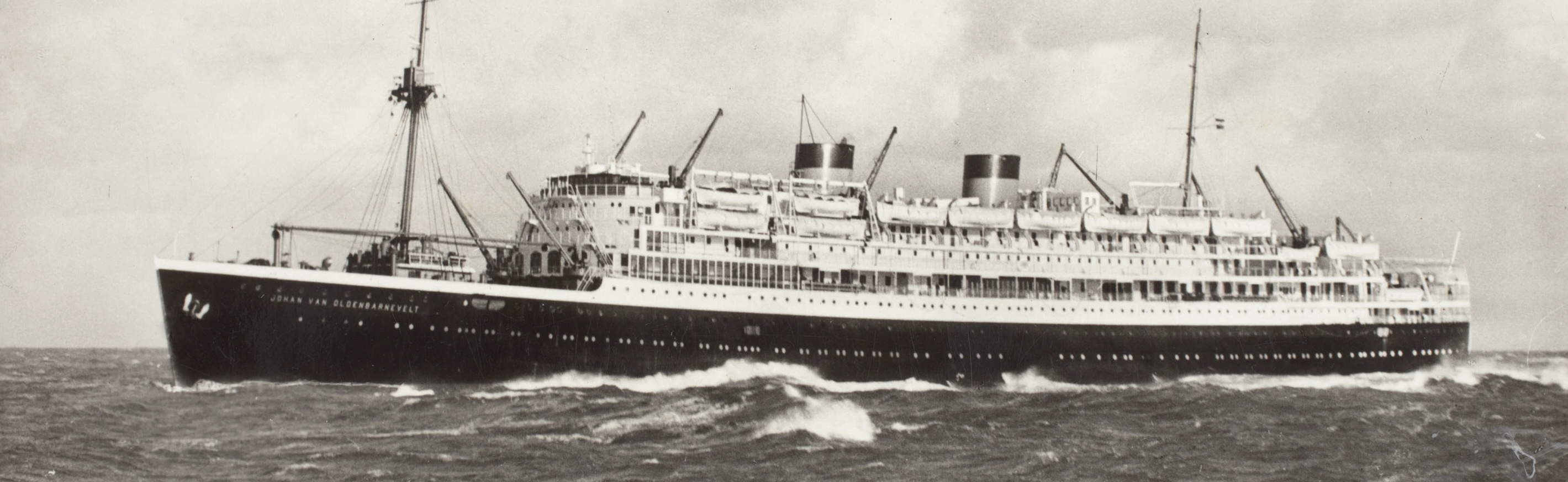
MS Johan van Oldenbarnevelt
Netherland Line · 1930 · Ship Guide
For the wider historical network and its changing political context, see The Dutch East Indies Passenger Network.
Overview
MS Johan van Oldenbarnevelt was a major Dutch passenger liner built for Stoomvaart Maatschappij Nederland’s long-distance Netherlands–Dutch East Indies service. She belonged to the interwar generation of large diesel-powered liners designed for endurance, cargo flexibility, and sustained imperial-route operation rather than Atlantic speed competition. Her career spanned prewar colonial-route service, wartime troopship employment, and a substantial postwar life first on the Indonesian route and later on the Australia and New Zealand run.
In collecting and interpretation, Johan van Oldenbarnevelt is best divided into four main phases: prewar Netherlands–Dutch East Indies service, wartime troopship service, postwar Indonesia service, and later Australia / New Zealand migrant and passenger service. Material from those phases should be distinguished carefully rather than treated as a single undifferentiated ship identity.
Key Facts
Published tonnage and accommodation figures vary because sources often describe different stages of the ship’s long career. For cataloging purposes, it is best to preserve the exact wording and service phase used by the source or artifact being cited.
Design & Construction Context
Johan van Oldenbarnevelt belonged to the interwar Dutch motor-liner generation built for the long route between the Netherlands and the Dutch East Indies. This was a very different operating world from the North Atlantic express trade: the ship’s significance lies in long-distance colonial-route service, passenger and cargo flexibility, and modern diesel efficiency. She should therefore be understood primarily within the Amsterdam–Java imperial-route system rather than through Atlantic prestige comparisons.
At launch she was described as the largest diesel-powered ship yet built in the Netherlands. Her interiors were notable as well, with decorative work by Carel Adolph Lion Cachet and Lambertus Zijl giving the ship a strong Dutch artistic identity. That combination of technical modernity and national design character is part of what makes her especially interesting curatorially.
Service History (Summary)
1929–1930: Built at Amsterdam by NSM, Johan van Oldenbarnevelt was launched in August 1929, completed in March 1930, and entered Netherland Line service that spring. Her maiden voyage began in May 1930 on the Dutch East Indies route.
Prewar Netherlands–East Indies service: In her original role she linked Amsterdam with the Dutch East Indies by way of the Mediterranean and Suez. This is the proper interpretive frame for passenger lists, brochures, menus, deck plans, luggage labels, and commercial photography tied to her civilian identity before the war.
1939–1940 transition: With the onset of war in Europe, her operating geography shifted. She was chartered for cargo work connected with Batavia and New York, reflecting the wartime dislocation of normal Dutch passenger-liner operations.
1941 wartime conversion: On 20 January 1941 she was requisitioned for Allied troopship service and converted accordingly. From that point onward, references to the vessel increasingly belong to a military transport framework rather than a civilian passenger one.
Wartime troopship service: In Allied use she served widely across the Indian Ocean, South African, Middle Eastern, and Mediterranean convoy systems. Wartime references commonly emphasize convoy participation and troop capacity rather than passenger-service culture.
1946 postwar return: After release from government service, she returned to Amsterdam in February 1946 and re-entered civilian operations. Initially this meant renewed service to the Dutch East Indies / Indonesia, including the movement of Dutch military personnel returning from the decolonization conflict.
1950 Australia service: After Indonesian independence altered the old colonial-route context, the ship was transferred to the Australia and New Zealand service and began that new phase in September 1950. This is an important interpretive break in her career and should be reflected in how artifacts are dated.
1951 one-class refit: She was extensively refitted as a one-class migrant liner with capacity for about 1,414 passengers. This phase belongs to the great postwar migration era rather than the prewar imperial-route world in which she began service.
1958 modernization: Another refit reshaped the ship further, reducing berths, updating passenger facilities, and pushing her presentation toward the late-liner / cruise-travel world. In 1959 Southampton replaced Amsterdam as her home port, and she entered round-the-world service patterns.
1963 end of career under Netherland Line: Her final voyage for the line ended at Sydney on 3 February 1963. She was then sold and renamed Lakonia, closing a 33-year career with the Netherland Line.
From Colonial Route to Migrant Ship
Johan van Oldenbarnevelt was built for the long Netherlands–Dutch East Indies route, but the political and demographic world that sustained that service changed radically after the Second World War and Indonesian independence.
Museums Victoria records that from 1950 to 1963 the ship became an important vessel in Dutch-Australian migration, making 44 voyages to Melbourne during that period.
The 1950s Migrant Configuration
After her first postwar migrant voyages, the liner was refitted to carry approximately 1,414 passengers in a single class—nearly twice her original passenger capacity. That change materially altered the social and physical character of the ship.
For artifact attribution, this is an important boundary. A prewar cabin plan or colonial-route brochure represents a very different passenger environment from material associated with the 1950s migrant trade.
Round-the-World Service and Late Career
When the migrant charter ended in 1958, Johan van Oldenbarnevelt was refitted again for round-the-world passenger service. Her career therefore maps several major twentieth-century transitions: colonial transport, wartime troop movement, postwar migration, and the shift toward long-distance leisure travel.
Interpretive Notes
This is a Dutch East Indies liner first: Johan van Oldenbarnevelt should be understood chiefly within the Netherlands–Dutch East Indies service world, not through North Atlantic assumptions.
The ship had a genuinely long multi-phase life: prewar colonial-route material, wartime troopship records, postwar Indonesian references, and Australia-migrant-service ephemera belong to very different interpretive contexts.
Source styling varies: many references use MS Johan van Oldenbarnevelt rather than “SS.” For indexing and cataloging, it may help to cross-reference both forms so material is not split artificially.
The 1951 and 1958 refits matter for dating artifacts: changes in class language, passenger totals, décor, and even exterior appearance can help place surviving items more precisely within the ship’s long career.
This ship also bridges two worlds of liner history: she began in the late colonial-route era and ended in the migrant / round-the-world travel era, making her especially useful for illustrating how passenger shipping adapted after the Second World War.
Evidence-first ship guideSpeed-source distinction: The MarHisData vessel register lists 17 knots for the original twin-diesel ship, and the Dutch Australia Cultural Centre also identifies about 17 knots as service speed. Some secondary accounts give 19 knots, with a Dutch maritime discussion labeling that figure maximum speed. A dated builder's trial sheet or owner service specification would be needed to establish whether 19 knots was actually attained, and under what conditions; it is not interchangeable with documented service speed.
Sources (Selected)
- MarHisData — Johan van Oldenbarnevelt, vessel ID 3244; 14,000 bhp and 17 knots in technical particulars
- Dutch Australia Cultural Centre — historical profile, service speed about 17 knots
- NVM technical drawing catalogue — ship and sister, two ten-cylinder diesels, 14,000 hp, 17 knots
- Ocean Liner Curator — Sources (master bibliography)
- Johan van Oldenbarnevelt — overview chronology, specifications, wartime service, postwar routes, and later refits
- Museums Victoria — migrant-ship history summary for Johan van Oldenbarnevelt
- Simplon Postcards — photographic and service context for Johan van Oldenbarnevelt
- Technical and service summary reference for Johan van Oldenbarnevelt