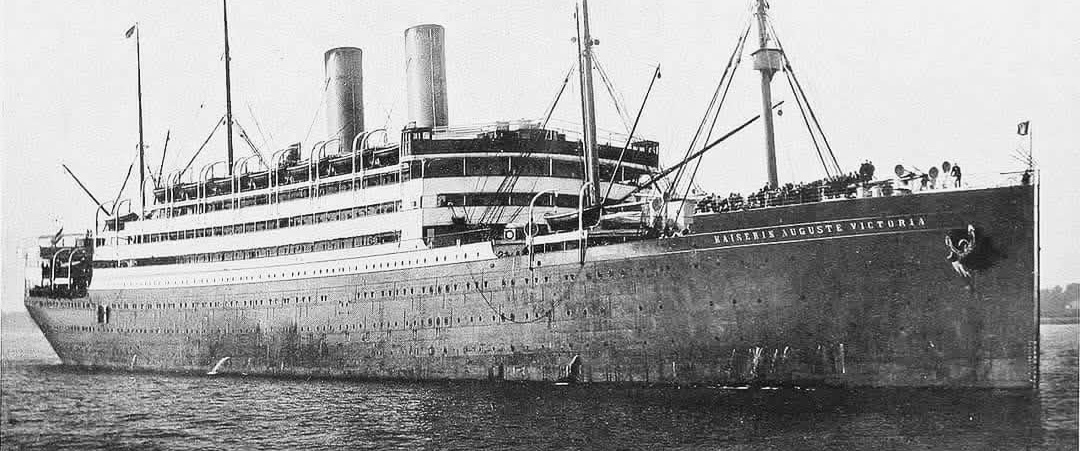
SS Kaiserin Auguste Victoria
Hamburg America Line · entered service 1906 · Ship Guide
Overview
SS Kaiserin Auguste Victoria was one of the major German express liners of the pre-First World War era, built for the Hamburg America Line at a moment when German shipping companies were competing aggressively for prestige on the North Atlantic. Large, richly fitted, and strongly identified with HAPAG’s expansionist ambitions, she briefly held the distinction of being the largest passenger liner in the world. Her career later extended beyond German service, passing through wartime seizure, troop transport work, and eventual re-emergence under Canadian Pacific as Empress of Scotland.
In collecting and interpretation, Kaiserin Auguste Victoria is best treated in clearly separated phases: prewar HAPAG liner service, wartime and immediate postwar government control, and later Canadian Pacific service under a different name. Material from those phases should not be merged casually into a single undifferentiated identity.
Key Facts
Design & Construction Context
Kaiserin Auguste Victoria belonged to the high-stakes era of German-British liner rivalry before the First World War. HAPAG was building not just capacity but prestige, and ships like this projected confidence, scale, and imperial modernity. Her size alone made her a headline vessel, but her real importance lies in how she embodied Hamburg America’s ambition to stand alongside or above the great British North Atlantic competitors.
She also stands at an interesting point in liner development. Although large and luxurious, she still belongs to the transitional world before the even more colossal German giants such as Imperator. In that sense, she represents both a culmination of one phase and a prelude to another.
Service History (Summary)
1905–1906: Built by Vulcan AG at Stettin for the Hamburg America Line, launched in August 1905, and completed for service in 1906. She began her maiden voyage in May 1906 on the Hamburg–New York route.
1906–1914: Served regularly in HAPAG’s North Atlantic passenger trade. In this period she was one of the most prominent German liners in service and, for a time, the largest passenger ship in the world.
1910: The ship was briefly associated with planned early ship-to-shore aviation experiments. These did not become a defining part of her career, but they reflect the era’s fascination with new technological spectacle around major liners.
1914–1919: Her normal commercial career was interrupted by the First World War. Like many major German liners, she fell into the postwar redistribution of German merchant tonnage.
1919–1920: Re-flagged as USS Kaiserin Auguste Victoria, she carried American troops home from Europe after the war. She then briefly passed through Cunard control, still under her original name.
1921 onward: Sold to Canadian Pacific Steamships and renamed Empress of Scotland. After refit, she entered a new phase of transatlantic service under Canadian Pacific, with altered accommodations and a very different company identity.
1930: Withdrawn after newer tonnage entered service and sold for breaking up. A fire at the breaker’s yard complicated the final disposal, but her career as an active liner had effectively ended.
Interpretive Notes
This is a German prestige liner first: Kaiserin Auguste Victoria should primarily be understood as a HAPAG flagship-type vessel in the prewar North Atlantic context, not merely as the earlier name of a later Canadian Pacific ship.
Name changes matter: once she became Empress of Scotland, the ship entered a distinct interpretive world of Canadian Pacific branding, routes, and passenger literature. Artifacts under that name should not be back-read as purely HAPAG material.
Her fame is partly about scale: being briefly the world’s largest passenger liner was central to her identity and public image. That status makes her especially relevant in discussions of the pre-1914 size race before the even larger giants arrived.
Government and troop transport phases require care: wartime and immediate postwar references may use military or state-control language rather than commercial passenger language. Those documents belong to a different evidentiary category than prewar passenger ephemera.
A career extending beyond HAPAG: Kaiserin Auguste Victoria began as a German prestige liner but later passed through U.S. troop-transport service and into Canadian Pacific operation as Empress of Scotland. Those phases should be treated as distinct documentary identities rather than one continuous passenger-service story.
The 1919 transport phase is especially important because it belongs to the mass repatriation of American forces after the First World War. Later Canadian Pacific material documents a different commercial system, route structure, and national presentation. The hull remained the same, but the meaning of the ship changed substantially with each transfer.
Evidence-first ship guide