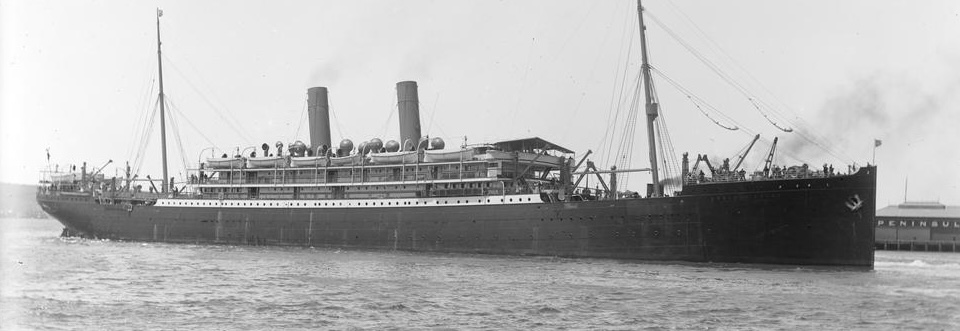
SS Königin Luise
Norddeutscher Lloyd · 1896 · Ship Guide
Overview
SS Königin Luise was a Norddeutscher Lloyd passenger and cargo liner built by AG Vulcan at Stettin and launched on 17 October 1896. She was one of the original ships of the Barbarossa class, a family of large twin-screw intermediate liners designed to combine substantial freight capacity with first-, second-, and steerage-class accommodation.
Her working life extended far beyond one route or one national flag. Before the First World War she served Norddeutscher Lloyd on Australian, Far Eastern, and North Atlantic services. She remained in Germany during the war, was surrendered to Britain as reparations in 1919, and later sailed as Omar and Edison before being scrapped in 1935.
Identity correction: an earlier version of this page accidentally contained the history and specifications of SS Barbarossa. This guide now treats the correct vessel, SS Königin Luise (1896). Historical sources also spell the name Konigin Louise or omit the umlaut.
Key Facts
Design & Construction Context
The Barbarossa design emphasized mixed revenue rather than express speed. Cabin accommodation was concentrated in a long central superstructure while large cargo spaces and extensive steerage capacity occupied the rest of the hull. Twin screws and quadruple-expansion machinery gave the class dependable power for long routes at a moderate service speed.
Königin Luise shared the broad family characteristics of Friedrich der Grosse, Barbarossa, and Bremen, but she was a distinct ship with her own builder number, chronology, later ownership, and fate. Sister-class resemblance should therefore never substitute for vessel-level identification.
Global Norddeutscher Lloyd Service
Before 1914 the liner worked across several parts of Norddeutscher Lloyd's international network. Surviving fleet summaries place her on Australian, Far Eastern, and North Atlantic routes. That mobility is characteristic of the class: these were large combination liners intended to be commercially useful over very different long-distance trades.
Her high steerage capacity also places migration at the center of the ship's history. Passenger lists, port records, and line schedules are especially valuable because they tie a particular voyage to a route and date rather than assuming the ship remained on one service throughout her career.
First World War and Reparations
Unlike many German liners caught in neutral or Allied ports in 1914, Königin Luise spent the war in German-controlled waters. She therefore avoided the U.S. seizure that transformed several related ships into American troop transports.
After Germany's defeat, the vessel was surrendered to Great Britain in 1919 as part of the postwar redistribution of merchant tonnage. She came under the British Shipping Controller and was operated in British service before being sold into a new civilian career.
Omar and Edison
In 1921 the Orient Steam Navigation Company acquired the ship and renamed her Omar. This postwar phase moved the former German liner into a British commercial context without changing the underlying hull that had already accumulated more than two decades of service.
She changed hands again in 1924, becoming Edison under Byron Steamship Company ownership. In that identity she served the Piraeus–New York trade, extending her association with migration and transatlantic passenger traffic into a third national and corporate setting. She was finally scrapped in Italy in 1935.
Interpretive Notes
Do not confuse her with Barbarossa: the two ships belonged to the same broad class and had similar dimensions, but they followed different wartime and postwar careers. Barbarossa became USS Mercury; Königin Luise did not.
Names are chronology markers: material labeled Omar or Edison belongs to the same hull but to later British-owned phases. Catalog records should preserve the contemporary name rather than normalizing every object back to Königin Luise.
Evidence-first ship guideSources (Selected)
This list is intentionally conservative.