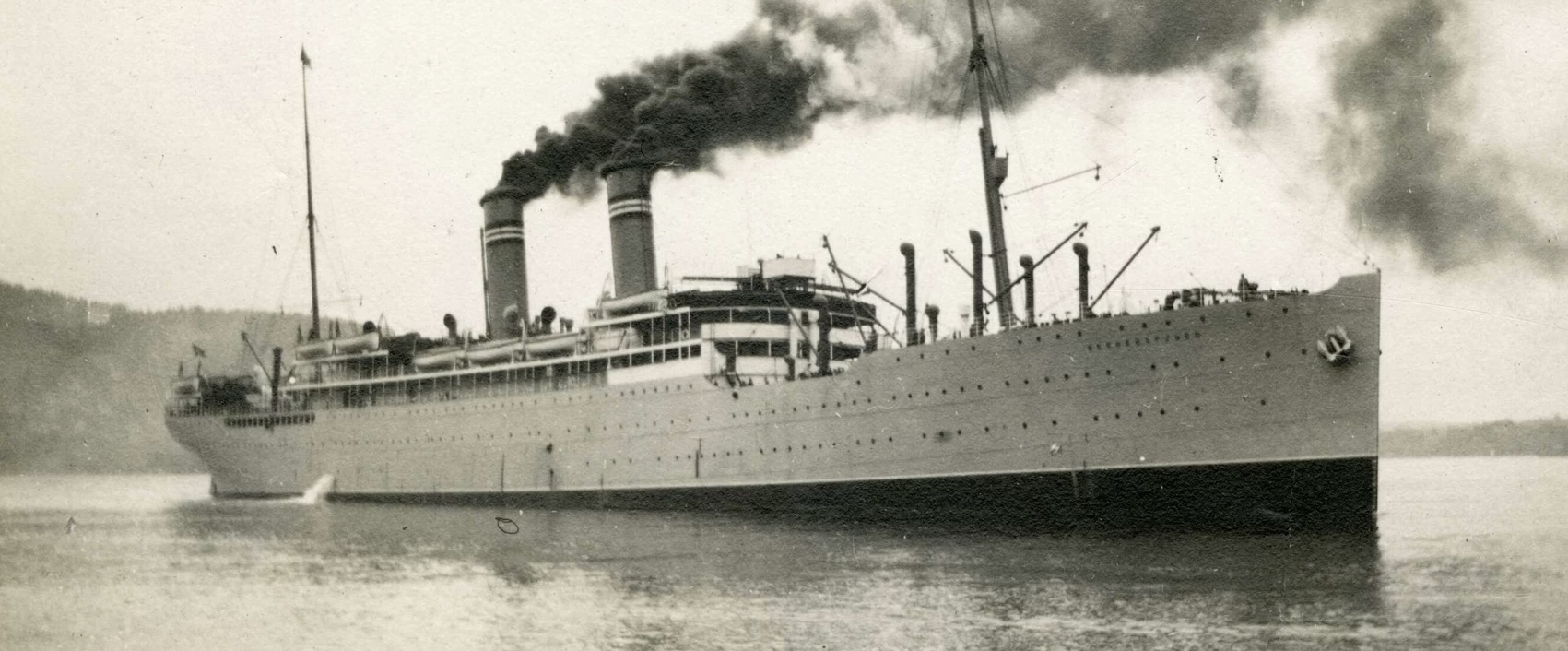
SS Kristianiafjord (1913)
Norwegian America Line · Norway–New York Service · Ship Guide
Overview
SS Kristianiafjord was the first purpose-built ocean liner of the Norwegian America Line, founded in 1910 to establish a direct Norwegian passenger and mail service to North America. Built by Cammell, Laird & Co. at Birkenhead, she was launched in November 1912 and entered service in June 1913.
Her arrival marked an important shift in Norwegian emigrant travel. Instead of relying principally on foreign lines and transshipment through continental ports, passengers could sail on a Norwegian-owned liner from Kristiania and western Norwegian ports directly to New York. Her sister Bergensfjord joined the route shortly afterward.
Key Facts
A Norwegian National Line
The Norwegian America Line was created to give Norway a direct national steamship connection with the United States. That objective was commercially significant and symbolically powerful in a country with a large emigrant population and close ties to Norwegian communities in North America.
Kristianiafjord was the company's first large purpose-built liner. Her name referred to the fjord serving the Norwegian capital—today known as Oslofjord—and established the naming tradition that would characterize much of the line's later fleet.
Design and Passenger Accommodation
At just over 10,600 gross tons, Kristianiafjord was substantial but not a giant by contemporary North Atlantic standards. Her twin-screw machinery used paired quadruple-expansion engines, and she was fitted with electric lighting and wireless telegraphy.
Her accommodation reflected the emigrant traffic that underpinned the route. Published figures give space for roughly 100 first-class passengers, 250 second-class passengers, and 850 in third class. The large third-class capacity made her especially relevant to Norwegian migration history.
Maiden Service in 1913
Kristianiafjord sailed from Kristiania on 4 June 1913, calling at Kristiansand, Stavanger, and Bergen before crossing to New York. The route gave passengers from several major Norwegian ports direct access to the Atlantic service without first traveling abroad to join a foreign liner.
Passenger-list records show repeated sailings through the remainder of 1913 and continued service in the following years. Her sister Bergensfjord joined the operation later that same year, giving the new line the paired service it had been organized to provide.
War Years Without Requisition
Norway remained neutral during the First World War, and Kristianiafjord continued commercial Atlantic service through much of the conflict. That did not make the route safe: wartime navigation brought mines, submarines, changing convoy practices, and increased pressure on crews operating in difficult North Atlantic conditions.
Her final loss, however, was not caused by enemy action. It resulted from a navigational grounding near Cape Race in June 1917.
The Cape Race Wreck
On 15 June 1917 Kristianiafjord ran aground near Cape Race, Newfoundland. Contemporary and later fleet records attribute the accident to navigational error. The ship carried 1,144 people, all of whom were successfully saved.
Salvage efforts followed, but the stranded vessel could not be recovered. A severe storm on 28 June further broke up the wreck, ending any realistic prospect of returning her to service.
Why Kristianiafjord Matters
Kristianiafjord matters less for speed or luxury than for what she represented: Norway's entry into direct national transatlantic passenger service. She was the physical expression of Norwegian America Line's founding purpose and a key ship in the history of Norwegian migration.
Her sister relationship with Bergensfjord is especially useful for the archive. Together, the two ships form the original purpose-built pair behind the line's early identity, predating the better-known Stavangerfjord generation that followed after the First World War.
Interpretive Notes
Launch year versus service year: the ship was launched in 1912 but entered commercial service in 1913. This guide uses 1913 in the title because that was her service-entry year.
Passenger totals vary by context: class capacities describe normal accommodation, while the 1,144 figure refers to the total number of persons aboard at the time of the 1917 wreck.
The wreck was not a wartime attack: despite occurring during the First World War, the grounding near Cape Race was a navigational casualty rather than a sinking caused by enemy action.
Evidence-first ship guide