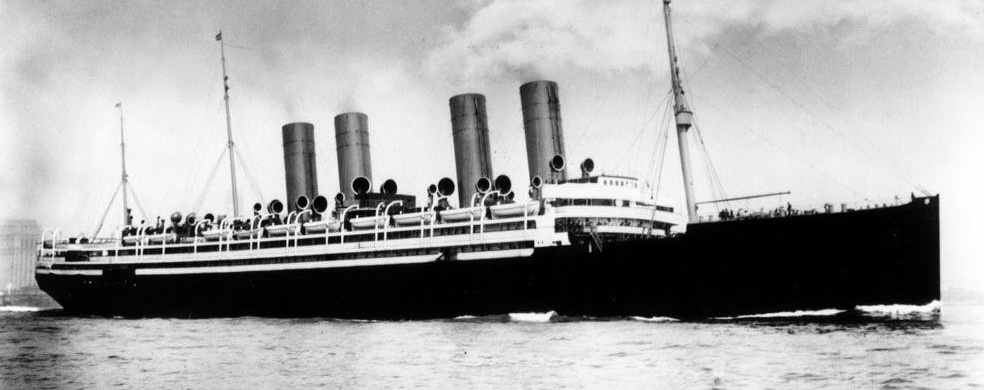
SS Kronprinzessin Cecilie
Norddeutscher Lloyd · 1907 · Ship Guide
Overview
SS Kronprinzessin Cecilie was the last of Norddeutscher Lloyd’s four-funnel “Kaiser-class” express liners, built at AG Vulcan (Stettin) and introduced in 1907. She operated on the North Atlantic—principally Bremen/Bremerhaven to New York—and became one of the era’s most recognizable German liners, both for her four-funnel silhouette and for her reputation as a fast, high-status passenger ship in the pre-1914 prestige race.
Collector context: her story is unusually “artifact-friendly” because it includes a dramatic 1914 U.S. diversion and internment, a U.S. Navy conversion (as USS Mount Vernon), and well-documented wartime events. That combination produces many tempting claims—date your item first, then attach the narrative.
Key Facts
Design & Construction Context
As the final “four flyer” for Norddeutscher Lloyd, Kronprinzessin Cecilie reflects the mature phase of German express-liner design immediately before the First World War. She is frequently cited as carrying exceptionally large reciprocating machinery for her era, paired with a hull and profile optimized for sustained Atlantic service speeds. The four-funnel silhouette—part engineering, part branding—also positioned her within an international prestige language that passengers instantly understood.
The ship’s interiors were conceived as a national showcase: contemporary descriptions emphasize lavish first-class public rooms and a deliberate “modern luxury” atmosphere within an Edwardian framework. For evidence-first writing, keep a clear boundary between (1) documented design intent (from period sources) and (2) later nostalgia.
Service History (Summary)
1907–1914: Operated on Norddeutscher Lloyd’s North Atlantic route to New York, with occasional calls to other ports depending on season and operational needs. She became a familiar “name ship” in the company’s pre-war prestige lineup.
August 1914: While returning toward Germany at the outbreak of World War I, she reversed course for the United States and entered Bar Harbor, Maine on August 4, 1914. Contemporary accounts note that her funnel tops were painted black in an attempt to resemble a British liner as a disguise.
1917–1919: After the United States entered the war, the ship was seized and commissioned as USS Mount Vernon (ID-4508). She made multiple troop transport voyages; in September 1918 she was torpedoed and suffered significant damage and casualties but was able to reach port and later returned to service.
1919–1940: Transferred to Army transport use after naval service, then placed under U.S. Shipping Board control and laid up for years before being scrapped in Boston in 1940.
Interpretive Notes
Bar Harbor “treasure ship” claims: the 1914 diversion is frequently retold with dramatic emphasis on precious-metal cargo and secrecy. Treat those details as a claim that requires a date and a source. For object cataloging, you’re looking for: a dated voyage, a documented port call, and a publication trail.
How she shows up in collections: Norddeutscher Lloyd passenger lists, menus, postcards, sailing brochures, and onboard stationery are the common categories. The strongest attributions combine ship name + line branding + a dated sailing (or at least a printed port sequence and printer’s imprint).
USS Mount Vernon material: items from the U.S. conversion era can be misdescribed as “original liner interiors” or “pre-war relics.” When possible, separate (1) pre-1914 NDL passenger ephemera from (2) U.S. Navy/Army documentation and photographs that reuse or depict surviving fittings.
Evidence-first ship guideSources (Selected)
- Ocean Liner Curator — Sources (master bibliography)
- SS Kronprinzessin Cecilie (1906) — summary & specifications (cross-check recommended)
- Bar Harbor Historical Society — the 1914 arrival and later U.S. use
- Naval History and Heritage Command (DANFS) — USS Mount Vernon (ID-4508)
- Naval History and Heritage Command — photo catalog record (Kronprinzessin Cecilie / Mount Vernon)
- Great Ships — narrative overview and 1914 disguise context