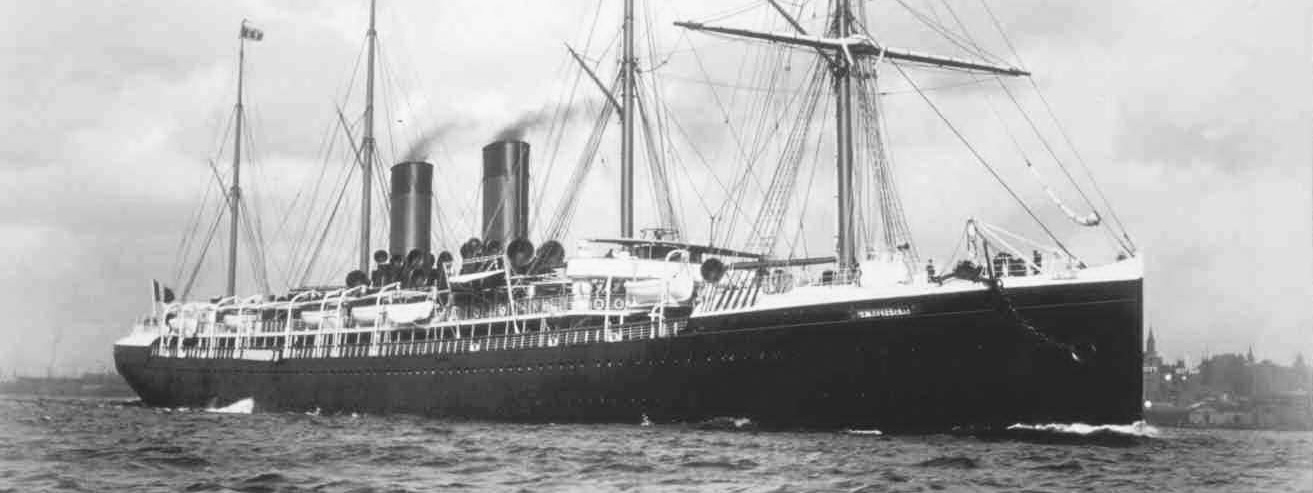
SS La Bourgogne
Compagnie Générale Transatlantique · 1886 · Ship Guide
Overview
SS La Bourgogne was a French transatlantic liner and mail steamer built for Compagnie Générale Transatlantique (CGT), commonly known as the French Line. Launched at La Seyne-sur-Mer on 8 October 1885 and entering Le Havre–New York service on 19 June 1886, she belonged to the four-ship “province” group that also included La Champagne, La Bretagne, and La Gascogne.
Her career combined regular North Atlantic passenger and mail work with a significant 1897 machinery modernization. She is remembered above all for her loss on 4 July 1898 after colliding with the British sailing ship Cromartyshire in dense fog south of Sable Island. The disaster became one of the most notorious North Atlantic passenger-ship losses of the late nineteenth century.
Key Facts
The French Line’s Province Group
La Bourgogne was part of CGT’s mid-1880s effort to strengthen its principal North Atlantic mail route. The four province-named liners represented a more modern generation of French express steamers before the larger and more visually distinctive liners of the twentieth century.
Her early appearance—two funnels and a heavy auxiliary sailing rig—still reflected the transitional visual language of nineteenth-century steam navigation. That makes photographs and postcards especially useful as chronological evidence when compared with the ship’s later rebuilt configuration.
Service and Modernization
Through the late 1880s and 1890s, La Bourgogne maintained scheduled passenger and mail service between France and New York. Contemporary records also preserve earlier collision incidents, including a January 1890 collision near the Scilly Isles and the February 1896 collision in which the Atlas Line steamer Ailsa was sunk near New York.
In 1897, the French liner received new boilers and quadruple-expansion machinery. Published accounts describe higher funnels and a simplified mast arrangement. As with her sister La Bretagne, the rebuilding created a materially different mechanical and visual phase that should be respected when dating photographs or other ephemera.
The Collision with Cromartyshire
On 2 July 1898, La Bourgogne departed New York eastbound for Le Havre. Early on 4 July, in dense fog south of Sable Island, she collided with the British sailing ship Cromartyshire. The sailing vessel’s bow opened the liner’s starboard side, and La Bourgogne sank within a short period.
Contemporary reports described exceptionally severe loss of life and chaotic conditions during the evacuation. The event quickly became the subject of international newspaper coverage, official inquiry, and controversy over speed in fog, shipboard discipline, access to boats and rafts, and the disparity between passenger and crew survival.
How Many People Were Lost?
Published totals are not fully consistent. Near-contemporary engineering reporting gave 553 deaths; later reference works commonly cite figures around 549, while other modern summaries give 562 deaths from 725 aboard. These differences reflect varying passenger-and-crew totals and later reconciliation of survivor lists.
For that reason, Ocean Liner Curator does not force a single casualty number where the underlying record remains inconsistent. The reliable conclusion is that well over five hundred people died and that only a minority of those aboard survived.
Why La Bourgogne Matters
La Bourgogne connects several important themes in late nineteenth-century liner history: national mail contracts, the competitive North Atlantic express trade, rapid machinery development, mass migration, and the persistent danger of high-speed navigation before radar and modern collision-avoidance systems.
Her 1898 loss also demonstrates why disaster narratives require particular care. Sensational contemporary reporting often mixed documented testimony with rumor, ethnic stereotyping, and moral accusation. Strong attribution therefore matters when discussing conduct aboard the sinking ship.
Interpretive Notes
Casualty totals vary: contemporary and later sources do not agree on the exact number aboard or lost, so figures should be attributed rather than flattened into false precision.
Disaster reporting was highly charged: claims about the behavior of crew members or particular passenger groups should be treated as attributed testimony or journalism, not repeated as neutral fact without qualification.
The 1897 rebuild is a dating clue: machinery, funnels, and mast arrangement can help distinguish images from different phases of the ship’s career.
Evidence-first ship guideSources (Selected)
This list is intentionally conservative.