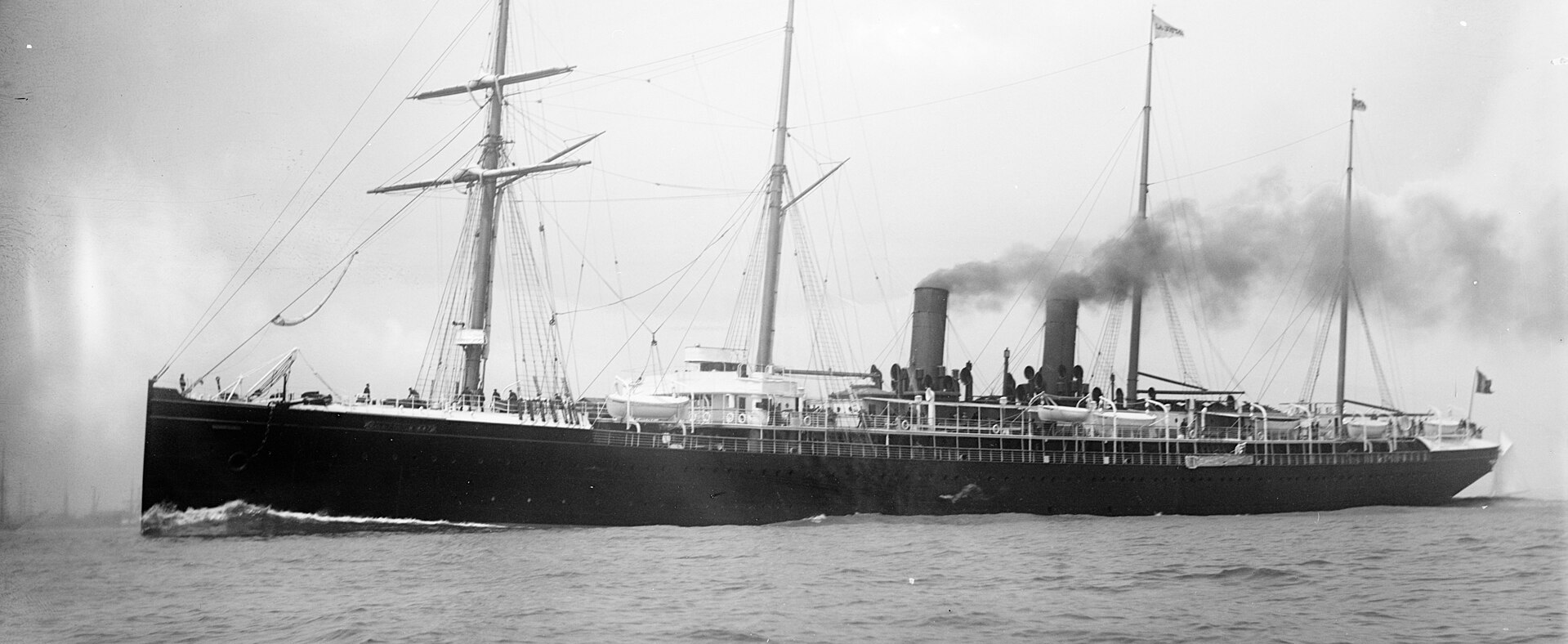
SS La Bretagne
Compagnie Générale Transatlantique · 1886 · Ship Guide
Overview
SS La Bretagne was one of the four large French Line “province” liners ordered for the Le Havre–New York mail service in the mid-1880s. Launched at Saint-Nazaire on 9 September 1885 and entering service in August 1886, she belonged to the generation that gave Compagnie Générale Transatlantique a more competitive, modern North Atlantic fleet before the company’s twentieth-century prestige liners.
Her long career is best read in four phases: original CGT transatlantic service, the major 1895 modernization, Compagnie de Navigation Sud-Atlantique service from 1912, and wartime use as a hospital ship and troop transport before her final Alésia identity.
Key Facts
A French Mail-Liner Generation
La Bretagne belonged to a four-ship CGT program with La Champagne, La Bourgogne, and La Gascogne. The vessels were tied to the renewal of France’s transatlantic mail arrangements and were expected to maintain speeds above the standards of earlier company tonnage.
Her original two-funnel, four-masted appearance captures the transition from the visual language of sailing ships toward a more recognizably modern steam-liner silhouette. That makes dated photography especially useful for determining whether an image predates or follows the 1895 rebuilding.
The 1895 Modernization
The 1895 overhaul was much more than cosmetic. Contemporary and later French accounts describe new boilers and quadruple-expansion machinery, raised funnels, and removal of two masts. Passenger capacity was also altered. The refit effectively created a second visual and mechanical phase within the same CGT career.
For curatorial work, pre- and post-1895 material should not be casually mixed. A four-masted photograph and a two-masted postcard may depict the same ship but document materially different configurations.
From New York to South America
La Bretagne remained in French Line North Atlantic service until 1912, when she transferred to the newly organized Compagnie de Navigation Sud-Atlantique. Her commercial geography then shifted from Le Havre–New York to South American service from Bordeaux.
This change matters for ephemera attribution. A route card or passenger document from the Sud-Atlantique period belongs to a different company, service network, and marketing context than the better-known CGT material even though the ship initially retained the same name.
Hospital Ship and Troop Transport
In August 1914, wartime requirements transformed the liner into a hospital ship. French sources describe a capacity of roughly 550 beds. In October 1916 she was styled Bretagne II, and in 1917 she was briefly employed as a troop transport, including service to Dakar, before being released from wartime duty.
This entire phase was missing from the previous guide and is important because it separates civilian passenger evidence from military medical and troop-movement documentation.
Alésia and the 1923 Loss
Renamed Alésia in 1919 while awaiting possible return to service, the aging liner never resumed a normal peacetime passenger career. She was eventually sold for demolition in 1923.
While under tow toward the Netherlands in December 1923, the towline parted near Texel and the ship grounded, becoming a total loss before conventional breaking could take place.
Why La Bretagne Matters
La Bretagne is a strong example of how a long-lived nineteenth-century liner could repeatedly change meaning without changing hull identity: mail liner, modernized emigrant/passenger ship, South Atlantic liner, hospital ship, troop transport, and finally Alésia.
For attribution, mast arrangement, operator, route, wartime status, and name are all useful chronological anchors. Her career rewards phase-specific cataloging rather than one generic “French Line” label.
Evidence-first ship guideSources (Selected)
This list is intentionally conservative.