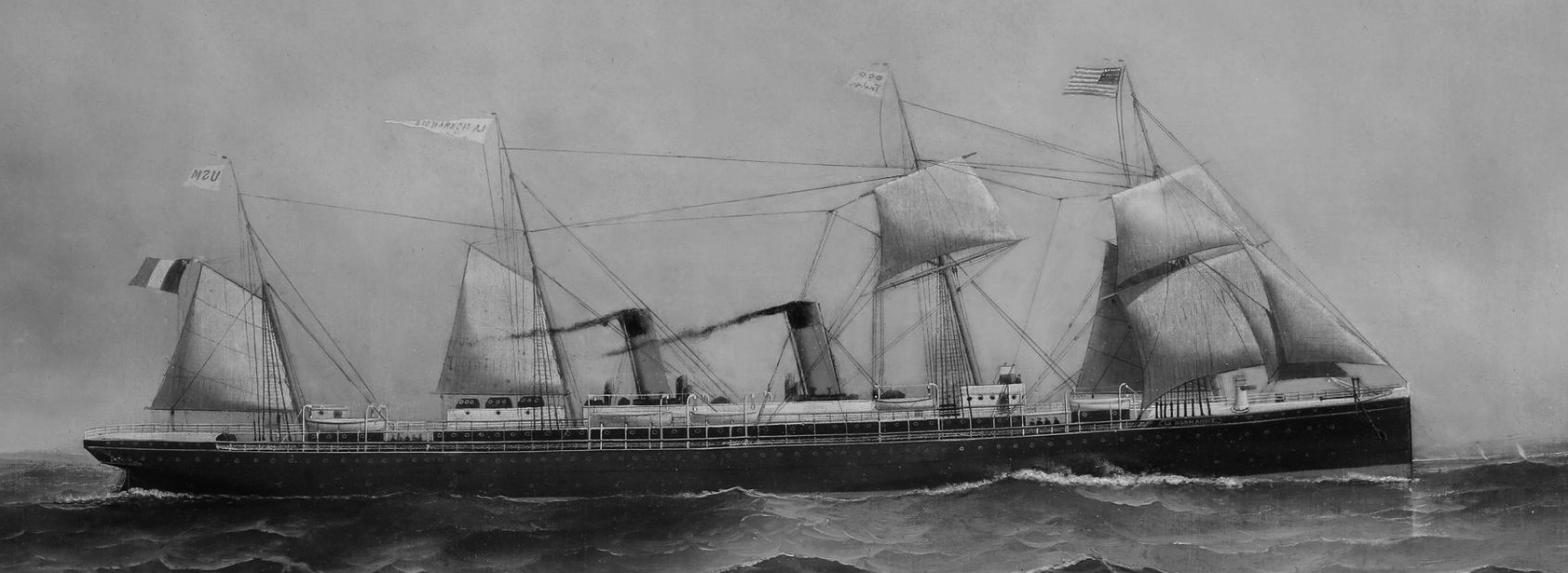
SS La Normandie
Compagnie Générale Transatlantique / French Line · 1883 · Ship Guide
Overview
SS La Normandie was a major early Compagnie Générale Transatlantique liner built at Barrow and launched on 28 October 1882 as Normandie. She entered the Le Havre–New York service on 5 May 1883 and became one of the most important French transatlantic prototypes of the decade.
The current guide previously extended her later career into Caribbean and Central American work after 1912. The stronger chronological evidence instead points to a 1912 withdrawal and demolition. Route changes did occur before final withdrawal, but they belong to the 1890s–1900s service period rather than to a post-1912 second career.
Key Facts
A Prototype for French Line Modernization
Normandie was ordered while CGT’s older Atlantic fleet was becoming less competitive. She represented a deliberate step toward larger, faster, more modern passenger ships and helped establish design lessons later reflected in La Champagne, La Bretagne, La Bourgogne, and La Gascogne.
Her importance is therefore structural rather than merely chronological: she was part of the bridge between earlier French steamships and the more confident national liner program of the late nineteenth century.
Electric Lighting and Passenger Experience
French sources emphasize the ship’s electric lighting system, powered by multiple dynamos and hundreds of lamps. In the early 1880s this was a meaningful passenger-service innovation rather than a trivial amenity.
Publicity around lighting, promenade space, and passenger comfort shows CGT beginning to sell technological modernity as part of the travel experience itself.
The 1886 Name Change
When the newer “La” series entered service in 1886, Normandie became La Normandie. This is not simply a modern stylistic choice: pre-1886 documents may legitimately use Normandie without the article.
For cataloging, the date should determine which form is preferred. A 1883 passenger list labeled Normandie is not an error.
The 1894 Rebuilding
The 1894 refit substantially altered the ship. Sources agree that two of the four masts were removed and the funnels were changed; French accounts also describe lengthening and machinery modernization.
This gives researchers an unusually useful visual breakpoint. A four-masted view belongs to the earlier configuration; a two-masted view belongs to the post-1894 ship.
Later Routes Before Withdrawal
After newer CGT liners displaced her from the premier New York role, La Normandie was redeployed to other French Line services, including Caribbean, Mexican, and Central American routes before final retirement.
The important correction is chronological: these route changes occurred while the ship remained in CGT service before 1912. The evidence does not support describing them as a later post-1912 career.
Passenger Capacity, Migration, and Public Health
La Normandie was notable not only for cabin passengers but also for her very large third-class capacity. That placed her within the mass migration system linking Le Havre with New York. Passenger lists, steerage records, and port-health documentation therefore deserve equal weight with first-class publicity when reconstructing the ship’s social history.
Nineteenth-century immigrant steamers also generated quarantine and inspection records. Such material should be interpreted as part of the administrative reality of mass migration rather than as sensational evidence about the ship itself. A dated health report can document a specific voyage without justifying broad claims about conditions across an entire career.
Collecting Profile
Useful material includes passenger lists, engravings, route advertisements, postcards, newspaper reports, and company notices. The 1894 rebuilding makes visual evidence particularly valuable: four masts indicate the earlier configuration, while the later two-masted profile belongs to the rebuilt ship. Funnel height and hull proportions provide additional dating clues.
Name form is another useful chronological marker. Material from 1883–85 may say Normandie; later material normally uses La Normandie. Neither should be “corrected” without regard to date.
From Prototype to Fleet Pattern
The ship’s design experience fed directly into CGT’s next generation. The later quartet of La Champagne, La Bretagne, La Bourgogne, and La Gascogne did not appear in isolation; Normandie helped demonstrate how a larger, faster, electrically lit French liner could compete on the New York route.
Research Caution: The Famous Later Normandie
Searches for “Normandie” are dominated by the 1935 flagship, so the 1882 ship is easily obscured or accidentally illustrated with later material. The safest identifying anchors are CGT, Barrow, 1882–83, four-masted or two-masted prewar profile, and the 1894 rebuilding. A date should accompany the name whenever possible.
That longer chronology also helps place later French Line achievements in context: the famous twentieth-century Normandie inherited a name already associated with an earlier generation of deliberate technological modernization.
That continuity is historically significant.
Why La Normandie Matters
La Normandie matters because she documents French Line modernization before the better-known “La” quartet and decades before the famous 1935 Normandie.
For attribution, the strongest clues are date, operator, pre- or post-1894 profile, and whether the printed name is Normandie or La Normandie. Those distinctions prevent the ship from being blurred into the much later flagship that reused the name.
Evidence-first ship guideSources (Selected)
This list is intentionally conservative.