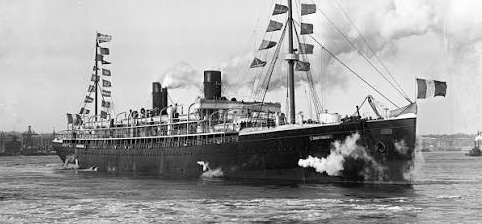
SS La Touraine (1891)
Compagnie Générale Transatlantique · French Line · Ship Guide
Overview
SS La Touraine was one of the most important French passenger liners of the 1890s. Built at Saint-Nazaire for the Compagnie Générale Transatlantique, she entered the Le Havre–New York service in June 1891 and helped establish a distinctly French presence in the competitive express-liner trade before the better-known generation of La Provence, France, Paris, and Île de France.
She was large for her date, fast without being an outright Blue Riband holder, and long-lived. Over more than three decades she was repeatedly altered to meet changing passenger expectations, survived serious accidents and a major fire, served through the First World War era, and remained useful long after newer French liners had eclipsed her in prestige.
Key Facts
A New French Atlantic Flagship
When La Touraine entered service, the French Line was competing against increasingly powerful British and German companies on the North Atlantic. Her size and twin-screw machinery placed her among the major liners of the moment and represented a substantial advance over the company's earlier single-screw steamers.
Her maiden voyage left Le Havre for New York on 20 June 1891. Contemporary and later summaries credit her with a passage of roughly six days and eighteen hours, and in 1892 she recorded 21.2 knots over a measured mile. Those figures made her an impressive French express liner even though she did not capture the Blue Riband.
Passenger Service and Identity
La Touraine was primarily a Le Havre–New York ship. Surviving passenger lists, menus, route material, postcards, and other ephemera show how firmly she became associated with the French Line's direct New York service. Her passenger spaces helped establish the company's reputation for French cuisine and a more consciously national style of hospitality.
As built she carried first-, second-, and steerage-class passengers. The exact capacity changed over time as the ship was repeatedly reconfigured. That evolution is important: La Touraine served during a period when North Atlantic passenger traffic was moving from nineteenth-century emigrant patterns toward increasingly differentiated cabin, tourist, and leisure markets.
Refits, Fire, and Reconstruction
The ship underwent a substantial modernization around the turn of the century. Her machinery was overhauled, stabilizing improvements were made, and her original rig was simplified. Passenger capacity and accommodation were also revised as the French Line sought to keep an aging but still valuable liner competitive.
In January 1903 a serious fire at Le Havre damaged important first-class spaces, including the grand staircase, dining room, and deluxe cabins. Those areas were rebuilt rather than abandoned. The episode is a useful reminder that the interiors of long-lived liners were not static: photographs or plans from one decade should not automatically be treated as representative of the ship throughout her career.
A Ship of the Wireless Era
By the early 1910s La Touraine had crossed into a very different technological age from the one in which she had been built. Wireless telegraphy had become an important part of North Atlantic navigation, and on 12 April 1912 the ship transmitted an ice report while Titanic was westbound toward New York.
The message is often mentioned because of the later disaster, but it should not be overstated as a unique warning. Multiple ships were reporting ice conditions in the North Atlantic that week; La Touraine's transmission belongs within that broader network of routine navigational information.
Canadian Service and the First World War
In 1913 the aging liner was assigned seasonally to the Le Havre–Quebec–Montreal trade. The change reflected the French Line's effort to use a still-capable vessel on routes where prestige speed mattered less than dependable passenger capacity.
At the beginning of the First World War, La Touraine was among the French liners affected by government requisition and wartime planning. She was soon returned to postal and passenger work and continued to help maintain transatlantic communications during the conflict. Her survival was notable in a war that cost the French merchant fleet heavily.
Longevity and Final Years
After the war La Touraine returned to civilian Atlantic service despite her age. Passenger manifests from 1920 and 1921 still document substantial traffic between France and the United States. By then she belonged to another era beside the larger and more modern ships entering service around her.
She made her final New York voyages in 1922 and was withdrawn after roughly thirty-one years of service. Sources differ slightly on whether the final scrapping process is best dated to late 1923 or 1924, so this guide preserves that narrow uncertainty rather than forcing an artificial single date.
Why La Touraine Matters
La Touraine helps explain the continuity of French transatlantic development. She links the late nineteenth-century express-steamer world to the Belle Époque French Line and then survives far enough into the twentieth century to encounter wireless navigation, Canadian route diversification, wartime service, and the postwar passenger market.
She also demonstrates why older liners should not be treated as unchanging artifacts. Her rig, machinery, accommodation, passenger capacities, and public rooms evolved substantially over three decades. A careful identification of a photograph, brochure, or interior therefore depends on dating the evidence rather than simply matching the ship's name.
Interpretive Notes
Tonnage varies by source: published figures reflect different dates and measurement contexts. Roughly 8,900 tons as built and around 9,047 tons in later fleet references are both encountered.
Do not confuse speed with a Blue Riband claim: La Touraine was notably fast and recorded impressive passages, but she was not the holder of the formal transatlantic speed record usually associated with Blue Riband histories.
Her appearance changed: mast arrangement and other external details were altered during refits, so photographs should be dated before being used as configuration evidence.
Evidence-first ship guide