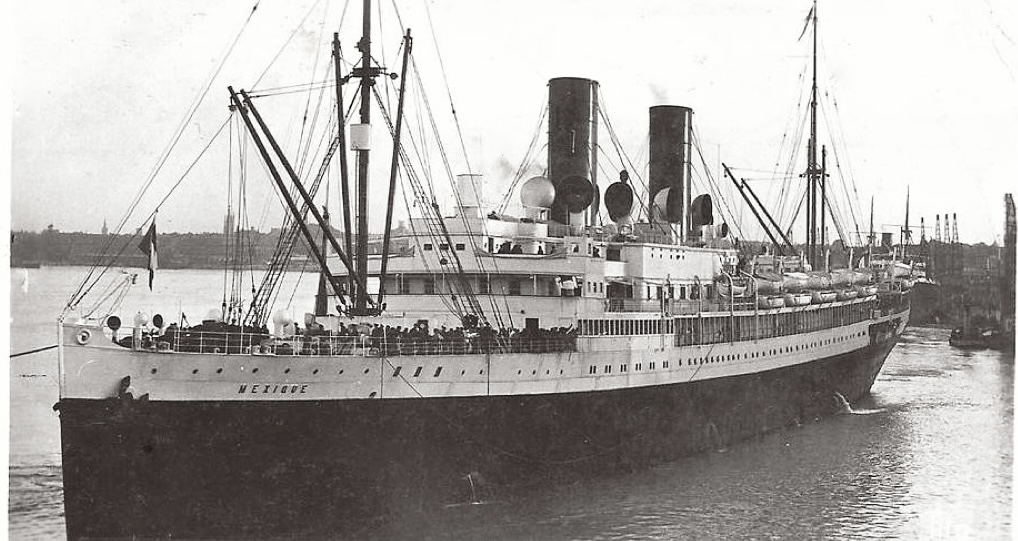
SS Lafayette (1915)
Compagnie Générale Transatlantique · entered service 1915 · Ship Guide
Overview
SS Lafayette was a Compagnie Générale Transatlantique passenger liner of the First World War era, built for French Line service but completed into a changed operational world. Laid down as Île de Cuba for Caribbean and Mexico service, she was instead completed in 1915 as Lafayette and placed on the Bordeaux–New York route. Her career then moved through several sharply different phases: civilian transatlantic service, wartime hospital-ship and troopship work, postwar North Atlantic operation, and finally rebuilding and renaming as Mexique.
In collecting and interpretation, Lafayette is a good example of why date, name, and service context matter. Material tied to Île de Cuba, Lafayette, and later Mexique belongs to the same hull but to meaningfully different interpretive frames and should not be casually merged.
Key Facts
Design & Construction Context
The ship was ordered for CGT’s Antilles, Central America, and Mexico routes under the name Île de Cuba. Her design therefore belongs to the broad French Line world of medium-to-large intercontinental liners rather than to a single fixed North Atlantic concept. The First World War altered that original plan before the ship could begin her intended service, and CGT redirected her into the Bordeaux–New York trade under the new name Lafayette.
Technically, she reflected a transitional propulsion approach used by several early twentieth-century liners, combining reciprocating engines and turbines across four screws. For interpretation, that matters less as a pure engineering curiosity than as a sign that CGT was building modern, flexible passenger ships suited to multiple long-distance services.
Service History (Summary)
1914–1915: Launched as Île de Cuba in May 1914 and completed in June 1915. Instead of entering Caribbean and Mexico service as planned, she was renamed Lafayette and allocated to the Bordeaux–New York route.
1915–1917: Entered transatlantic service in November 1915. Early voyages took place under wartime conditions and included high-profile passengers; the ship also drew the kind of anonymous threat warnings associated with German submarine warfare in the period.
1917–1919: Converted into a hospital ship for the French Navy, with accommodation for about 1,400 beds. She served on Mediterranean medical transport duties and later also performed troop and repatriation functions after the Armistice.
1919–1928: Returned to civilian CGT service and resumed North Atlantic operation, chiefly on the Le Havre–New York route. In this period she also made some voyages carrying emigrants to Mexico and the West Indies and was used for financial cargoes such as bullion shipments.
1928: Thoroughly rebuilt and renamed Mexique, effectively beginning a new service chapter on the routes for which the hull had originally been conceived.
Later career of the hull: As Mexique, the ship continued in CGT service, later entered wartime auxiliary service, and was sunk by a mine at the mouth of the Gironde on 19 June 1940.
Interpretive Notes
The name alone is not enough: CGT used the name Lafayette on more than one ship, and this particular vessel also had meaningful careers under two other names. Cataloging should therefore anchor identification in date, route, image evidence, and technical particulars rather than title alone.
Prewar intention and wartime reality diverged sharply: the ship’s original role as Île de Cuba and her actual early service as Lafayette belong to different operational worlds. That makes her especially useful as a case study in how war redirected liner planning.
Post-1928 material belongs to Mexique, not simply “Lafayette later on”: although it is the same hull, the rebuilt and renamed ship should be interpreted as a separate service phase with its own route context and collecting profile.
Identity discipline is essential: this guide concerns the 1914-built vessel launched as Île de Cuba, later completed and operated as Lafayette, and ultimately renamed Mexique. It is not the separate 1930 French Line Lafayette. Dates, builder, dimensions, and photographs must therefore be checked against the correct hull before material is attributed.
That identity chain is historically useful because it preserves the effects of wartime interruption and postwar reuse. A ship conceived under one name could emerge into service under another and later continue under yet another commercial identity. Contemporary naming should remain primary in catalog records, with later continuity explained in notes rather than silently normalized.
The corrected identity also protects search and cross-linking: references to the 1930 ship should not bleed into this earlier vessel’s service record.
Evidence-first ship guide