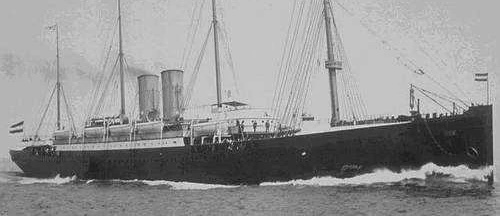
SS Lahn (1887)
Norddeutscher Lloyd · Bremen–Southampton–New York · Ship Guide
Overview
SS Lahn was a fast Norddeutscher Lloyd passenger liner built by Fairfield at Glasgow during the German company's rapid late-nineteenth-century expansion on the North Atlantic. Launched in September 1887, she belonged to the generation immediately before the four-funnel express liners that would make Norddeutscher Lloyd internationally famous.
Although smaller than the later Kaiser Wilhelm der Grosse, Lahn was an important transitional ship: iron-hulled, single-screw, turbine-era technology still far in the future, yet capable of roughly 18½ to 19 knots and able to carry first- and second-class travelers alongside hundreds of emigrants in steerage. She spent most of her German career connecting Bremen, Southampton, and New York before shifting to Mediterranean–New York service and, in 1904, passing into Russian ownership.
Key Facts
Fairfield and the German Express Fleet
Lahn was built in Scotland, not Germany. That was not unusual for Norddeutscher Lloyd in this period: British yards possessed deep experience with large, high-speed ocean steamers, and Fairfield supplied several important NDL ships in the mid-1880s. Aller, Trave, and Saale were close contemporaries, with Lahn somewhat larger than those earlier Fairfield-built vessels.
The ship's original profile—two funnels and four masts—still reflected nineteenth-century visual conventions even though steam propulsion was dominant. Her masts were later reduced to two during modernization, making dated photographs particularly important for visual identification.
Entry into Atlantic Service
The exact dating of Lahn's first commercial voyage is not perfectly consistent across secondary sources. Some archival compilations describe a Bremen–Southampton–New York maiden voyage in December 1887, while other fleet histories give 1 February 1888 as the start of regular service on that route.
Rather than force the disagreement into a single date, the safest conclusion is that she entered North Atlantic service at the turn of 1887–88 and was firmly established on the Bremen–Southampton–New York run during 1888. Surviving passenger lists document repeated crossings from that year onward.
Speed and Competition
When new, Lahn ranked among the faster Atlantic steamers. Contemporary and later sources describe her as capable of making the Southampton–New York passage in under seven days, with a service speed around 18½ knots. Some period-derived accounts place her among the three fastest steamships then operating the Atlantic.
That achievement should be understood in context. Lahn belonged to the final stage of the single-screw express-liner era. Within a decade, larger twin-screw ships such as Kaiser Wilhelm der Grosse would transform both speed expectations and the visual language of German passenger shipping.
Passengers and Emigration
Lahn was not merely a prestige vessel. Her passenger arrangements combined comparatively limited first- and second-class accommodation with a much larger steerage capacity. Passenger lists from the late 1880s and 1890s show the ship carrying substantial emigrant traffic from Central and Eastern Europe to the United States.
This mixture of cabin travelers and emigrants was central to Norddeutscher Lloyd's business model. Bremen served as one of Europe's great emigration gateways, and ships such as Lahn were commercial links between continental rail networks, Atlantic ports, and immigrant communities in North America.
Refit and Mediterranean Service
During the 1890s Lahn was modernized, including the reduction of her four-masted original rig to two masts. She continued on the Bremen route into the opening years of the twentieth century, but by then newer and larger NDL ships had taken over the company's premier North Atlantic role.
In 1901 she was transferred to Mediterranean service, operating from ports including Genoa and Naples to New York. The move extended the useful life of an aging express liner while placing her in another major migration corridor, carrying travelers and emigrants from southern Europe to the United States.
Russian Ownership
Norddeutscher Lloyd sold Lahn in 1904. Russian ownership brought the name Russ, and some later records also associate the ship with the name Dniester. Sources are less consistent about the details of this final phase than they are about her NDL service.
Some older summaries give an early scrapping date, while other fleet histories indicate that the vessel remained in Russian hands well into the 1920s. Because the surviving secondary record is inconsistent, this guide treats a final breakup around 1927 as the better-supported broad conclusion while retaining the uncertainty.
Why Lahn Matters
Lahn occupies an important place between two eras. She was faster and more capable than many earlier emigrant steamers, yet she still belonged to the world of iron hulls, single screws, multiple masts, and relatively modest tonnage. Only ten years later, the four-funnel German express liner would make her generation look visibly old.
For Ocean Liner Curator, she also helps fill a chronological gap in Norddeutscher Lloyd coverage. The better-known Kaiser-class liners make more sense when the ships immediately preceding them—ships such as Lahn—are understood as the commercial and technological foundation from which that later prestige fleet emerged.
Interpretive Notes
Maiden-voyage dating is inconsistent: published archival summaries give both December 1887 and 1 February 1888. The guide therefore treats late 1887–early 1888 as the documented entry-to-service window.
Tonnage figures vary: roughly 5,099 GRT appears in shipyard and fleet references, while some archival summaries cite 5,681 tons. The difference should not be silently harmonized without knowing the measurement basis.
Do not confuse her with later NDL giants: Lahn predates Kaiser Wilhelm der Grosse by a decade and belongs to a materially different generation of liner design.
Evidence-first ship guide