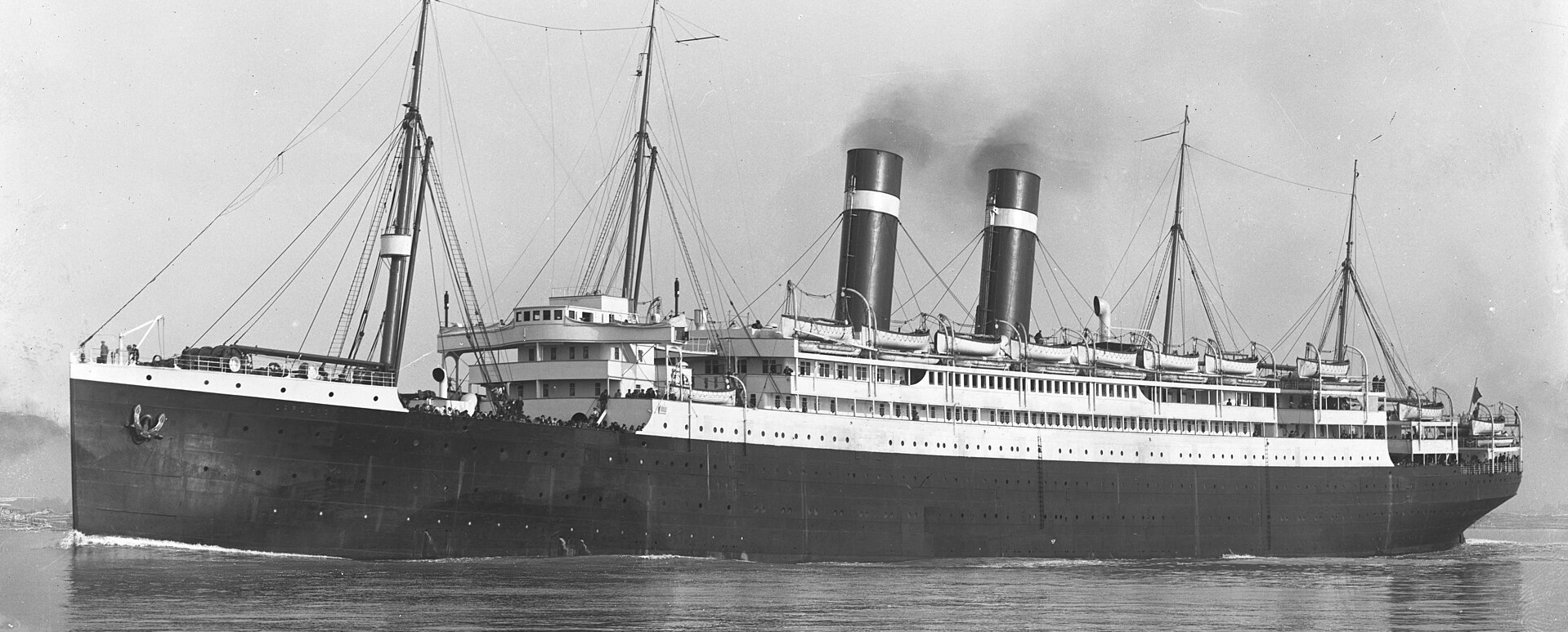
SS Lapland
Red Star Line · 1909 · Ship Guide
Overview
SS Lapland was built by Harland & Wolff (Belfast) as a flagship-scale liner for the Belgian Red Star Line. Entering service in 1909, she operated the company’s core Antwerp–New York route (often via Dover/Southampton depending on period), and became a familiar presence in North Atlantic passenger service across the pre-war, wartime, and interwar eras.
Lapland is frequently discussed in Titanic-era context: in April 1912 she carried surviving members of Titanic’s crew back to the UK, along with mail originally booked to Titanic. This episode often surfaces in collecting descriptions and ship-history summaries.
Key Facts
Many technical figures (tonnage, passenger accommodations, and some route calls) vary across sources because Lapland was refitted and remeasured over a long career. Where you need collector-grade precision, prefer contemporary company material (deck plans, sailings lists, ticket terms) matched to a date.
Design & Construction Context
Built at Harland & Wolff, Lapland belonged to a family resemblance of early-1900s North Atlantic liners associated with the International Navigation Company’s wider orbit, sharing certain visual cues with contemporary White Star practice (notably a “modern” bridge/island profile for the period). For Red Star, her size and prominence mattered: she projected Antwerp as a serious departure port in the competitive emigrant-and-cabin-class market.
In collecting terms, pre-World War I Red Star ephemera often emphasizes Antwerp departures and immigration travel logistics. After 1914, shifts in management/charter and wartime controls can produce hybrid branding (ship name retained, but route presentation and company framing altered).
Service History (Summary)
1909–1914: Regular Antwerp–New York service for Red Star Line. In April 1912, she made a widely noted voyage connected to the Titanic inquiry period, repatriating surviving crew to the UK and carrying mail originally booked to Titanic.
World War I: From 1914 onward her employment shifted under wartime conditions; she served in transport roles, and in April 1917 she struck a mine but remained afloat and was able to reach port. She was subsequently used as a troop transport during the later war period.
1920s: Returned to commercial operation in the postwar market, with accommodations and tonnage figures often cited as revised after refit and remeasurement. She resumed transatlantic service (frequently described as Antwerp–Southampton–New York in this era).
1932–1934: Late-career use included cruising as transatlantic economics shifted. She was sold for scrap in 1933 and dismantled at Osaka beginning in 1934.
Interpretive Notes
How “Lapland” shows up in collections: passenger lists, menus, baggage labels, postcards, and agent advertising are the most common categories. “Red Star Line” attributions are strongest when the piece includes an Antwerp departure reference, a Red Star house flag/wordmark, or a clearly dated sailing.
Titanic-adjacent material: items that explicitly mention April 1912 (crew repatriation, mail carriage, or inquiry-era travel) can attract premium descriptions. As a curator practice, treat claims of “Titanic crew ship” as context, not automatic proof of rarity—verify date, voyage, and publisher imprint.
Refit caution: because Lapland had a long, changeable career, undated ephemera can be misleading. Look for address lines, typography, port sequences, and fare-class terminology (e.g., “cabin/tourist/third” language appearing more commonly later) to anchor the object in time.
Evidence-first ship guideSources (Selected)
- Ocean Liner Curator — Sources (master bibliography)
- Red Star Line Museum site — Lapland (overview)
- Titanic Inquiry Project — Lapland (Titanic-related voyage context)
- Great Ships — Lapland (service narrative and wartime notes)
- Canadian War Museum — photo record featuring Lapland (troop movement context)
- SS Lapland (summary; cross-check recommended)