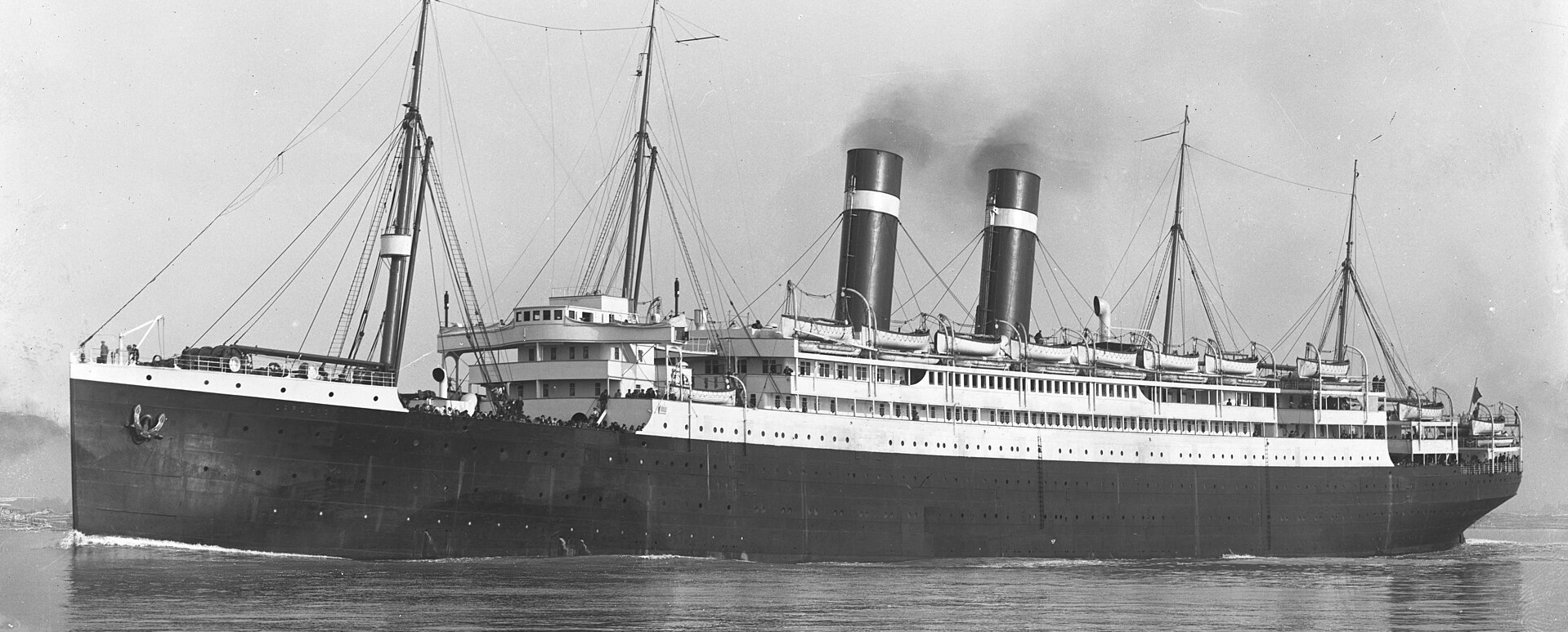
SS Lapland
Red Star Line · entered service 1909 · Ship Guide
Overview
SS Lapland was built by Harland & Wolff at Belfast as yard no. 393 for Red Star Line. Launched on 27 June 1908, completed on 27 March 1909, and sent on her maiden voyage from Antwerp via Dover to New York on 10 April, she became Red Star's flagship and a major Belgian-flag Atlantic liner.
Her long career crossed several corporate and national contexts: Red Star operation, temporary White Star employment, International Navigation Company ownership, wartime transport, and later Leyland Line ownership. That complexity is important when attributing ephemera.
Key Facts
Red Star Flagship and North Atlantic Context
For Red Star Line, Lapland represented a substantial increase in scale and visibility. Her regular Antwerp–New York service placed Belgium firmly within the competitive emigrant and cabin-passenger traffic of the North Atlantic, while calls and operating arrangements could vary by period. Prewar publicity therefore often emphasized Antwerp as much as the ship herself: the liner was part of a travel system linking continental departure points, British Channel ports, and New York.
Her documentary trail is complicated by the corporate structure around Red Star. The line operated within the wider International Mercantile Marine world, and ships could be shifted between associated services without changing identity. That is why White Star, Red Star, International Navigation, and later Leyland references can all appear in connection with the same hull. A dated imprint is usually more informative than a later simplified label.
Titanic-era Context
Lapland appears frequently in Titanic-related material because she carried surviving members of Titanic's crew home after the disaster. U.S. Senate inquiry testimony records White Star management arranging for the crew to travel on Lapland, sailing on the Saturday after Carpathia's arrival rather than delaying Cedric.
This connection is historically real, but it should be described precisely: Lapland was a Red Star liner temporarily used within the wider International Mercantile Marine network, not a participant in the sinking itself.
From Prewar Flagship to Wartime Utility
Lapland's 1912 Titanic connection tends to dominate modern references, but it was one episode in a much longer operating career. Before the war she was primarily a Red Star passenger liner serving the Antwerp traffic, and her importance came from regular scheduled work rather than from proximity to another ship's disaster. Keeping that proportion is useful when evaluating memorabilia: an ordinary prewar passenger list can be more representative of her actual career than a later item marketed chiefly through the Titanic association.
The First World War then changed both route structure and documentation. Passenger liners were absorbed into transport systems, company branding became less straightforward, and military requirements could supersede the commercial patterns visible in prewar material. Lapland's survival of mine damage in 1917 allowed those phases to remain part of one continuous hull history rather than ending in wartime loss.
War and Ownership Changes
Ownership and operation shifted during the First World War. The ship entered wartime transport service and on 7 April 1917 was damaged by a mine associated with German submarine UC-65. She survived, was repaired, and continued service.
After the war she returned to Atlantic passenger work. By the late 1920s ownership had moved to Leyland Line, while route and class arrangements changed with the market. Late-career tonnage figures therefore differ from the as-built value and should be dated rather than treated as one fixed specification.
Interpretive Note
Lapland is a good example of why “operator” and “owner” should not be used interchangeably. Red Star, White Star, International Navigation, and Leyland all appear in her documentary trail at different times. Date and imprint are essential.
Evidence-first ship guide