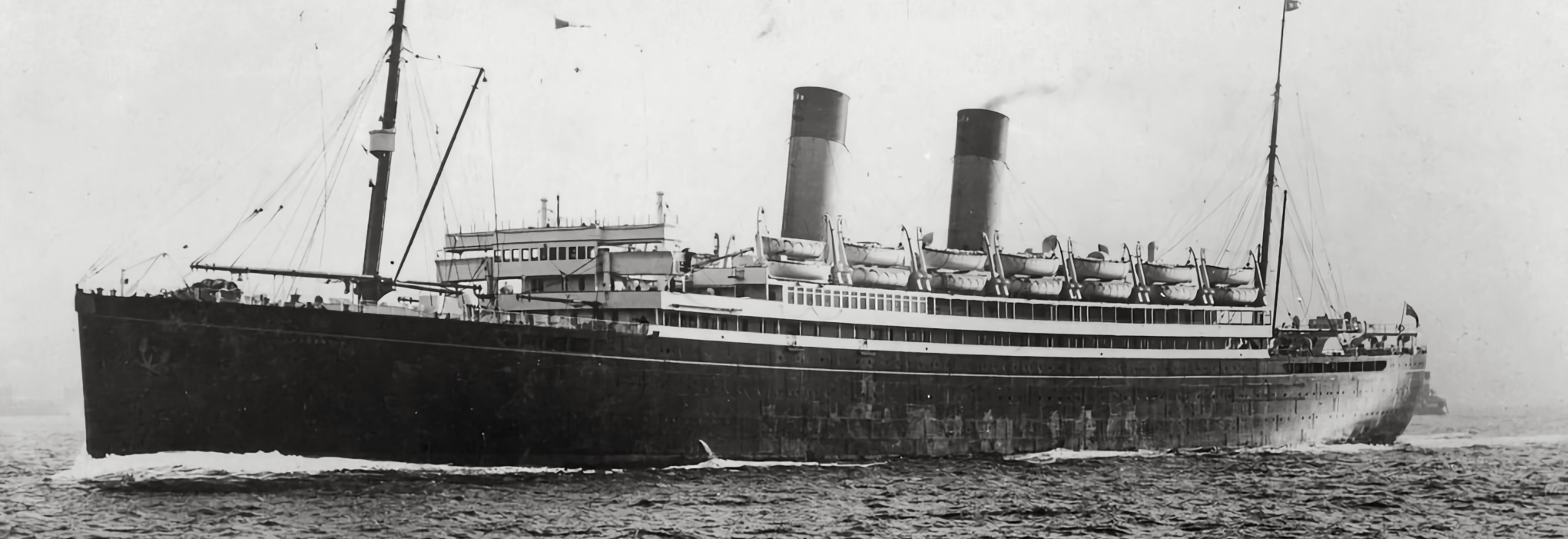
SS Laurentic
White Star Line · 1927 · Ship Guide
Overview
SS Laurentic was the second White Star Line liner to bear that name and one of the company’s last purpose-built Canadian-service ships. Built in the late interwar period, she belonged to the practical North Atlantic passenger trade linking Liverpool with Quebec and Montreal rather than the speed-focused prestige service of the great express liners. Her significance lies in that late White Star Canada-route context, and later in her wartime conversion into an armed merchant cruiser, a role in which she was lost in 1940.
In collecting and interpretation, Laurentic is best divided into two main phases: peacetime White Star / Cunard-White Star passenger service and wartime Royal Navy service as HMS Laurentic. Material from those phases should be distinguished carefully, and the ship should also be kept separate from the earlier White Star Laurentic of 1909.
Key Facts
Technical particulars and deck counts are not always expressed identically across sources. For cataloging purposes, it is best to preserve the exact wording used by the source or artifact being cited, especially when distinguishing civilian and naval phases.
Design & Construction Context
Laurentic belonged to White Star’s later operational world, when the line was maintaining practical passenger services on secondary and Canadian North Atlantic routes rather than building giant prestige liners. She is significant as the only newbuilding designed specifically for White Star’s Canadian route from the outset, which gives her a special place in the company’s late history.
Technically, she also represented continuity rather than radical innovation. Her three-screw machinery arrangement linked her in concept to earlier White Star practice, even as the wider liner world moved increasingly toward other propulsion solutions. In that sense, Laurentic can be read as both a late White Star ship and a somewhat conservative one.
Service History (Summary)
1927: Built by Harland & Wolff at Belfast, Laurentic was launched in June 1927, completed in November, and made her maiden voyage from Liverpool to New York later that month.
1928 onward: She soon settled into the Liverpool–Quebec–Montreal trade, the service sphere that forms the core context for interpreting her peacetime passenger identity. This is the proper frame for brochures, passenger lists, luggage labels, deck plans, and commercial photography tied to White Star or later Cunard-White Star service.
1934 corporate change: With the formation of Cunard-White Star, Laurentic passed into that merged operating framework. Material from the mid-1930s may therefore reflect branding changes even though the ship and route identity remained broadly continuous.
Late civilian service: She remained part of the practical North Atlantic service world rather than the elite express-liner sphere. Her significance lies in that durable Canada-route role, not in record attempts or flagship glamour.
1939 requisition: On 26 August 1939, just before the outbreak of war, the Admiralty requisitioned the ship. She was converted into an armed merchant cruiser and commissioned as HMS Laurentic with the pennant number F51.
Wartime naval service: In naval employment she became part of Britain’s escort and patrol system rather than remaining in commercial liner service. This phase should be treated separately from her civilian passenger life.
3–4 November 1940: Responding to distress calls after the banana boat Casanare was attacked west of Bloody Foreland, HMS Laurentic and HMS Patroclus came under attack from U-99. Laurentic was struck by multiple torpedoes during the action and finally sank in the early hours of 4 November 1940.
Loss and aftermath: The sinking killed 49 of her complement, while 368 survived. She was the last White Star Line ship to be sunk, giving her an added symbolic place in the line’s long decline and disappearance.
The Second Laurentic
This ship was White Star Line's second Laurentic, launched in 1927 and entering service late that year. She should be kept rigorously separate from the earlier 1909 liner of the same name, which was lost during the First World War.
The later ship was built for practical Canadian service rather than express-liner competition. From April 1928 she worked the Liverpool–Quebec–Montreal route, and her career belongs to White Star's final generation of conventional North Atlantic passenger ships.
1935 Collision with Napier Star
On 18 August 1935, while sailing on a cruise in heavy fog in the Irish Sea, Laurentic collided with the Blue Star liner Napier Star. Contemporary reporting recorded six Laurentic crew members killed and five injured.
The collision is an important dating boundary because the ship spent much of the following period laid up. Material from 1935 onward should therefore be interpreted against a career that was already becoming commercially marginal before the Second World War.
HMS Laurentic and the 1940 Loss
Requisitioned in August 1939, the liner became the armed merchant cruiser HMS Laurentic (F51). U-boat records identify her as sunk by U-99 on 3 November 1940 after a prolonged night action in the North Atlantic.
Uboat.net records a complement of 417, with 49 dead and 368 survivors. This wartime phase belongs to a fundamentally different operating identity from her White Star and Cunard-White Star passenger service and should be cataloged separately.
Why Laurentic II Matters
Laurentic is one of the clearest end-of-era White Star ships. She entered service only a few years before the Cunard–White Star merger, spent much of the mid-1930s underused, and then disappeared into wartime naval service. Her short civilian career makes chronology especially important when interpreting surviving artifacts.
Interpretive Notes
This is a Canada-route White Star liner first: Laurentic should be understood chiefly through White Star’s Liverpool–Canada service world rather than through North Atlantic express-liner assumptions.
Do not confuse this ship with the earlier Laurentic: the 1909 and 1927 vessels have separate careers, separate technical identities, and separate collecting contexts.
Civilian and naval material belong to different interpretive worlds: passenger ephemera reflects peacetime route culture, while AMC records, battle accounts, and naval photographs belong to a wartime operational framework.
The last-White-Star-loss point is notable but should not dominate everything else: it is historically meaningful, but the ship also deserves attention as a specifically Canadian-route liner in White Star’s late fleet history.
This is a contraction-era ship: Laurentic belongs to the later period of White Star history when the company was maintaining useful route tonnage rather than projecting prestige through grand new ships.
Evidence-first ship guideSources (Selected)
- Ocean Liner Curator — Sources (master bibliography)
- SS Laurentic (1927) — overview chronology, specifications, civilian service, requisition, and sinking
- Norway Heritage — SS Laurentic (2) summary and passenger-service context
- uboat.net — HMS Laurentic loss summary and casualty figures
- White Star postwar fleet context, including Laurentic as a Canadian-route ship
- White Star Line History — Laurentic (II) chronology and White Star context
- uboat.net — HMS Laurentic (F51) loss and casualty record