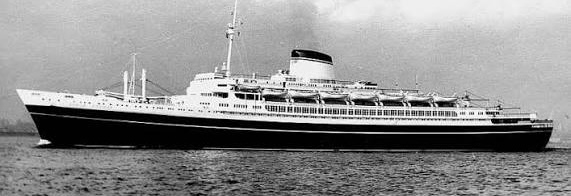
SS Leonardo da Vinci
Italian Line · 1960 · Ship Guide
Overview
SS Leonardo da Vinci was a postwar Italian Line ocean liner built to restore strength and prestige to Italy’s North Atlantic passenger service after the loss of Andrea Doria. Entering service in 1960, she operated primarily on the Genoa–Naples–New York route and became one of the major Italian liners of the late transatlantic era. Although she was rooted in the same broad service world as Cristoforo Colombo, she occupied a distinct symbolic role as the line’s answer to both commercial need and national image after a major maritime disaster.
In collecting and interpretation, Leonardo da Vinci belongs to the late classic liner period, when traditional transatlantic travel still carried prestige but increasingly faced pressure from jet aviation. Material associated with the ship often reflects a mixture of national pride, modern Italian design language, and the transition from scheduled liner service toward cruising.
Key Facts
Tonnage and capacity figures are summarized somewhat differently across quick-reference sources, especially where later cruise configurations are mixed with original liner-service figures. For cataloging purposes, retain the figures and wording used by the specific source or artifact being cited.
Design & Construction Context
Leonardo da Vinci was conceived in a moment of recovery and repositioning for the Italian Line. After the loss of Andrea Doria, the company needed not only another large liner, but a vessel that could preserve Italy’s standing on the North Atlantic route. The result was a ship that carried forward the broad service logic of the postwar Italian transatlantic liner while also signaling technical refinement, style, and national confidence.
She belonged to the late period in which ocean liners were expected to combine scheduled service respectability with increasingly flexible tourist and cruise appeal. This transitional character is central to her importance: she was still a true liner, but one operating in a world already being reshaped by air travel and changing passenger expectations.
Service History (Summary)
1958–1960: Built at Genoa and launched in December 1958, then completed for Italian Line service and placed in operation in June 1960. Her commissioning followed the 1956 loss of Andrea Doria and formed part of Italy’s effort to maintain a strong transatlantic passenger presence.
1960s: Served on the Genoa–Naples–New York route and functioned as one of the major Italian liners of the decade. In this period she operated alongside other postwar Italian Line ships and later shared the broader service world reshaped by the arrival of Michelangelo and Raffaello.
Mid-1960s onward: As jet travel further reduced the viability of scheduled liner crossings, Leonardo da Vinci increasingly occupied a mixed role, combining transatlantic identity with more cruise-oriented deployment.
1970s: Continued service into the final phase of the Italian Line’s classic passenger era. She became one of the last important Italian liners still associated with North Atlantic service and transitional cruise operation as the traditional route system contracted.
1978–1982: Withdrawn from regular service and laid up. In 1980 she was badly damaged by fire while out of service, and the ship was ultimately scrapped in 1982.
Replacement After Andrea Doria
Leonardo da Vinci was ordered in the aftermath of the 1956 loss of Andrea Doria. She was not a sister replacement in the literal sense, but she filled the commercial and symbolic gap left in the Italian Line's North Atlantic fleet.
The ship therefore carried a burden beyond ordinary route economics. Her public image was tied to technological competence, national design, and the need to demonstrate continuity after one of the best-known passenger-ship disasters of the postwar era.
Late-Liner Economics
By the time Leonardo da Vinci entered service in 1960, jet aircraft were already transforming transatlantic travel. She continued scheduled service, but the economics that had justified large passenger liners were changing rapidly.
After the arrival of Michelangelo and Raffaello, Leonardo da Vinci was increasingly employed in cruising. This shift makes her career especially useful for tracing how established liner operators tried to repurpose expensive ships rather than abandon them immediately.
Lay-Up, Fire, and Disposal
After withdrawal from regular service, the ship spent extended periods laid up. A serious fire in 1980 caused major damage while she was inactive, ending realistic prospects for further passenger use.
She was ultimately scrapped in 1982. The final years contrast sharply with the optimism surrounding her introduction only two decades earlier and illustrate how quickly the commercial value of a conventional liner could collapse once the market changed.
Interpretive Notes
This is a late-era liner, not a classic interwar transatlantic giant: Leonardo da Vinci should be interpreted within the postwar and jet-age transition rather than grouped too casually with prewar Italian prestige liners such as Rex or Conte di Savoia.
Her replacement role matters: many artifacts connected to the ship implicitly carry the shadow of Andrea Doria. That context can shape advertising language, public memory, and the ship’s symbolic status in ways that go beyond her technical particulars alone.
Late-service material may blur liner and cruise identities: because the ship increasingly operated in a cruise-oriented world, later ephemera may reflect a different commercial logic from earlier scheduled transatlantic material. Those phases should be distinguished carefully in cataloging.
Evidence-first ship guideSources (Selected)
- Ocean Liner Curator — Sources (master bibliography)
- SS Leonardo da Vinci (1958) — overview chronology, specifications, and service summary
- SS Maritime — Italian Line SS Leonardo da Vinci history and illustrated service overview
- The Great Ocean Liners — SS Leonardo da Vinci article and late-liner context
- Italian Liners — Italia Flotte Riunite / Italian Line context and late passenger-era summary
- Italian Line — company background and fleet context