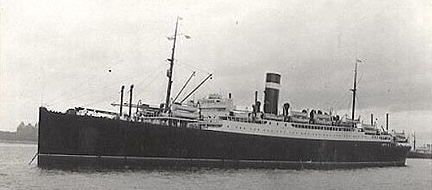
SS Letitia
Anchor-Donaldson Line · 1924 · Ship Guide
Overview
SS Letitia was an Anchor-Donaldson Line ocean liner launched in 1924 and completed in 1925 for North Atlantic service between Britain and Canada. Built at Govan by the Fairfield Shipbuilding and Engineering Company, she belonged to the practical interwar Atlantic world: comfortable cabin and tourist accommodation, substantial third-class capacity, and regular seasonal service rather than record-breaking express speed.
Letitia is especially useful as a research subject because her career passes through several sharply different identities: Anchor-Donaldson passenger liner, Donaldson Atlantic Line vessel, wartime armed merchant cruiser, troopship, hospital ship, government-owned Empire Brent, and later emigrant ship Captain Cook. A good attribution therefore needs to establish not only the ship name, but the period, operator, route, and function represented by the object or document.
This page treats Letitia as the 1924 vessel. A separate earlier Donaldson Line Letitia was built in 1912 and lost during the First World War, so dates are essential when cataloguing material under this name.
Key Facts
Note on identity: the 1924 Letitia should not be confused with the 1912 Donaldson Line Letitia, which became HMHS Letitia and was lost in 1917.
Design & Construction (Context)
Letitia was built for the Canadian trade rather than the luxury express race. Her design emphasized dependable North Atlantic service, mixed passenger accommodation, and seasonal flexibility. The ship’s profile and accommodation belong to the interwar “workhorse liner” category: important to migration, family travel, mail, cargo, and imperial or Commonwealth movement, even if less famous than the largest prestige liners.
For collectors, this makes Letitia valuable precisely because she is documentary. Passenger lists, landing cards, schedules, baggage labels, photographs, and menus can illuminate ordinary Atlantic movement between Britain and Canada. The strongest objects are those that fix a voyage, class of travel, route, or named passenger rather than simply presenting a decorative ship image.
Service History (Summary)
Entering service in 1925, Letitia operated in Anchor-Donaldson service on the Britain–Canada route. Summer service is commonly associated with Quebec and Montreal, while winter operations shifted toward ice-season ports such as Halifax and St. John. This seasonal route pattern is important when interpreting dated material, because a winter Halifax document and a summer Montreal passenger list may both be authentic to the same ship.
In the mid-1930s the corporate setting changed as Anchor-Donaldson gave way to Donaldson Atlantic Line arrangements. Printed matter from this period may therefore carry different line imprints even when referring to the same ship. A date and imprint should be preserved exactly in cataloguing rather than normalized into a single simplified operator label.
With the outbreak of the Second World War, Letitia was requisitioned and converted for naval service as an armed merchant cruiser. She later served as a troopship and then as a hospital ship. Those wartime identities created documentation that should be separated from ordinary passenger-service material, especially where medical, troop, convoy, or Admiralty records are involved.
Wartime Identity Note
Wartime Letitia material can be compelling, but it must be labelled carefully. HMS Letitia, HMHS Letitia, troopship references, hospital-ship usage, and ordinary commercial Letitia service are connected phases, not interchangeable categories. A photograph or document may be authentic to the ship while still belonging to a different operational identity than a seller claims.
A useful test is to ask what the object itself proves: ship name, military designation, date, port, unit, passenger, patient, convoy, or line imprint. If those anchors are missing, use cautious wording such as “associated with the wartime Letitia” rather than “from HMS Letitia” or “from the hospital ship.”
Postwar and Emigrant Service
After the war, Letitia continued through further identity changes. As Empire Brent and later Captain Cook, she participated in postwar movement, including emigrant traffic. This later phase is historically important, but it should not be folded back into the 1920s Anchor-Donaldson passenger-liner story unless the object clearly belongs to that earlier period.
For collection records, the later names should be treated as cross-references. A Captain Cook item may be connected to the same hull as Letitia, but it is not automatically an Anchor-Donaldson artifact. The name in use at the time of the item matters.
Collecting Profile (What Tends to Survive)
Likely surviving material includes passenger lists, postcards, shipboard menus, sailing schedules, immigration and landing documents, agency material, wartime photographs, hospital-ship references, and postwar emigrant ephemera. Because Letitia had several names and functions, cataloguing should lead with the evidence visible on the item: imprint, date, route, ship name, and operational status.
Strong attributions usually include at least one fixed anchor: Anchor-Donaldson or Donaldson Atlantic imprint, Canada route evidence, a dated voyage, military designation, hospital-ship context, or one of the later names tied to a documented postwar use. Without those anchors, a restrained description is safer than a confident claim.
From Armed Merchant Cruiser to Hospital Ship
Requisitioned at the beginning of the Second World War, Letitia initially served as an armed merchant cruiser. Experience quickly showed the limits of large passenger liners in that role, and in 1941 she was reassigned as a troopship.
After being badly damaged in 1943, she was repaired and converted for hospital-ship service in Canada. These successive wartime identities are important because photographs and official records from the period may show radically different fittings, markings, and functions while still documenting the same ship.
Empire Brent and Captain Cook
Returned to civilian control after the war, the ship was purchased by the Ministry of Transport and renamed Empire Brent. She carried troops to the Far East and later emigrants to Australia before being laid up briefly in 1950.
Refitted again, she became Captain Cook in 1952 under charter to the Government of New Zealand, carrying emigrants between Britain and New Zealand. The New Zealand government eventually acquired the vessel outright. After final withdrawal in 1960, she was sold for demolition.
Why Letitia Matters
Few liners demonstrate functional adaptability as clearly. In one career the same hull served as a Canadian-route passenger liner, armed merchant cruiser, troopship, hospital ship, government transport, and emigrant carrier. That continuity makes chronology and naming especially important when attributing objects or photographs.
Interpretive Notes (What to Avoid)
The biggest risk is collapsing Letitia into a single name across four decades of use. The same hull moved through commercial, naval, medical, government, and emigrant roles. The ship’s significance comes partly from that continuity, but object attribution depends on keeping each phase distinct.
A second risk is confusing the 1924 Letitia with the 1912 Letitia. Both names appear in North Atlantic and wartime contexts, and both are associated with Donaldson-related history. Dates, builder, tonnage, route, and fate should be checked before any object is assigned to one vessel or the other.
Evidence-first ship guideSources (Selected)
This list is intentionally conservative.
- Ocean Liner Curator — Sources (master bibliography)
- GG Archives — SS Letitia archival collection
- Wanted on the Voyage — Donaldson Dominion Duo: T.S.S. Athenia & T.S.S. Letitia
- Wikipedia — SS Letitia (1924) (use as a pointer map; verify key claims in primary or specialist sources)
- Wikipedia — HMHS Letitia (1912) (identity caution for the earlier vessel)
- GG Archives — SS Letitia passenger lists and career summary