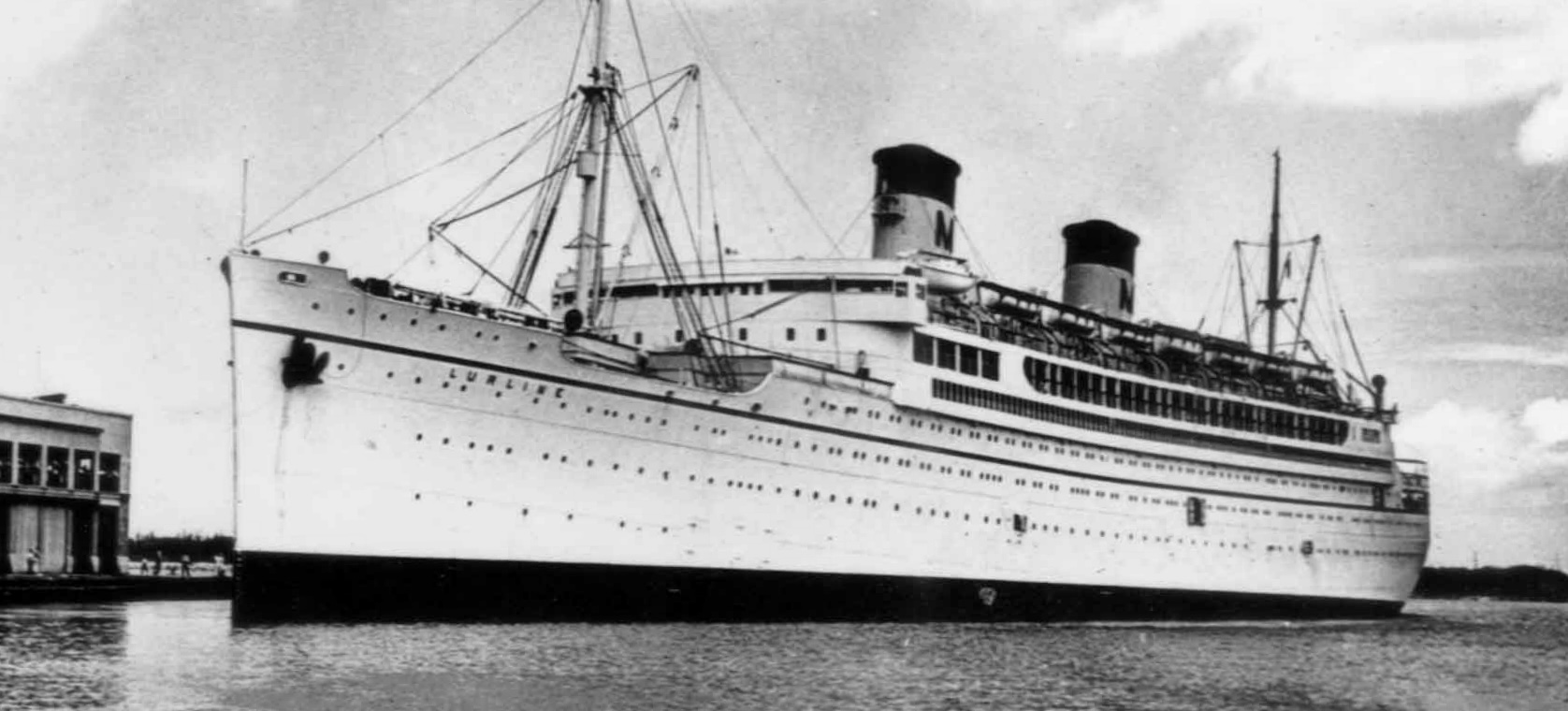
SS Lurline (1932)
Matson Line · 1933 · Ship Guide
Overview
SS Lurline (1932) was one of Matson Line’s signature “White Ships,” built for fast, luxury service between the U.S. West Coast and Hawaii. In cultural memory she is tied to the classic prewar Hawaiian vacation era—San Francisco to Honolulu with Matson’s distinctive resort marketing—yet her full life arc is broader: wartime conversion and troop transport under U.S. government control, an expensive postwar modernization, a final Matson career in the jet-age squeeze, and a long second life as a Greek cruise liner after sale and renaming as Ellinis.
For collectors, Lurline is rewarding because Matson printed identity cleanly: ship name, ports, sailing dates, and house style often appear on passenger lists, brochures, menus, sailing cards, and baggage labels. The main risk is not scarcity—it’s name reuse and era drift: Matson and later operators reused the name, and sellers often blur prewar “White Ships” romance into postwar or cruise-era objects.
Evidence-first note: “SS Lurline” can mean several different vessels across decades. This page covers the 1932-built liner (maiden voyage in January 1933), later sold to Chandris as Ellinis. Confirm your object’s era with printed dates, route wording, or operator branding before locking an attribution.
Key Facts
Design & Construction (Context)
Lurline belongs to Matson’s interwar push to make the Hawaii run feel like a first-class resort experience at sea: a fast, modern liner intended to shorten schedules and maximize comfort on a route defined by leisure rather than immigrant mass traffic. In collecting terms, that brand strategy matters: Matson ephemera often emphasizes destination imagery (Hawaii motifs), company identity, and the idea of a seamless “vacation package.”
The ship is also part of a tight “family resemblance” among Matson’s premium Pacific liners. That’s helpful for style recognition but dangerous for attribution: brochure art and souvenir graphics can simplify silhouettes. Treat any unlabeled image-based claim (“This menu is from Lurline because the ship looks like…”) as weaker than a printed ship name + date/route line.
Service History (Summary)
1933–1941: Hawaii express era. After her 12 January 1933 maiden voyage (commonly described as New York to San Francisco via Panama, followed by a Circle Pacific itinerary), Lurline settled into Matson’s marquee West Coast–Hawaii service. This is the peak “collectible” era for classic pieces: passenger lists, menus, brochures, deck plans, stationery, and luggage labels—often richly designed and strongly branded.
1941–1946: Wartime service. With U.S. entry into World War II, the ship was taken into government service and used as a troop transport. Documents from this era can be compelling, but they’re also where seller narratives tend to outpace object evidence. Prefer items that self-document: dated letters, troopship movement notices, official headers, or photographs with clear captions.
1947–1963: Postwar refit and final Matson career. Returned to Matson in 1946, Lurline underwent major modernization in 1947 and is commonly cited as resuming Hawaii service in April 1948. The postwar period produces a different paper trail—more “modern travel” typography, different class language, and sometimes more standardized printing. These pieces are still legitimate Lurline artifacts; they’re just not 1930s.
1963–1987: Chandris era as Ellinis. After engine trouble and the economic pressure of jet travel, Matson sold the ship in 1963. Under Chandris she sailed as Ellinis and developed a long cruise-service afterlife, including Australasia itineraries. Many attractive souvenirs from this era exist, but they should be cataloged under the correct operator and name rather than retro-labeled “Matson White Ship” material.
Interpretive Notes
Lurline is a frequent listing keyword, so disciplined attribution pays off. The most common issues are: (1) multiple ships named Lurline, (2) the 1963 Matson name-swap (Matson reused the name on another ship), and (3) “Hawaii nostalgia” used to sell later items.
Practical checks:
1) Printed date + ports: “San Francisco–Honolulu” plus a dated sailing line is a high-value anchor.
2) Operator branding: “Matson Navigation Co.” versus “Chandris” / “Ellinis” branding separates eras cleanly.
3) Name on the object: If it says Ellinis, catalog it as Ellinis—do not “upgrade” it back to Lurline for romance.
4) Silhouette-only proof is weak: Art and photos can mislead; printed ship name beats visual similarity.
Sources (Selected)
Use these as a starting index; for technical particulars, corroborate against registers and contemporary Matson materials where possible.
- Ocean Liner Curator — Sources (master bibliography)
- Wikipedia — SS Lurline (1932) (starting index; verify against registers)
- SS Maritime — Ellinis / ex-Lurline narrative (compiled; cross-check)
- ShipIndex — SS Lurline (bibliographic index; useful for chasing stronger references)
- Shipping Today & Yesterday — Matson Lines overview (context on sale/renaming; cross-check)