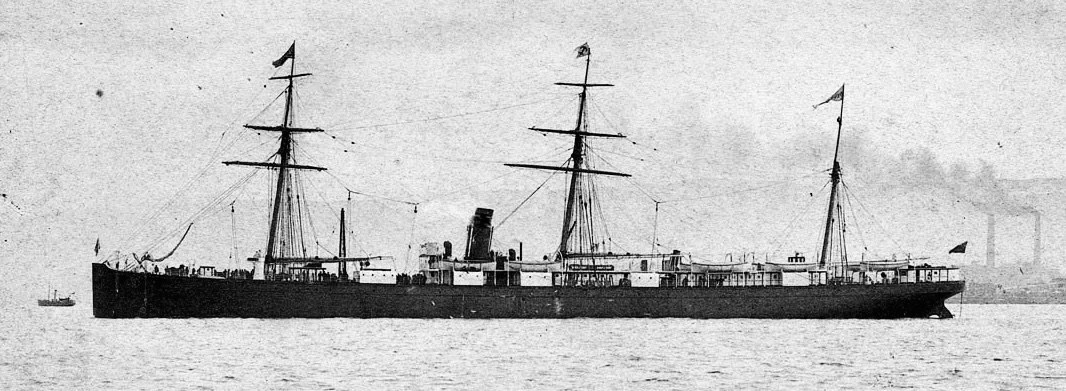
SS Macedonia
Anchor Line · renamed 1873 · Ship Guide
Overview
SS Macedonia was the Anchor Line name of an older steamship whose career began as SS Iowa. The previous guide incorrectly attributed the hull to Sir James Laing & Sons and placed construction in the mid-1860s. Norway Heritage’s compiled fleet record instead identifies the vessel as built at Waterford by Malcolmson & Co., launched on 28 November 1863, and entering service in 1864 before Anchor acquired her in 1866.
Anchor renamed the ship Macedonia in December 1873 and modernized her with new machinery. She continued in North Atlantic service until wrecked north of the Mull of Kintyre on 30 May 1881 while homeward bound from New York to Glasgow.
Key Facts
Iowa Before Anchor Line
The hull’s story begins before Anchor Line. Launched as Iowa in 1863 for London–New York service, she made her maiden voyage from London via Havre in July 1864. Later that year she stranded near Cherbourg and required recovery and repair before returning to service.
This pre-Anchor phase matters because records marked Iowa are not unrelated material: they document the same physical vessel before the later Scottish ownership and name change.
Anchor Acquisition in 1866
Anchor acquired the ship on 28 June 1866 and placed her on a Glasgow–New York voyage only days later. That move tied the hull to Anchor’s expanding transatlantic system years before the name Macedonia appeared.
For curatorial practice, “Anchor Line Iowa” and “Anchor Line Macedonia” should therefore be treated as two chronological identities within one ownership history.
Renaming and Machinery Changes
In December 1873 the vessel was renamed Macedonia. Norway Heritage’s record gives a revised tonnage and notes new machinery, followed by compound-engine work by D. & W. Henderson in 1874.
This refit phase changes the interpretation of technical descriptions. Specifications drawn from the original Iowa period should not automatically be applied to the later Macedonia.
North Atlantic Working Service
As Macedonia, the ship belonged to the practical Glasgow–New York trade, carrying passengers, cargo, emigrants, livestock, and mail. Her history survives most strongly in operational records rather than in luxury publicity.
That makes her an especially useful case for evidence-first research: fleet lists, passenger records, sailing notices, and wreck reports can reconstruct a career that decorative souvenir material barely represents.
Wreck at the Mull of Kintyre
On 30 May 1881, homeward bound from New York to Glasgow, Macedonia was wrecked near the Mull of Kintyre. Later accounts describe fog, grounding, salvage activity, and the safe escape of those aboard.
The casualty belongs to the final phase of a hull that had already accumulated nearly two decades of service under two names and different machinery configurations.
Passenger, Cargo, and Livestock Traffic
The Anchor Line phase belongs to a mixed commercial world in which emigrants, cabin passengers, freight, livestock, and mail could all share the same voyage economy. That context helps explain why surviving records for Macedonia are often practical rather than glamorous. Shipping notices, cattlemen references, cargo lists, and immigration records are not peripheral evidence; they are central to understanding what the ship did.
The 1881 Casualty Record
Later summaries of the Mull of Kintyre wreck preserve details of general cargo, American produce, cattle, crew, and cattlemen aboard on the final homeward passage. Salvage efforts removed livestock, valuables, papers, and other material before the wreck deteriorated further. The formal inquiry later criticized navigation and imposed a temporary suspension on the master’s certificate.
For collections, “wreck material” should be treated cautiously. Contemporary press, inquiry records, salvage documents, and photographs can be associated securely with the casualty; physical objects claimed to have been recovered from the wreck require independent provenance.
Collecting Across Iowa and Macedonia
An object dated before December 1873 should normally remain under Iowa, even if a modern collector knows the hull later became Macedonia. Post-renaming records should use Macedonia, with “ex-Iowa” added when useful. Preserving both names makes the ownership and modernization sequence visible instead of flattening the hull’s biography.
Identity Errors in Secondary Sources
The former guide’s incorrect builder attribution illustrates a broader problem with reused ship names: later fleet summaries can merge data from unrelated vessels. Anchor’s Macedonia should be checked against the Iowa chronology, official number, route, and 1881 wreck before technical details are accepted.
Why Macedonia Matters
Macedonia matters because her corrected history shows how easily a nineteenth-century ship can be misdescribed when a later operating name is treated as if it were the original construction identity.
The safest catalog label is “SS Macedonia, ex-SS Iowa,” with the date attached. Before December 1873, the primary name should remain Iowa.
Evidence-first ship guideSources (Selected)
This list is intentionally conservative.