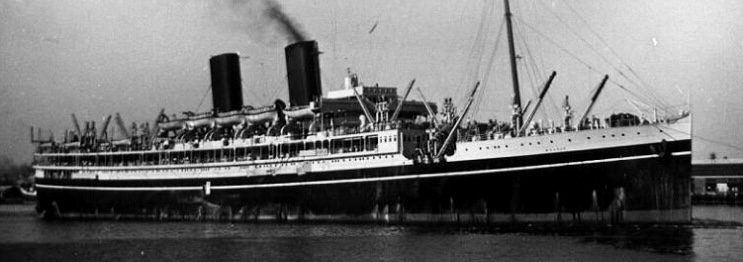
RMS Maloja (1923)
P&O · entered service 1923 · Ship Guide
Overview
SS Maloja was one of P&O’s major post-First World War liners on the long route from Britain to India, China, and Australia, and a close sister to Mooltan. The pair were deliberately sized for Suez and used quadruple-expansion machinery for dependable long-route service. Built at Belfast as part of the company’s fleet renewal, she was among the largest P&O ships of her day and represented the firm’s continued commitment to long-distance imperial passenger service rather than Atlantic speed rivalry. Her career later passed through important technical modification, wartime naval and troopship duty, and a final postwar phase in one-class tourist and emigrant service.
In collecting and interpretation, Maloja is best divided into four phases: early two-class liner service, post-1930 rebuilt service, wartime armed merchant-cruiser and troopship service, and postwar one-class tourist/emigrant service. Material from those phases should be identified carefully rather than folded into a single undifferentiated ship identity.
Key Facts
Some figures vary slightly depending on whether a source describes the ship before or after her 1930 machinery modification, or whether it uses registry and route-service figures from different moments in her career. For cataloging purposes, preserve the exact wording and service phase used by the source or artifact being cited.
Design & Construction Context
Maloja belongs to P&O’s postwar rebuilding of its long-haul passenger fleet. She was not intended for a North Atlantic speed contest; instead, she was designed for steady and dependable service across the much longer imperial mail and passenger route to India, China, and Australia. That route identity is central to understanding the ship.
She is also interesting as part of a technological transition. Though built with large reciprocating steam engines, she later received Bauer-Wach exhaust turbines, which improved performance without completely replacing the original machinery. This makes her a useful example of interwar adaptation rather than total mechanical reinvention.
Service History (Summary)
1918–1923: Ordered after the First World War and built by Harland & Wolff at Belfast, Maloja was launched in April 1923 and completed in October of that year. She entered service soon afterward as one of P&O’s largest ships.
1923–1924 early service: After her initial late-1923 sailing, she began the long Britain–Australia route work for which she had been built. This is the correct context for early P&O passenger lists, mail-route references, and company literature tied to her two-class service.
1920s peacetime role: In her early career, Maloja served the India–China–Australia mail and passenger network rather than the Atlantic trade. She should therefore be read within the imperial-route world of Tilbury, Colombo, Melbourne, and Sydney, not through Atlantic prestige assumptions.
1930 machinery modification: In 1930 the ship was fitted with Bauer-Wach exhaust turbines, improving her speed and marking an important dividing line between her original and later prewar technical forms. For specifications, photographs, and engineering discussion, this change matters.
1939–1941 wartime naval phase: Requisitioned at the outbreak of the Second World War, Maloja was converted into an armed merchant cruiser. In this phase she belonged to a naval auxiliary world rather than a passenger-liner one.
1941–1947 troopship phase: She later passed from armed merchant-cruiser work into troop transport duty. This wartime service became a major part of her career and should be treated separately from her earlier civilian identity.
1948 postwar return: After the war, Maloja returned to service as a one-class tourist and emigrant ship. In this final phase she reflected the changed economics of long-distance sea travel, especially migration to Australia, rather than the prewar first- and second-class structure.
Final years: She continued this postwar role into the early 1950s, completed her final voyage in early 1954, and was then sold for breaking up.
Interpretive Notes
A Britain–India–Australia liner first: Maloja should be interpreted primarily through the P&O imperial-route system, not as an Atlantic-type liner.
The 1930 machinery change matters: early and later prewar technical descriptions may not be describing quite the same performance profile. That distinction is useful when dating engineering references or comparing sources.
Wartime and peacetime material belong to different worlds: naval auxiliary records and troopship references should not be folded uncritically into the same category as passenger brochures, menus, passenger lists, and route ephemera.
Postwar material reflects migration and tourist travel rather than interwar hierarchy: after her return to service, Maloja no longer represented the same social structure as in the 1920s. Late-career material belongs to a distinct postwar passenger economy.
Evidence-first ship guide