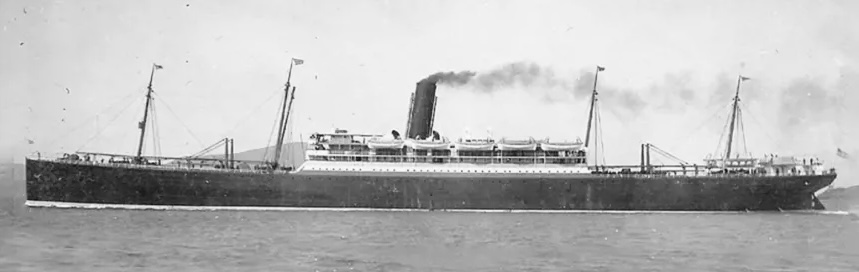
SS Manchuria
Pacific Mail Steamship Company · entered service 1904 · Ship Guide
Overview
SS Manchuria was a large American-built passenger and cargo liner launched in 1903 for the Pacific Mail Steamship Company’s transpacific service. Built by New York Shipbuilding at Camden, New Jersey, she and her sister Mongolia belonged to an ambitious generation of American liners intended for the San Francisco–Honolulu–Yokohama–Hong Kong–Manila trade.
Her career did not remain confined to one route or one identity. She served in Pacific Mail colors, passed into International Mercantile Marine interests, became a United States Navy transport during the First World War as USS Manchuria (ID-1633), returned to civilian service, was renamed President Johnson under Dollar Line and American President Lines, and later sailed under the name Santa Cruz before being scrapped in 1952.
This page treats Manchuria as the Pacific Mail steamship launched in 1903, later USS Manchuria, President Johnson, and Santa Cruz. Because several ships carried related or similar names, builder, route, date, and ownership should be checked before attributing ephemera or photographs.
Key Facts
Note on figures: tonnage and dimensions vary slightly between ship lists, registers, and later summaries. For cataloging, record the exact figure and source used.
Design & Construction Context
Manchuria was part of a major American transpacific building program at the beginning of the twentieth century. Her steel hull, twin screws, large steerage capacity, and mixed passenger-cargo role reflect the demands of a route that combined mails, migration, trade, colonial administration, and elite travel between the United States and East Asia.
Although she was not a North Atlantic express liner, Manchuria belongs firmly within ocean-liner history. Scheduled ocean service was not limited to Liverpool, Southampton, New York, and Cherbourg. The Pacific liner routes also shaped migration, diplomacy, commerce, and imperial networks, and Manchuria is a useful example of that broader geography.
Early Pacific Mail Service
In early service, Manchuria worked the Pacific Mail route from San Francisco across the Pacific, commonly associated with Honolulu, Yokohama, Hong Kong, and Manila. This placed her in a world of American expansion after the Spanish-American War, growing Pacific trade, and regular steamship links between the continental United States and newly important Pacific territories and ports.
One of the most historically visible episodes in her early career came in 1905, when she carried the Taft diplomatic party from San Francisco. Such episodes should be treated as documented historical associations rather than as the whole meaning of the ship; most of her working life was built from scheduled voyages, passenger movements, cargo carriage, and ordinary operational work.
1906 Grounding off Oahu
Manchuria grounded off Oahu in August 1906. The incident required removal of passengers, mail, and cargo and led to an extended salvage effort. In research terms, the grounding is important because it generated official, legal, newspaper, and salvage-related evidence that can help anchor dates, locations, and contemporary descriptions of the vessel.
Any item claimed to be associated with the 1906 grounding should be assessed cautiously. A postcard showing the ship, for example, is not automatically a grounding artifact. Stronger evidence would include dated correspondence, a contemporary newspaper clipping, a passenger or crew connection, a salvage record, or a chain of custody that can be tested.
World War I Transport Service
During the First World War, Manchuria was taken into United States Navy service as USS Manchuria (ID-1633). She was commissioned in April 1918 and served with the Cruiser and Transport Force, carrying troops across the Atlantic and later helping return American service members from Europe.
Wartime photographs of Manchuria can look quite different from commercial passenger material. Crowded decks, naval identifiers, convoy context, and troop-transport references should be read as part of her temporary military service rather than her original Pacific Mail identity.
Interwar Reuse and Renaming
After the war, Manchuria returned to civilian service and later operated in Atlantic and intercoastal contexts. In 1928 she was renamed President Johnson and refitted for Dollar Line service, including around-the-world travel. This was not simply a new paint scheme; the refit and new service pattern placed an older Pacific Mail liner into a different commercial story.
For researchers, this means that Manchuria material and President Johnson material may refer to the same hull but not the same operating identity. Catalog records should preserve both facts: the original ship identity and the name actually present on the document or object.
World War II and Later Career
Under the President Johnson name, the former Manchuria was again used as a transport during the Second World War, operated under wartime shipping arrangements. After the war she was sold, renamed Santa Cruz, and adapted for postwar civilian work before final scrapping in Italy in 1952.
Her long life makes her a useful case study in maritime reuse. A ship built for Pacific Mail’s transpacific route could become a Navy transport, an interwar passenger liner, a round-the-world vessel, a wartime transport again, and finally a postwar emigrant or general-service ship under another name.
Passenger Lists & Documentary Evidence
Passenger lists, cabin plans, sailing cards, menus, and postcards connected to Manchuria are especially valuable when they preserve route and date. A manifest or sailing notice may identify not only the ship but also the direction of travel, master, company, port sequence, and class structure.
Because Manchuria moved through multiple owners and names, evidence should be read in layers. A 1906 Pacific Mail item, a 1919 USS Manchuria photograph, a 1930 President Johnson brochure, and a postwar Santa Cruz reference may all belong to the same physical vessel, but each belongs to a distinct historical setting.
Collecting Profile
Collectible material may include Pacific Mail postcards, passenger lists, cabin plans, ephemera from the transpacific route, wartime transport photographs, Dollar Line or American President Lines material under the President Johnson name, and postwar references to Santa Cruz. The strongest pieces will usually be those that identify the ship by name and place her in a specific voyage, route, or service phase.
Avoid collapsing all identities into one label. A collector description such as “SS Manchuria, later President Johnson” is often useful, but the object’s own printed identity should remain primary. Evidence-first cataloging keeps the original wording visible instead of modernizing every item into a single preferred name.
Interpretive Notes
Manchuria broadens the ocean-liner story beyond the North Atlantic. She connects American shipbuilding, Pacific migration, diplomatic travel, naval transport, interwar cruising, and wartime logistics. Her significance lies less in luxury mythology than in the way one hull passed through many systems of twentieth-century movement.
Her value as a research subject also lies in continuity across radically different systems: Pacific Mail commerce, U.S. naval mobilization, Dollar Line passenger service, and later wartime transport all reused the same hull for different institutional purposes. That continuity makes dated operator evidence especially important.
Evidence-first ship guide