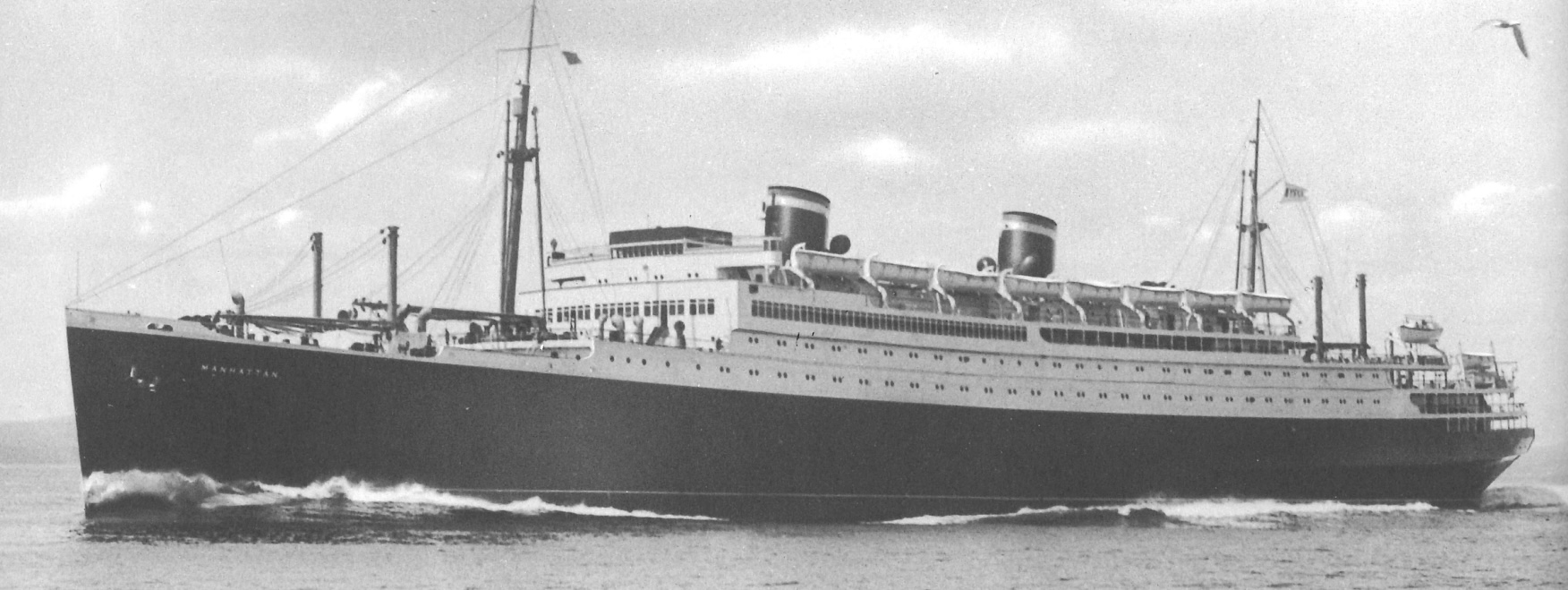
SS Manhattan (1932)
United States Lines · entered service 1932 · Ship Guide
Overview
SS Manhattan entered service in 1932 as one of the largest passenger liners yet built in the United States and one of United States Lines’ clearest interwar statements of national shipping ambition. Built by New York Shipbuilding Corporation at Camden, New Jersey, she paired American construction with a regular North Atlantic role at a moment when immigration restrictions, the Depression, and growing state involvement were reshaping the passenger business.
Her second life was even more consequential. Chartered by the U.S. government in 1941, renamed USS Wakefield (AP-21), bomb-damaged at Singapore, devastated by fire in 1942, and then almost completely rebuilt, the same hull became a major wartime troop transport. The passenger liner and the naval transport should be treated as two distinct documentary phases.
Key Facts
An American Interwar Flagship
Manhattan and Washington were built to give United States Lines modern, American-built tonnage for the North Atlantic. They were not record-breaking greyhounds in the classic prewar sense, but they were fast enough for competitive schedules and substantial enough to carry national symbolism. Their scale, streamlined public image, and modern interiors made them useful evidence of an American shipping industry trying to reassert itself between the wars.
On her maiden voyage in August 1932, Manhattan reached Hamburg after a ten-day eastbound passage. The return trip to New York took 5 days, 14 hours, and 28 minutes, which Naval History and Heritage Command records as a passenger-liner record and part of the publicity behind her “fastest cabin ship” reputation.
From Depression-Era Liner to Crisis Ship
During the 1930s, Manhattan maintained regular North Atlantic service while political conditions in Europe became increasingly unstable. During the Munich crisis in September 1938, she turned away from Hamburg and called at British and French ports to bring anxious Americans home. After war began, she made altered Mediterranean voyages and in July 1940 carried American nationals back from Portugal.
As neutral commercial service became more difficult, she was withdrawn from her normal Atlantic role and sent into intercoastal service between New York and California via the Panama Canal. In February 1941 she grounded off West Palm Beach and had to be lightened before tugs could free her. The episode marked the end of her normal passenger-liner career almost as clearly as the formal government charter that followed.
USS Wakefield and Singapore
The government chartered the ship on 6 June 1941 and renamed her USS Wakefield, AP-21. Her new function was mass transport rather than commercial passenger service. In January 1942 she reached Singapore with troops during the desperate final weeks before the colony fell.
On 30 January Japanese bombers attacked the harbor. A bomb penetrated Wakefield and exploded in sick-bay spaces, killing five people and wounding nine. The ship nevertheless embarked evacuees, sailed for Ceylon, then continued to Bombay for temporary repairs before returning to the United States.
The 1942 Fire and Near-Reconstruction
On 3 September 1942, while returning from Britain with convoy TA-18, a major fire broke out deep within Wakefield. Passengers and nonessential crew were removed to accompanying warships while salvage parties fought to save the vessel. Tugs eventually grounded her near Halifax so firefighting and stabilization could continue.
The damage was so severe that the ship was declared a constructive total loss. Rather than abandon her, the Navy purchased the hulk on 18 September 1942 and stripped it down for an extraordinary rebuilding. The resulting transport retained the identity and basic hull of the former Manhattan, but much of what emerged was effectively a new wartime ship built on the surviving structure.
Postwar Reserve and Disposal
Wakefield continued transport work through the war and into the immediate postwar movement of personnel. She did not return to United States Lines passenger service. Instead, the rebuilt transport entered reserve, surviving long after the glamorous commercial world in which Manhattan had been introduced.
For curatorial work, this makes late photographs especially easy to misread. A post-rebuild USS Wakefield view should not be used uncritically to illustrate the 1932 passenger liner, even though both names refer to the same underlying hull.
Why Manhattan Matters
Manhattan matters because her history compresses the changing purpose of American passenger shipping into one vessel: commercial prestige, repatriation and emergency transport, military requisition, catastrophe, reconstruction, and long reserve service.
Collectors should separate United States Lines material from USS Wakefield documentation. Route blocks, line branding, naval hull designation AP-21, and post-1942 physical changes are stronger attribution tools than the hull’s continuous identity alone.
Evidence-first ship guideSources (Selected)
Corroborate specifications and dates across multiple references (builder data, registers, and contemporary press), especially for “commonly cited” figures.
- Ocean Liner Curator — Sources (master bibliography)
- Naval History and Heritage Command — USS Wakefield (AP-21), DANFS
- United States Lines contemporary sailing literature and passenger-service ephemera