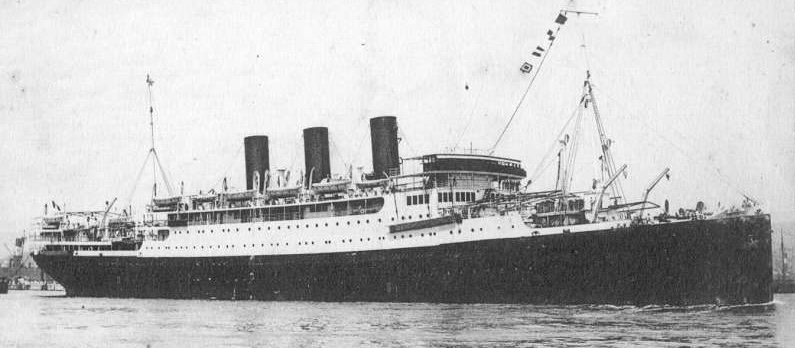
SS Mariette Pacha (1926)
Messageries Maritimes · entered service 1926 · Ship Guide
Overview
SS Mariette Pacha was a fast Messageries Maritimes mail and passenger liner built at La Ciotat for the Marseille–Alexandria–Beirut service. Launched in February 1925 and entering service in September 1926, she was the sister ship of Champollion and shared the same basic dimensions, machinery, and three-funnel profile.
The sisters later diverged sharply. Champollion underwent a major 1934 lengthening and modernization; Mariette Pacha did not. She retained the original straight stem, three funnels, and approximately 16-knot performance for the rest of her career. Requisitioned in 1939, she served as a troop transport through the early war years and was ultimately scuttled by explosives in Marseille on 21 August 1944.
Key Facts
The Egypt–Syria Route
Mariette Pacha was built for Messageries Maritimes' fast Levant service linking Marseille with Alexandria and Beirut. The route served travellers moving between France, Egypt, Palestine, Syria, and Lebanon and formed part of a dense Mediterranean passenger network largely separate from the better-known North Atlantic liner world.
Her first scheduled departure followed an initial cruise along the Spanish coast. From 1926 onward she operated as one of the principal ships on the route alongside Champollion.
Egyptian-Inspired Interiors
The ship's interiors were deliberately tied to the geography of the service. Decorative schemes in first class drew heavily on Egyptian imagery, producing one of the more distinctive French liner interiors of the interwar period. French Lines has specifically highlighted the ship's surviving model and the richness of her Egypt-inspired decoration.
First-class spaces included luxury suites, dining rooms, a music salon, winter garden, smoking room, children's room, galleries, and promenade areas. Second and third class had dedicated accommodation of their own. The result was a route-specific visual identity rather than a generic luxury interior transplanted from another service.
Why Mariette Pacha and Champollion Diverged
The most important physical distinction between the sisters came in 1934. Champollion was lengthened, given a new bow, and fitted with additional turbine machinery that increased her speed. Mariette Pacha was left substantially as built.
That decision preserved her original straight stem and three-funnel silhouette. For photographic attribution, the pair therefore became increasingly easy to distinguish after 1934: Champollion developed a markedly altered profile, while Mariette Pacha remained visually close to the original 1920s design.
Neutrality and the Spanish Civil War
Photographs from the late 1930s show Mariette Pacha carrying conspicuous French tricolour markings on the hull during the Spanish Civil War. Such markings were intended to identify a neutral French merchant ship clearly from the air and at sea.
This visual detail is especially valuable for dating photographs. A hull carrying oversized national markings belongs to a specific political and operational context rather than the normal peacetime appearance of the ship.
The 1939 Collision with Chenonceaux
After the outbreak of the Second World War, Mariette Pacha was requisitioned as a troop transport. On 22 September 1939 she was sailing in Convoy L3 from Oran toward the Levant when the convoy crossed Convoy L1 in darkness.
Mariette Pacha collided with the Messageries Maritimes ship Chenonceaux. The accident caused eleven deaths according to the company archive and damaged the ships, although Mariette Pacha survived and returned to service after repairs.
War in the Mediterranean
The ship's wartime movements repeatedly placed her close to major events. In June 1940 she carried troops and material from Marseille toward North Africa. On 3 July she was at Oran during the British attack on Mers-el-Kébir but escaped damage.
On 27 November 1940, while returning from Beirut with Champollion, she was caught near Sardinia during a naval engagement between British and Italian forces. Again, she survived. In August 1941 she sailed from Toulon toward the Levant in connection with the repatriation of Vichy French troops from Syria.
Axis Transfer and Immobilization
In January 1943 Mariette Pacha was among French merchant ships formally ceded to the Axis under the Laval–Kaufmann agreements. The administrative transfer did not become a normal German-operated career: the ship remained laid up rather than entering sustained Axis service.
She spent periods immobilized at Sète and Port-de-Bouc as the military situation in southern France deteriorated.
Destruction at Marseille
German forces moved Mariette Pacha in July 1944 during preparations for the defence and eventual abandonment of Marseille. On 21 August she was scuttled with explosives in the harbour, the blasts cutting the hull in two.
The destruction ended an eighteen-year career that had begun as a refined Levant passenger service and ended as part of the devastated wartime port infrastructure of southern France.
Why Mariette Pacha Matters
Mariette Pacha is valuable precisely because she remained comparatively unchanged while her sister evolved. Studied alongside Champollion, she preserves the original form of the class and makes the 1934 modernization of her sister much easier to understand.
She also broadens the history of French liners beyond prestige Atlantic ships. Her world was Marseille, Alexandria, Beirut, troop convoys, colonial and regional traffic, and the eastern Mediterranean.
Collecting Profile
Surviving material is unusually rich. Messageries Maritimes collections preserve dozens of exterior and interior photographs, including first-, second-, and third-class spaces, wartime markings, collision damage, and views in Middle Eastern ports.
Because the ship retained her original profile, photographs can often be dated through context rather than major structural changes: hull markings, port location, wartime paint, and visible collision damage are especially useful clues.
Interpretive Notes
Do not transfer Champollion's 1934 specifications to Mariette Pacha: the sister ship was not lengthened or similarly re-engined.
Wartime ownership language needs precision: formal Axis transfer in 1943 did not amount to a normal operational German career.
The 1939 collision is part of her own service history: it should not be confused with the later 1952 loss of Champollion.
Evidence-first ship guideSources (Selected)
- Ocean Liner Curator — Sources (master bibliography)
- Encyclopédie des Messageries Maritimes — Mariette Pacha specifications, career, and interior photographs
- Encyclopédie des Messageries Maritimes — sister ship Champollion and the 1934 divergence
- French Lines & Cies — model and Egyptian-inspired interior context
- Contemporary French press extracts — construction and 1926 trials