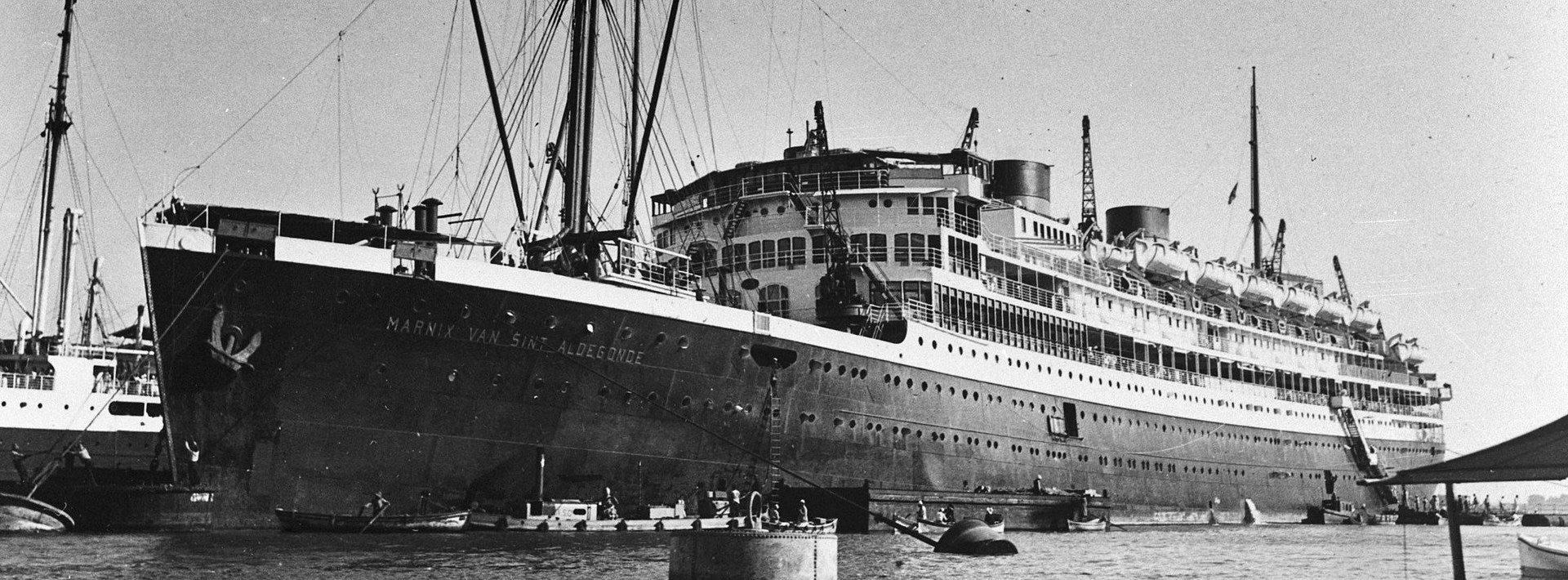
MS Marnix Van St Aldegonde
Netherland Line · 1930 · Ship Guide
Overview
MS Marnix Van St Aldegonde was a large Dutch passenger and cargo liner built for the Netherland Line’s long Amsterdam–Dutch East Indies service. She belonged to the interwar generation of modern motor liners that emphasized diesel propulsion, commercial versatility, and long-range imperial-route operation rather than North Atlantic speed competition. Her peacetime career linked the Netherlands with Southeast Asia, and her wartime life as a troopship brought her into Allied convoy service far from her original commercial world.
For the wider engineering context of motor liners and changing propulsion systems, see Propulsion and Machinery in the Liner Age.
In collecting and interpretation, Marnix Van St Aldegonde is best divided into three main phases: peacetime Amsterdam–Dutch East Indies liner service, late prewar lay-up and regional repositioning, and wartime troopship service. Material from those phases should be distinguished carefully rather than treated as a single undifferentiated ship identity.
Key Facts
Published dimensions and accommodation figures vary somewhat across technical summaries and service references. For cataloging purposes, preserve the exact wording used by the original source or artifact when possible, especially when distinguishing peacetime passenger service from wartime troop transport use.
Design & Construction Context
Marnix Van St Aldegonde belonged to the interwar Dutch motor-liner generation built for the long route between the Netherlands and the Dutch East Indies. This was a very different operating world from the North Atlantic express trade: the ship’s significance lies in long-distance colonial-route service, passenger and cargo flexibility, and modern diesel efficiency. She should therefore be understood primarily within the Amsterdam–Java imperial-route system rather than through Atlantic prestige comparisons.
She was also part of a broader Dutch fleet-renewal moment that included other substantial liners built to maintain commercial and passenger links with Southeast Asia, including Johan van Oldenbarnevelt, built immediately before her at the same Amsterdam yard for the same Netherland Line route system. In curatorial terms, she represents the mature interwar Netherlands–East Indies liner world at or near its high point before wartime disruption.
Service History (Summary)
1928–1930: Built at Amsterdam by NSM, Marnix Van St Aldegonde was laid down in 1928, launched in December 1929, completed in September 1930, and began her maiden voyage the following month.
Peacetime liner service: In her original role she served the route between Amsterdam and the Dutch East Indies. This is the proper interpretive frame for passenger lists, brochures, menus, deck plans, luggage labels, and commercial photography tied to her civilian identity.
Late prewar shift: By 1940 she was operating out of Surabaya, reflecting the altered geography of Dutch shipping as European war conditions changed the position of ships in service. Material from this late prewar phase may differ in route emphasis from earlier Amsterdam-origin printed matter.
1941 wartime conversion: At Singapore in May 1941 she was requisitioned as a troopship. From that point onward, references to the vessel increasingly belong to a military transport framework rather than a civilian passenger one.
Wartime transport service: In troopship use she carried Australian and Allied forces between the Indian Ocean, the Middle East, and later the Mediterranean theater. She also carried Italian prisoners of war on at least one wartime movement.
1942–1943 Allied operations: After leaving the Indian Ocean service world, she was employed in major Allied troop movements linked to operations in North Africa, Sicily, and Italy. This later wartime phase is central to her surviving memory.
6 November 1943: While in convoy KMF 25 in the Mediterranean, she was attacked by German Dornier torpedo bombers and hit, flooding the engine room. All personnel were rescued from the ship.
7 November 1943: While under tow after the attack, she collided with another damaged vessel also being towed and then sank from progressive flooding. Her loss thus belongs to a compound wartime disaster rather than to a simple one-stage sinking narrative.
Colonial Route and Wartime Requisition
Marnix van Sint Aldegonde was built for the Netherlands–Dutch East Indies passenger and cargo trade, a long-distance route that depended on diesel endurance and substantial cargo capacity as much as passenger accommodation.
The war broke that commercial pattern completely. Requisitioned as a troopship in 1941, she carried Allied personnel across the Indian Ocean and later supported major Mediterranean operations, including the North African and Italian campaigns.
The 1943 Loss
On 6 November 1943, while sailing in convoy KMF 25 in the Mediterranean, Marnix van Sint Aldegonde was struck by an aerial torpedo. Her personnel were evacuated and the disabled ship taken in tow.
Progressive flooding continued, and the following day she collided while under tow with the similarly damaged Santa Elena. Both ships were ultimately lost. The evacuation of those aboard before the sinking is an important part of the casualty context.
Why the Wartime Phase Matters
The ship's wartime record should not be treated as an appendix to her liner career. It placed the same hull in a radically different operating system of convoys, military loading, anti-aircraft defense, and emergency movement across multiple theaters.
Interpretive Notes
This is a Dutch East Indies liner first: Marnix Van St Aldegonde should be understood chiefly within the Amsterdam–Java / Dutch East Indies service world, not through North Atlantic assumptions.
Passenger and troopship material belong to different interpretive worlds: commercial ephemera reflects peacetime colonial-route travel culture, while wartime records concern Allied logistics, convoy service, and ship loss.
Source spelling varies: many references use Marnix van Sint Aldegonde rather than “St Aldegonde.” For indexing and cataloging, this is worth cross-referencing so material is not split artificially.
Late-service geography matters: Amsterdam-origin artifacts, Surabaya references, Indian Ocean troopship records, and Mediterranean convoy material belong to quite different phases and should be dated with care.
The loss was operationally complex: because the ship survived the initial hit, was evacuated, taken in tow, and then sank later, accounts may describe the disaster slightly differently. Preserving exact source wording is therefore especially useful here.
Evidence-first ship guideSources (Selected)
- Ocean Liner Curator — Sources (master bibliography)
- MS Marnix van Sint Aldegonde — overview chronology, service, and wartime loss
- Dutch cultural-heritage entry for Marnix van Sint Aldegonde
- Technical and service summary reference for Marnix van Sint Aldegonde
- Dutch mail and Netherlands–East Indies liner context