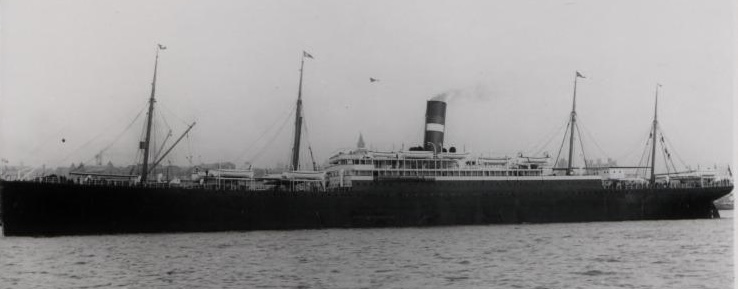
SS Mayflower
Dominion Line · 1902 · Ship Guide
Overview
SS Mayflower was a large early-twentieth-century transatlantic steamship associated briefly with the Dominion Line. Built at Hebburn-on-Tyne by R. & W. Hawthorn, Leslie & Co. Ltd., she was launched in 1902 as Hanoverian for the Leyland Line and made her first Liverpool–Boston voyage that July. In 1903 she entered Dominion Line service under the name Mayflower, a historically loaded name that deliberately echoed English migration memory while the ship herself served the practical passenger-and-emigrant traffic of the North Atlantic.
Her time as Mayflower was short. By later 1903 she had become White Star Line's Cretic, later passed through Leyland ownership as Devonian, and was ultimately scrapped in 1929. That sequence makes her a particularly useful case for evidence-first cataloging: a menu, passenger list, postcard, or sailing notice may refer to the same hull under several names, and the correct attribution depends on date, operator, route, and printed context.
This page treats Mayflower as the Dominion Line steamship of 1903, formerly Hanoverian and later White Star Line's Cretic. It should not be confused with the seventeenth-century Mayflower of Pilgrim history or with other vessels bearing the same name.
Key Facts
Note on figures: the ship is often listed at about 13,508 gross tons, while some compiled fleet lists give a slightly different value. Such differences are common in secondary summaries and should be resolved by consulting the specific register or fleet list being cited.
Design & Construction Context
Mayflower belonged to the large intermediate-liner world of the early 1900s. She was not built primarily as a record breaker, but as a substantial North Atlantic passenger vessel with space for saloon, second-cabin, and large third-class traffic. Her scale placed her well above the small Victorian emigrant steamers of earlier decades, while still below the celebrated superliners that soon dominated public memory.
The ship's design context is also tied to corporate movement. Built as Hanoverian, renamed Mayflower, then renamed Cretic, she demonstrates how large steamships could be shifted among companies and identities within the broader International Mercantile Marine-era Atlantic system. For researchers, the ship's physical continuity matters as much as her changing names.
Service History (Summary)
The vessel was launched as Hanoverian on February 25, 1902, and began Liverpool–Boston service on July 19 of that year. In 1903 she became Dominion Line's Mayflower, with documented Liverpool–Boston sailings in the spring and summer. The name was powerful, but the ship's actual Dominion Line career appears to have been brief.
Later in 1903 the vessel became White Star Line's Cretic, afterward serving in Mediterranean work and later wartime-related transport contexts. In 1923 she was sold to Leyland Line, renamed Devonian, and rebuilt to a lower gross tonnage. She was eventually broken up in 1929.
Dominion Line and the Boston Route
Dominion Line is especially important in the history of British, Canadian, and American migration routes. Its services connected Liverpool with North American ports including Boston, Halifax, Quebec, Montreal, Portland, and related seasonal or commercial routings. In that setting, Mayflower should be read less as a ceremonial namesake and more as part of a working migration network.
Boston-route material can be especially useful for family historians because it may preserve passenger names, embarkation details, class of travel, and arrival dates. For an ocean-liner collection, these documents help restore the social function of a ship whose name otherwise risks being overshadowed by the famous colonial-era vessel.
Name Changes and Attribution
The most important cataloging issue for this ship is name history. An item dated 1902 may belong to Hanoverian; an item from 1903 may belong to Dominion Line's Mayflower or, depending on the month and source, White Star Line's Cretic; later material may belong to Cretic or Devonian. The hull may be the same, but the interpretive context changes with the name and operator.
For that reason, the strongest attributions will include a dated sailing, company name, route, master, ticket office, passenger list heading, or other printed evidence. A generic photograph or postcard captioned only “Mayflower” should be treated cautiously unless it can be tied to the Dominion Line vessel by image features, publisher, date, or comparative documentation.
Passenger Lists & Migration Evidence
The ship's brief Dominion Line career makes passenger-list evidence unusually valuable. A single list can locate the vessel within a precise route and date, and may provide the strongest surviving evidence for how the ship functioned in ordinary transatlantic life. These records are often more historically meaningful than later summary entries because they show the vessel carrying actual communities across the Atlantic.
When cataloging passenger-list material, preserve the exact heading and wording. The ship name, line, route, and date are not decorative details; they are the evidence that separates Dominion Line's Mayflower from other ships of the same name and from the same hull under later identities.
Collecting Profile
Material specifically naming Dominion Line's Mayflower may be scarcer than material from her later White Star Line identity as Cretic. Likely collecting categories include passenger lists, sailing notices, period photographs, postcards, advertisements, route brochures, and fleet-list references. Because the Dominion Line name period was short, date-specific material carries special evidentiary value.
The ship is also useful for interpretive collections about renamed liners. A single hull moving through Hanoverian, Mayflower, Cretic, and Devonian can illustrate how commercial ownership, route strategy, and corporate branding reshaped a vessel's public identity.
From Hanoverian to Cretic
The ship's brief identity as Mayflower sits between two longer careers. Built as Leyland Line's Hanoverian, she was transferred into Dominion Line service in 1903 and renamed Mayflower, then passed to White Star later that same year as Cretic. The sequence makes precise dating essential: the same hull can appear under three different company identities within roughly eighteen months.
As Cretic, she continued on the Boston route and then became closely associated with Mediterranean service. Her large third-class capacity made her useful in the movement of southern European migrants to North America, extending the migration role already present in her Dominion period.
Later Leyland Career
In 1923 the vessel returned to Leyland ownership and was renamed Devonian. She was rebuilt and remeasured before resuming cargo-oriented service, closing a circle that returned the former Hanoverian to the corporate world in which she had begun.
The ship was broken up in 1929. For research purposes, her biography is therefore best treated as one continuous hull history rather than four disconnected ship names: Hanoverian, Mayflower, Cretic, and Devonian.
Interpretive Notes
Mayflower is historically interesting precisely because she is not simple. Her famous name suggests memory and symbolism, while her service record points to the practical realities of transatlantic transport: company transfers, route adjustments, migration traffic, wartime use, rebuilding, and eventual scrapping. She is best understood as a working liner whose changing names preserve the business history of the North Atlantic.
Evidence-first ship guideSources (Selected)
This list is intentionally conservative.
- Ocean Liner Curator — Sources (master bibliography)
- Norway Heritage — S/S Mayflower, Dominion Line
- Gjenvick-Gjønvik Archives — Dominion Line Fleet List
- Gjenvick-Gjønvik Archives — Dominion Line Passenger Lists
- Mystic Seaport Museum — Immigration & Steamships
- National Museums Liverpool — Photograph of Mayflower, Dominion Line
- Norway Heritage — Cretic / former Mayflower chronology