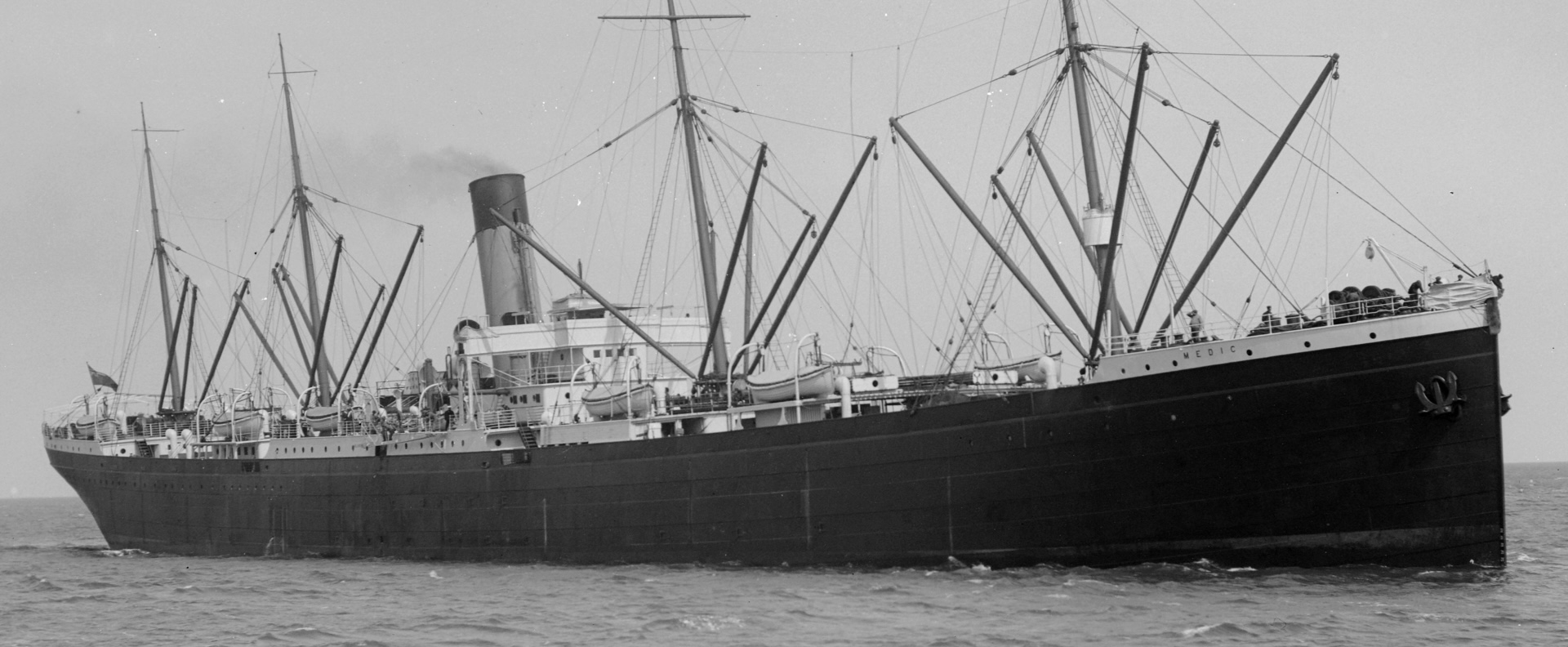
SS Medic
White Star Line · entered service 1899 · Ship Guide
Overview
SS Medic was one of White Star Line's Jubilee-class cargo-passenger ships built for the long Liverpool–Cape Town–Australia service. Harland & Wolff launched her on 15 December 1898, and she entered service in 1899.
She belonged to a very different White Star world from the North Atlantic express liners. The Australia service was built around endurance, regularity, passengers and large volumes of refrigerated and general cargo rather than speed records or prestige competition. White Star's own 1907 literature described the service as carrying one passenger class, an important correction to later summaries that too easily import Atlantic first/second/third-class assumptions.
For collecting and interpretation, Medic is valuable precisely because she represents White Star's working global fleet. Passenger material, route literature, freight records and company ephemera connected with her can illuminate migration, provisioning and imperial trade in ways the famous Atlantic flagships often cannot.
Key Facts
Design for the Australia Trade
Medic was designed for a route where cargo mattered as much as passengers. Refrigerating machinery and large holds supported the movement of meat and other produce toward Britain, while wool and general freight formed part of the wider commercial system. The ship's practical machinery and moderate service speed reflected the economics of a long route on which dependable capacity mattered more than a fast passage.
This makes the Jubilee ships an important corrective to a prestige-centered view of White Star. They were large, modern ships, but their significance lay in sustained commercial usefulness across a huge geographical system rather than in luxury publicity.
Service History
1899 onward: Medic entered White Star's Australia service and became part of the regular long-distance system linking Britain, South Africa and Australian ports. The route carried migrants and other passengers alongside refrigerated produce and general cargo.
South African War era: Like other ships in this traffic, Medic operated in a world where commercial liner service and imperial transport requirements could overlap. References from this period should therefore be dated carefully rather than assumed to represent ordinary peacetime passenger service.
First World War: The ship continued under wartime requisition arrangements. Her cargo capacity and long-range utility made the type strategically useful even though her underlying identity remained that of a commercial Australia-route liner.
Postwar: She returned to White Star's Australia trade and remained in the fleet into the late 1920s, a long career that shows the durability of the Jubilee-class concept.
1928: Sale and conversion to the whale-factory ship Hektoria marked a decisive break. The later industrial vessel shared the same hull history, but it belonged to a different operational and documentary context.
Interpretive Notes
White Star Australia-service material should not be labeled through North Atlantic assumptions. Route, cargo function and the one-class passenger model are essential context. Likewise, later Hektoria material should not be allowed to erase the ship's much longer White Star liner identity.
For collectors, Medic is a reminder that functional ships can preserve unusually rich evidence of how a shipping company actually worked: contracts, passenger documents, freight records, route brochures and ordinary commercial photography may be more historically revealing than prestige advertising.
Collecting & Attribution Context
Dating Medic material depends less on dramatic rebuilds than on recognizing changes in service phase. A White Star passenger document, a wartime transport reference and a later Hektoria image may all concern the same hull but should not be cataloged as though they represent one unchanged identity. Operator, date, route wording and visible conversion details are therefore useful attribution anchors.
The ship's relative lack of celebrity is itself historically useful. Ordinary working-liner material tends to preserve the practical language of shipping—ports, passage conditions, cargo, sailing schedules and migration—rather than the myth-making language attached to famous flagships. In a curated collection, those quieter records help reconstruct the commercial system around the better-known ships.
Within the Jubilee group, Medic's historical value also comes from repetition and regularity. A liner that quietly performs the same demanding route year after year can tell us more about the durability of a transport system than a ship remembered for one famous crossing. Her long White Star career is evidence that the design answered the practical needs for which it had been created.
Evidence-first ship guide