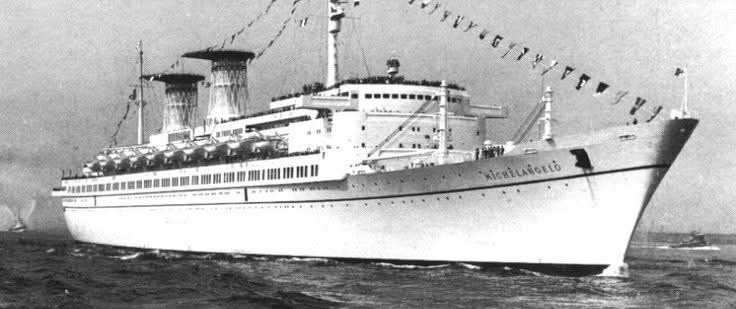
SS Michelangelo (1965)
Italian Line · 1965 · Ship Guide
Overview
SS Michelangelo entered service in 1965 as one of the final large passenger liners purpose-built for scheduled North Atlantic operation. Together with her sister Raffaello, she represented the Italian Line’s last attempt to sustain a national transatlantic flagship service in the jet age. Her career lasted only a decade in regular Italian Line service, but it generated an unusually strong documentary record of design ambition, changing economics, and the physical demands of Atlantic operation.
The ship is particularly remembered for the 12 April 1966 storm in which an exceptional wave struck her forward superstructure. Contemporary and specialist accounts agree on three deaths and more than fifty injuries, while surviving photographs document the severe damage.
Key Facts
A Superliner Built Against the Jet Age
Planning for Michelangelo and Raffaello began while scheduled ocean travel still carried national prestige, but by the time the ships entered service the economics had shifted decisively toward aviation. That timing is central to the story. They were not outdated designs accidentally surviving into the jet age; they were costly, modern ships commissioned even as the market for their primary role was contracting.
The result was a pair of liners optimized for speed, prestige, and three-class transatlantic service rather than for the open-plan flexibility later associated with mass-market cruising.
Italian Design as National Display
Michelangelo was intended to function as a floating statement of postwar Italian industry and design. Her profile was dominated by distinctive lattice-sided funnels developed to keep exhaust away from open decks, while interiors brought together architecture, decorative art, furniture, and graphics from contemporary Italian designers.
For collections, this integrated design program is visible in menus, wine lists, passenger folders, deck plans, and advertising. The strongest pieces can be dated through voyage itineraries, class terminology, printer information, and changing corporate marks.
The 12 April 1966 Storm
On a westbound passage to New York, Michelangelo encountered severe Atlantic weather on 12 April 1966. Specialist accounts describe repeated very high seas before an exceptional wave struck the forward superstructure. The impact smashed windows and penetrated spaces far above the normal waterline.
Two passengers were killed outright and a crew member later died from injuries; more than fifty people were injured. Photographs taken after the event show extensive structural damage around the forward superstructure and remain among the most important primary visual records of the ship’s career.
Later discussions often call the event a “rogue wave.” That description is reasonable as a modern interpretive category, but contemporary documentation should still be described in its own terms unless the source itself uses modern wave-science terminology.
Service Under Economic Pressure
After repairs, Michelangelo returned to regular service. The Italian Line increasingly mixed crossings with cruise work as transatlantic passenger demand weakened, but her basic three-class arrangement and operating costs limited how easily she could be transformed into a conventional cruise ship.
The end of Italian Line passenger service in 1975 therefore reflected structural economics rather than a single mechanical failure. For interpretation, this distinction matters: the ship did not become obsolete because she was badly built, but because the market for which she had been designed disappeared faster than her design could economically adapt.
Iran and Final Disposal
After withdrawal, Michelangelo and Raffaello were sold to Iran and used as static accommodation. This late phase produced a very different visual and documentary record from Italian Line passenger service. By then the ships were no longer functioning ocean liners even though much of their original structure remained.
Michelangelo deteriorated during years of static use and was eventually sold for demolition, reaching Gadani for scrapping in 1991.
Why Michelangelo Matters
Michelangelo is one of the strongest physical symbols of the final national-flagship era: technically sophisticated, visually ambitious, and commercially launched into a market already turning against the liner.
Her surviving archive should be divided into Italian Line service, the 1966 casualty record, later cruise-era material, and Iranian static use. That separation preserves both the ship’s design achievement and the economic reason her active career was so short.
Evidence-first ship guideSources (Selected)