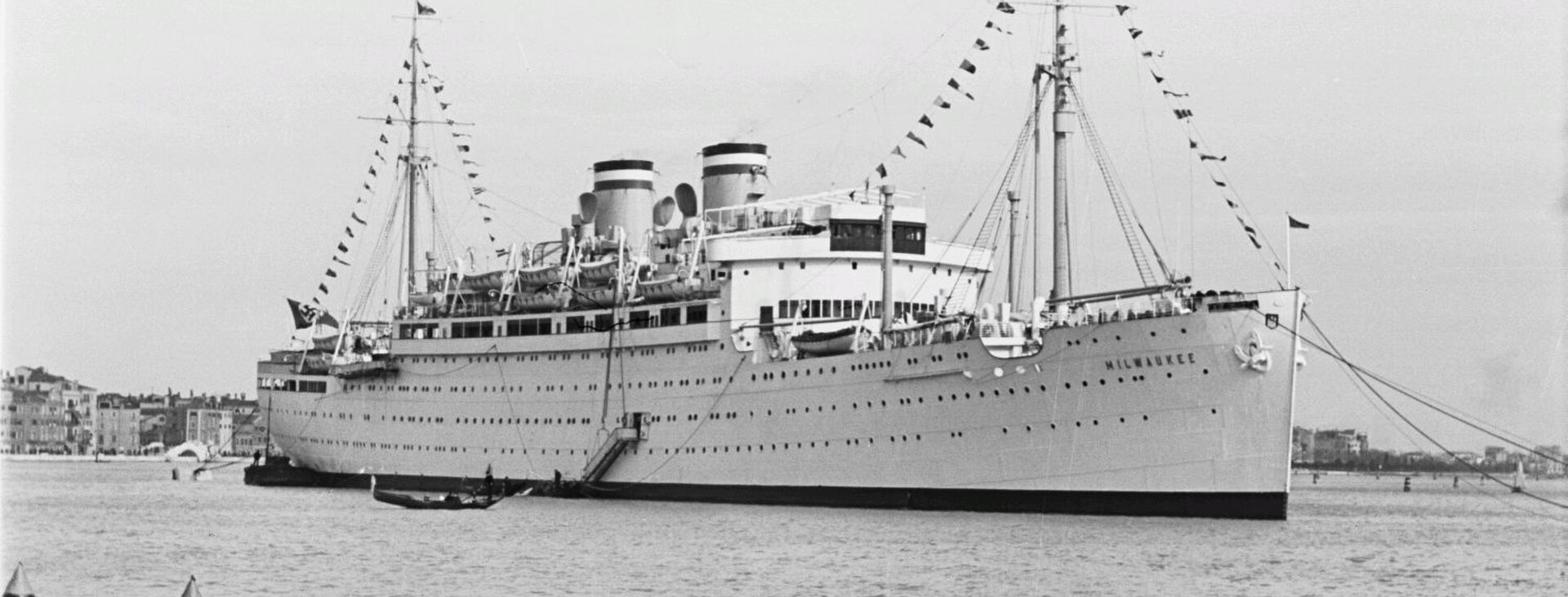
SS Milwaukee
Hamburg America Line · 1929 · Ship Guide
Overview
SS Milwaukee was a Hamburg America Line passenger liner built at Hamburg by Blohm & Voss and launched in 1929. Because she was diesel-powered, many contemporary and reference sources style her as M/S or MS Milwaukee; this guide keeps the public-facing “SS Milwaukee” title while noting that the more technically precise machinery designation is motor ship.
Milwaukee belonged to the late-1920s generation of German liners that balanced transatlantic service with an increasingly important cruise market. She is closely associated with her sister ship St. Louis, but her collecting profile is different: St. Louis is dominated by the 1939 refugee voyage, while Milwaukee is often encountered through Hamburg America Line passenger lists, cruise ephemera, route material, photographs, and later wartime or postwar references.
This page is a reference doorway: it summarizes widely documented facts, flags uncertainty where it exists, and avoids converting repeated catalog language into certainty without supporting evidence.
Key Facts
Note on name and prefix: “SS” is often used generically for ocean liners, but Milwaukee was diesel-powered. For captions, object records, and archive notes, “M/S Milwaukee” or “MS Milwaukee” is usually the more precise form.
Design & Construction (Context)
Milwaukee was not a giant prestige liner in the Imperator, Vaterland, or Bismarck mold. Her significance lies instead in the practical middle tier of the interwar Atlantic: modern machinery, flexible passenger accommodation, and suitability for both scheduled crossings and pleasure cruising. That makes her a useful ship for understanding how Hamburg America Line rebuilt identity and operations after the disruption and ship losses of the First World War.
The diesel machinery matters historically because it places Milwaukee within a broader shift away from the older steamship vocabulary. In collecting and cataloging, this can create confusion: a postcard, passenger list, or brochure may be filed under “SS Milwaukee,” while technical sources may identify the vessel as “MS” or “M/S.” Both labels may point to the same ship, but the distinction should be preserved when accuracy matters.
Service History (Summary)
Milwaukee entered Hamburg America Line service in 1929 on the Hamburg–New York route, commonly described with calls at Boulogne and Southampton. She served the transatlantic market during a difficult period: the late 1920s and early 1930s brought economic pressure, changing migration patterns, and a growing reliance on cruise traffic to keep liners useful outside peak Atlantic seasons.
By 1936, Milwaukee had been refitted for cruising service, with references often describing her as a first-class cruising liner. This phase is especially important for ephemera because cruise brochures, Mediterranean and Scandinavian itinerary material, onboard lists, and souvenir photography may reflect a different commercial use than the ship’s original North Atlantic passenger role.
Hamburg America Line Context
Hamburg America Line had been one of the great names of prewar German transatlantic shipping, but the interwar company operated in a changed world. Ships such as Milwaukee show HAPAG adapting to a market where national prestige still mattered, but efficient operation, cruise versatility, and the ability to attract travelers outside traditional emigrant traffic mattered too.
For Ocean Liner Curator, that makes Milwaukee valuable precisely because she is not only a “headline” ship. She helps explain the working middle of the liner system: the ships that connected port cities, carried ordinary travelers, supported cruise programs, and generated the paper trail now used by collectors and family historians.
Cruising Career
Milwaukee’s later-1930s cruising career is a useful reminder that ocean liners were not limited to point-to-point Atlantic service. References place her on cruises to destinations such as the Canary Islands, Madeira, Spain, the Mediterranean, and Scandinavia. When evaluating cruise material, the route and date are often more important than the ship name alone: a 1937 cruise program, for example, belongs to a different interpretive context than a 1929 New York passenger list.
The collector’s caution is that cruise ephemera can be visually attractive and easily separated from its original context. Stronger examples preserve itinerary dates, passenger-class references, HAPAG marks, printer information, or a named passenger connection.
Wartime and Postwar Fate
During World War II, Milwaukee was used as an accommodation ship at Kiel. At the end of the war she was seized by Britain and renamed Empire Waveney. Her postwar career was brief: she was badly damaged by fire at Liverpool in March 1946, refloated, and scrapped at Dalmuir in 1947.
This end-of-life sequence matters for provenance. Material described as “from Empire Waveney,” “from Kiel,” or “from Liverpool after the fire” should be treated as a different evidentiary category from prewar HAPAG passenger material. The later the claim, the more important the supporting chain of custody becomes.
Collecting Profile (What Tends to Survive)
Milwaukee-related material often appears as passenger lists, postcards, photographs, HAPAG brochures, cruise programs, baggage or route ephemera, and occasional wartime or postwar references under the Empire Waveney name. Because she is less mythologized than many famous liners, attributions may be more ordinary—but that does not make them automatic.
Practical method: first determine whether an item belongs to the North Atlantic service period, the cruising refit period, the wartime accommodation-ship period, or the postwar Empire Waveney period. Then look for hard anchors: date, route, line name, passenger class, printer marks, original album context, or a credible ownership chain. If those anchors are missing, use restrained wording such as “Hamburg America Line material associated with Milwaukee” rather than overstating certainty.
Diesel Propulsion and the Interwar HAPAG Fleet
Milwaukee belonged to a generation in which diesel machinery was becoming a practical alternative to steam for large passenger ships. Contemporary technical accounts describe four double-acting MAN-type six-cylinder two-stroke diesels driving twin screws, giving the ship a service speed of roughly sixteen knots.
That machinery helps explain why “MS” or “M/S” is the more precise prefix despite the persistent use of “SS” in later cataloging. The distinction is not merely stylistic: it identifies a major change in propulsion technology within the interwar liner fleet.
Cruising and the Milwaukee Identity
Scheduled North Atlantic service was only part of the ship's commercial life. Hamburg America Line also used Milwaukee for cruises, including itineraries to Atlantic islands and southern European destinations. That dual employment illustrates the growing importance of leisure cruising before the Second World War.
The ship also had a direct civic connection to Milwaukee, Wisconsin: the city's mayor and an official delegation attended the 1929 launch, and the mayor's wife christened the vessel. That naming connection gave the German liner an unusually visible American municipal identity even before she entered transatlantic service.
Empire Waveney and Final Loss
After wartime use at Kiel as an accommodation ship, Milwaukee was seized in 1945 and transferred into British hands as Empire Waveney. She was being refitted at Liverpool when fire caused catastrophic damage in 1946.
The wreck was refloated but declared a total loss and ultimately towed to Scotland for demolition in 1947. Her final phase therefore belongs to the broader postwar redistribution and disposal of former German passenger tonnage.
Interpretive Notes (What to Avoid)
The main interpretive trap is treating Milwaukee as merely an obscure sister ship to St. Louis. The sister-ship relationship is useful, but it should not flatten Milwaukee into someone else’s story. Her own history belongs to interwar HAPAG reconstruction, diesel-era modernization, Atlantic service, cruise adaptation, wartime repurposing, and postwar disposal.
A second trap is the prefix problem. “SS Milwaukee” may work as a familiar search label, but object descriptions should note that the ship was a motor liner. Precision here is not pedantry; it helps separate technical fact from inherited catalog habits.
Evidence-first ship guideSources (Selected)
This list is intentionally conservative.
- Ocean Liner Curator — Sources (master bibliography)
- Norway Heritage — M/S Milwaukee, Hamburg America Line
- GG Archives — SS Milwaukee Passenger Lists
- OnMilwaukee / Wisconsin Marine Historical Society — S.S. Milwaukee launched
- Cruise Line History — MS Milwaukee cruise-era overview and images
- Wikipedia — MS Milwaukee (1929) (use as a pointer map; verify key claims in stronger sources)
- Wikipedia — MS St. Louis (sister-ship context; verify specifics separately)
- Wisconsin Marine Historical Society — MS Milwaukee launch, service, and wartime history