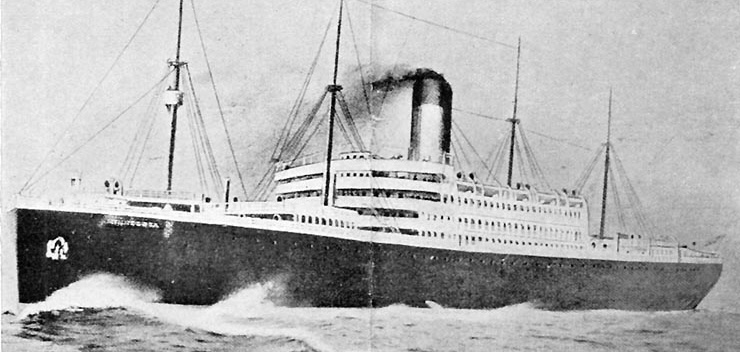
SS Minnesota
Great Northern Steamship Company / Atlantic Transport Line · 1903 · Ship Guide
Overview
SS Minnesota was one of the largest and most luxurious American-built liners of the early twentieth century, created for James J. Hill’s Great Northern Steamship Company as part of a bold Pacific passenger-and-cargo venture linking Seattle with East Asia. She belonged to a distinctive American trans-Pacific context rather than the more familiar North Atlantic prestige race, and her scale reflected both commercial ambition and regional pride. Later in life, her career broadened into wartime service, brief naval commission, and final disposal without any substantial postwar commercial second life.
In collecting and interpretation, Minnesota is best divided into four phases: Great Northern Pacific liner service, Atlantic Transport Line ownership, wartime U.S.-guarded merchant service, and brief U.S. Navy commission as USS Troy. Material from those phases should be identified carefully rather than grouped together as one simple operating identity.
Key Facts
Published tonnage and deck counts vary somewhat depending on whether the source emphasizes passenger spaces, structural decks, or registry figures. For cataloging purposes, it is best to preserve the exact wording used by the specific source or artifact being cited.
Design & Construction Context
Minnesota belongs to a fascinating but less frequently discussed chapter of liner history: the American trans-Pacific passenger-and-cargo trade centered on Seattle rather than New York. She was conceived as a major statement of American shipbuilding and western commercial ambition, not as a North Atlantic speed champion. That regional context matters.
Her importance lies partly in contrast. While British and German liners dominated public memory of the period, Minnesota shows that the United States also produced very large and highly appointed liners aimed at prestige service, even if on a different oceanic stage. In that sense, she is a Pacific counterpart to better-known Atlantic status ships.
Service History (Summary)
1901–1905: Built in Connecticut for James J. Hill’s Great Northern Steamship Company, Minnesota was launched in 1903 and entered service in early 1905. Her maiden voyage departed Seattle for East Asia, placing her squarely in the Pacific passenger-and-cargo sphere.
1905–1917 Great Northern years: In her original commercial phase, Minnesota served the Great Northern’s Pacific network. She was among the largest passenger ships operating in that arena and became a visible symbol of western American maritime ambition.
1912 Titanic aftermath association: Like a number of ships in the wider commercial and communications network of the day, Minnesota became loosely associated with the broader information flow surrounding the Titanic disaster. This is secondary to her main identity but places her within the communications web of the era’s liner world.
1915 boiler-damage suspicion: During her later Great Northern period, there were suspicions that her boilers may have been damaged by sabotage. Whether framed cautiously or more directly, this belongs to the wartime atmosphere gathering around merchant shipping rather than to her earlier peacetime role.
1917 transfer eastward: Sold in January 1917 to Atlantic Transport interests, she reached New York in March. There she was armed in accordance with wartime defensive measures for merchant ships and operated with a U.S. Navy armed guard.
1917–1918 wartime service: During the First World War, Minnesota made multiple Atlantic round trips under wartime conditions. In this phase she no longer belonged to her original Pacific passenger context, and records from this period should be treated separately.
1919 naval phase: Chartered by the U.S. Navy to return troops home after the war, she was renamed USS Troy and commissioned in February 1919. She then made a series of transport voyages before decommissioning in September of that year.
Final years: After naval service she regained the name Minnesota, but although converted for oil firing, she never returned to active sea service. During the influenza pandemic she was also used as a floating isolation hospital in New York before eventual scrapping in 1923.
Forty Pacific Round Trips
U.S. Naval History and Heritage Command records that Minnesota completed forty round-trip voyages between the American West Coast and the Far East from January 1905 through October 1915.
That decade of service places the ship firmly within the early twentieth-century American Pacific trade rather than as a one-off prestige experiment. Her size and cargo capacity were central to James J. Hill's attempt to tie rail traffic directly to trans-Pacific shipping.
Commercial Difficulty and the 1915 Breakdown
The same Navy history notes that Japanese competition and higher insurance costs after the loss of sister ship Dakota made Minnesota commercially difficult to operate. In late 1915, while attempting to move to the East Coast via Cape Horn, boiler trouble forced her back to San Francisco for prolonged repairs.
USS Troy
In 1919 the Navy chartered the ship for troop-repatriation work, commissioned her as USS Troy, and used her to bring American servicemen home from Europe. She was decommissioned in September 1919 and returned to her owners.
This creates a short but very clear naval identity boundary: Minnesota and USS Troy are the same hull, but their records belong to different operating systems and should be cataloged accordingly.
Interpretive Notes
This is a Pacific liner first: Minnesota should be understood primarily as part of the Seattle–Asia service world, not through North Atlantic prestige assumptions.
Her American-built identity matters: she was one of the major American-built liners of her era, and that alone gives her significance beyond her specific route pattern.
Multiple ownership and service phases should be kept distinct: Great Northern, Atlantic Transport, wartime merchant service, and USS Troy are related but not interchangeable interpretive frames.
She has no major postwar commercial second act: unlike some liners that returned to civilian prominence after wartime use, Minnesota effectively ended her maritime career in the immediate aftermath of the First World War. That makes surviving prewar commercial material especially important.
Evidence-first ship guideSources (Selected)
- Ocean Liner Curator — Sources (master bibliography)
- SS Minnesota (1903) — overview chronology, specifications, Pacific service, and wartime career
- University of Washington Digital Collections — steamship Minnesota at sea
- HistoryLink — Minnesota in Great Northern Pacific service context
- Naval History and Heritage Command — Minnesota / USS Troy reference context
- U.S. Naval History and Heritage Command — USS Troy / SS Minnesota chronology