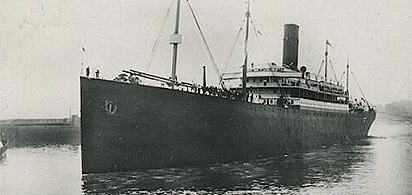
SS Minnetonka (1902)
Atlantic Transport Line · entered service 1902 · Ship Guide
Overview
SS Minnetonka was an Atlantic Transport Line passenger-cargo liner of the early twentieth century, built for the company’s London–New York service and belonging to the group often called the “Minnie” ships. Unlike many better-known North Atlantic liners, she was designed around a mixed commercial formula: substantial cargo capacity paired with all-first-class passenger accommodation. That service identity makes her especially useful for understanding a strand of Atlantic travel that emphasized comfort and exclusivity without belonging to the very top prestige tier.
In collecting and interpretation, Minnetonka is important because Atlantic Transport Line material often looks different from Cunard, White Star, or Hamburg-America ephemera. Her route and accommodation profile point to a more specialized first-class travel world, and wartime material belongs to a sharply different interpretive phase from her pre-1914 civilian service.
Key Facts
Tonnage, dimensions, and passenger figures are summarized somewhat differently across quick-reference works. For cataloging purposes, retain the exact wording and figures used by the specific source or artifact being cited.
Design & Construction Context
Minnetonka was built in the same general Atlantic Transport Line environment as Minneapolis, Minnehaha, and related ships, a fleet pattern that emphasized large, commercially capable vessels with first-class accommodations rather than multi-class mass transport. This gave the line a distinct niche on the North Atlantic, closer to an upper-tier mixed passenger-cargo service than to the giant emigrant carriers or speed-focused express liners.
Her Harland & Wolff construction also places her in the wider Belfast-built world that shaped so many British and IMM-associated liners in the period. For interpretation, that matters not only as a builder’s name, but as part of a recognizable design and commercial network linking Atlantic Transport Line with the broader Morgan combine era.
Service History (Summary)
1901–1902: Built at Belfast, launched in December 1901, completed in May 1902, and entered Atlantic Transport Line service in July 1902 on the London–New York route.
1900s–1914: Operated in peacetime North Atlantic service, carrying first-class passengers and cargo between London and New York. Surviving passenger lists from 1904 and 1914 help document this phase clearly and confirm the line’s first-class travel identity.
Technical note: Minnetonka is also associated with early wireless history, with surviving references to Marconi equipment aboard the ship in 1902. This is a useful contextual detail, though it should be treated as part of her broader modernization setting rather than as the defining feature of the ship.
First World War: Withdrawn from ordinary civilian service and used as a troop transport. In this phase she is often identified as HMT 158, reflecting military rather than commercial operation.
1918: Torpedoed and sunk in the Mediterranean on 30 January 1918 by German submarine attack while in wartime transport service.
Interpretive Notes
This is not a mass-emigrant Atlantic liner: Minnetonka should be interpreted through Atlantic Transport Line’s distinctive first-class passenger-cargo model rather than through the more familiar multi-class structure of Cunard or White Star express service.
Passenger lists are especially valuable here: because the ship’s public identity was strongly tied to first-class passage, surviving passenger-list material can be particularly informative for route, onboard culture, and line branding.
Prewar and wartime material should be separated carefully: civilian Atlantic Transport Line ephemera and troop-transport references belong to very different interpretive phases and should not be casually merged under a single generic “Minnetonka” label.
Minnetonka is especially useful for understanding Atlantic Transport Line's unusual business model: a first-class-only passenger offering could coexist with heavy freight and livestock carriage. Passenger exclusivity therefore described the accommodation plan, not a purely luxury-driven economic model.
That mixed commercial logic helps explain why surviving passenger ephemera alone can understate the cargo-centered economics of her regular service.
Explore the wider context: Express Liners and Intermediate Liners · Migrant Traffic and Tourist Traffic · First Class and Third Class.
Evidence-first ship guide