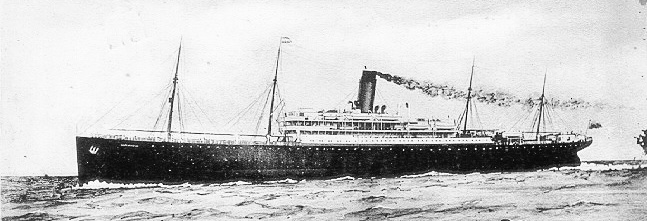
SS Minnewaska (1908)
Atlantic Transport Line · entered service 1909 · Ship Guide
Overview
SS Minnewaska was a British Atlantic Transport Line liner built at Belfast in the years just before the First World War, part of the company’s effort to maintain a substantial London–New York passenger service outside the better-known Cunard and White Star rivalry. She belonged to the “Minne”-type family of Atlantic Transport Line ships and combined moderate speed, large carrying capacity, and a route identity shaped by London rather than Liverpool or Southampton. Her later career shifted decisively from commercial liner service to military transport, ending not with scrapping after peaceful retirement but with wartime mining and total loss.
In collecting and interpretation, Minnewaska is best divided into two broad phases: prewar Atlantic Transport Line passenger service and wartime troop transport service. Ephemera, passenger lists, and company literature from the first phase should not be merged casually with the military transport references of the second.
Key Facts
Passenger totals are often summarized differently in secondary sources. For cataloging purposes, it is usually best to preserve the exact wording and date context used by the specific passenger list, brochure, or registry entry being cited.
Design & Construction Context
Minnewaska belonged to Atlantic Transport Line’s less glamorous but historically important London-based transatlantic service. She was not built to challenge the fastest express liners, but to provide substantial and dependable passenger and cargo capacity on a major commercial route. That makes her especially useful in interpretation: she represents the broader working world of North Atlantic liner traffic beyond the very top prestige tier.
Her Harland & Wolff construction is also worth noting. Though Atlantic Transport Line is sometimes overshadowed in public memory, ships like Minnewaska were part of the same industrial and shipping universe that produced many of the better-known White Star vessels. In that sense, she sits in a familiar shipbuilding tradition while serving a somewhat different corporate role.
Service History (Summary)
1908–1909: Built at Harland & Wolff’s Belfast yard, launched in November 1908, and completed in April 1909. She began her maiden voyage from London to New York on 1 May 1909.
1909–1915 prewar service: In peacetime, Minnewaska served the Atlantic Transport Line’s London–New York route. This phase is the correct context for passenger lists, company stationery, route brochures, and onboard ephemera connected with commercial Atlantic travel.
1911 incident: During her peacetime career, the ship was involved in at least a few notable incidents, including a crewman going overboard in 1911 while working near the lifeboats. Such episodes are part of her operational history, though not central to her long-term identity.
1912 communication role: Minnewaska is also remembered in connection with the aftermath of the Titanic disaster, as one of the ships involved in relaying survivor-name information. That association is secondary rather than defining, but it places her within the communications web of the North Atlantic liner world.
1915 wartime conversion: With the First World War reshaping merchant shipping priorities, Minnewaska was taken out of normal commercial service and converted into a troop transport. From this point onward, references to the ship belong increasingly to a military logistics context rather than a passenger-travel one.
29 November 1916: While traveling from Alexandria to Saloniki with troops aboard, she struck a mine in Suda Bay, Crete. The ship was beached after the damage, but she was a total loss and never returned to service.
1918: The wreck was eventually broken up in situ, bringing her career to an end without a postwar civilian phase.
Interpretive Notes
This is a London-based Atlantic Transport Line liner first: Minnewaska should be understood in the context of the London–New York service and the broader Atlantic Transport Line network, not simply as a footnote to larger and more famous express fleets.
She represents the wider North Atlantic system: not every important liner was a record-breaker. Minnewaska is useful precisely because she reflects the substantial middle ground of transatlantic passenger and cargo operations.
Passenger and military material should be separated clearly: a first-class passenger list and a wartime troop transport reference belong to two very different interpretive worlds, even though they refer to the same ship.
Her career ends in wartime loss, not postwar reinvention: unlike many liners that later returned to civilian service or were rebuilt, Minnewaska ended abruptly in 1916. That gives the surviving peacetime material added interpretive importance.
The successful beaching at Suda Bay is important interpretively because “total loss” does not mean immediate catastrophic loss of life. The hull was lost, but the master's response allowed the troops aboard to escape, separating the ship's material fate from the human outcome.
Evidence-first ship guide