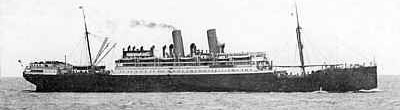
SS Moltke
Hamburg-Amerika Line · 1901 · Ship Guide
Overview
SS Moltke was a German passenger liner built by Blohm & Voss for the Hamburg-Amerika Line. Launched in 1901 and entering service in 1902, she was a substantial twin-screw vessel intended to combine comfortable cabin accommodation with the large third-class capacity required by the migration trade.
Although originally associated with plans for eastern service, Moltke was adapted before completion for transatlantic employment. She served between Hamburg and New York and later became closely associated with the Mediterranean route from Genoa and Naples to New York. During the First World War she was seized by Italy, renamed Pesaro, and continued in Italian service until the mid-1920s.
This page treats Moltke as the Hamburg-Amerika Line passenger liner launched in 1901 and later renamed Pesaro. She should not be confused with the Imperial German Navy battlecruiser SMS Moltke.
Key Facts
Note on specifications: passenger-capacity totals differ markedly among contemporary descriptions and later summaries. The configuration and date represented by a source should be preserved rather than forcing all figures into one total.
Design & Construction Context
Moltke was built as a large combination liner rather than a record-breaking express ship. Her twin-screw machinery, two funnels, and long superstructure reflected Hamburg-Amerika Line’s effort to provide reliable transatlantic service with a balance of passenger comfort, cargo capacity, and operating economy.
Contemporary descriptions emphasized her public rooms and cabin arrangements. A saloon seating more than two hundred passengers, a ladies’ parlor, grill room, and gymnasium placed her within the increasingly competitive world of early twentieth-century liner amenities, even though she was not promoted as the company’s fastest vessel.
Early Atlantic Service
Moltke entered transatlantic service in early 1902. Her initial route connected Hamburg, Plymouth, and New York, placing her within Hamburg-Amerika Line’s central migration and passenger network. Her first years also included special cruises and West Indies voyages, a reminder that large liners could be used for seasonal leisure travel as well as scheduled crossings.
The ship’s employment shifted as HAPAG adjusted tonnage to changing demand. For researchers, dated sailing notices and passenger lists are therefore more reliable than assuming she remained on one route throughout her German career.
Mediterranean–New York Service
From 1906, Moltke became particularly associated with service from Genoa and Naples to New York. This route carried tourists, returning residents, business travelers, and large numbers of migrants from southern and southeastern Europe.
Surviving passenger lists document voyages from Genoa via Naples, and these records can preserve class divisions, passenger names, destination information, and the identity of the ship’s commander. They are among the strongest forms of evidence for reconstructing the liner’s active service.
Passenger Experience
The experience aboard Moltke varied sharply by class. First-class passengers had access to more spacious public rooms and private accommodations, while third-class travelers occupied more functional spaces designed for high-capacity migration traffic. Any interpretation of the ship should avoid allowing surviving first-class promotional material to stand in for the experience of all aboard.
Menus, brochures, and interior postcards are valuable evidence, but they are selective artifacts produced for commercial and social purposes. Passenger manifests, regulations, and personal accounts can provide a more complete picture when read alongside the line’s advertising.
First World War & Italian Seizure
At the outbreak of the First World War, Moltke was in Italy and was laid up at Genoa. When Italy entered the war in 1915, the ship was seized by the Italian government. Her Hamburg-Amerika Line career ended at that point.
Renamed Pesaro, she passed into Italian service. This was not simply a cosmetic change: the vessel’s flag, administration, route system, records, and national context all changed. Documents created after the seizure should therefore be cataloged under the name in use at the time.
As Pesaro
Under the Italian flag, Pesaro later served Lloyd Sabaudo and returned to passenger service between Mediterranean ports and New York. Her postwar voyages continued the migration function that had defined much of her earlier career, but within a different corporate and national framework.
She remained in use until 1925, when she was withdrawn and sold for scrapping. Her final years show how a liner could survive a wartime transfer and continue working even after the fleet and political order for which she had been built had changed.
Dating the Maiden Voyage
The opening voyage is a useful example of source disagreement. Modern summaries variously give 22 February and 2 March 1902 for the start of Moltke’s first Hamburg–New York voyage. Rather than force one date where the surviving compiled record is inconsistent, the guide preserves that disagreement and treats the early-1902 service entry as certain.
Pesaro After the War
Italy seized the laid-up liner on 25 May 1915 and renamed her Pesaro. She returned to passenger service for Lloyd Sabaudo on 23 April 1919, sailing from Genoa via Marseille to New York. Her final Genoa–Naples–New York voyage began on 3 July 1921 after a dozen round voyages under the Italian name.
Afterward Pesaro shifted to Genoa–Naples–South America work. This later phase is important because it shows that the ship’s postwar career did not simply repeat her prewar HAPAG route under a new flag.
Why Moltke Matters
Moltke/Pesaro demonstrates how migration routes, cruising, wartime seizure, and postwar reuse could all inhabit one hull. The two names should be treated as chronological evidence, not as interchangeable labels.
Collecting Profile
Surviving material associated with Moltke includes passenger lists, menus, postcards, brochures, sailing schedules, advertisements, photographs, and information-for-passengers booklets. Italian-period material may identify the same vessel as Pesaro.
Because the name “Moltke” was also used by a famous warship, photographs and ephemera require basic identity checks. A credible liner attribution should align with HAPAG branding, the ship’s two-funnel passenger-liner profile, a documented route, or a dated voyage.
Interpretive Notes
Moltke illustrates the importance of the intermediate liner: large enough to provide substantial comfort and capacity, but designed primarily for dependable commercial work rather than prestige alone. Her history connects tourism, migration, transatlantic commerce, wartime seizure, and postwar reuse.
She also demonstrates why a ship’s later names matter. Research that stops at Moltke misses her Italian career, while research beginning only with Pesaro can obscure the vessel’s German origins. The hull’s complete history depends on preserving both identities and the transition between them.
Evidence-first ship guideSources (Selected)
This list is intentionally conservative.
- Ocean Liner Curator — Sources (master bibliography)
- Norway Heritage — S/S Moltke, Hamburg America Line
- GG Archives — SS Moltke archival collection
- GG Archives — SS Moltke passenger lists
- Naval History and Heritage Command — photograph of SS Moltke
- The National Archives — Passenger lists research guide