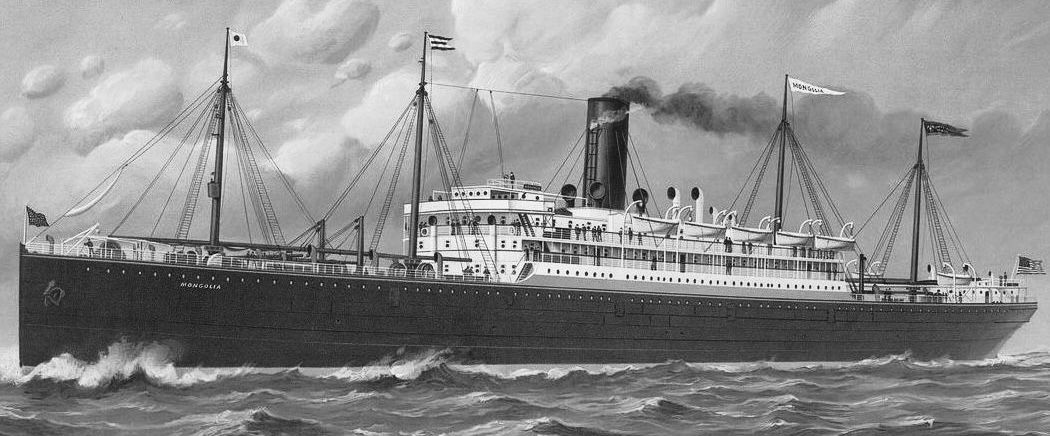
SS Mongolia
Pacific Mail Steamship Company · entered service 1904 · Ship Guide
Overview
SS Mongolia was a large American passenger and cargo liner launched in 1903 by New York Shipbuilding at Camden, New Jersey. Built for Pacific Mail Steamship Company’s San Francisco–Far East service, she and her sister Manchuria represented an ambitious American-built transpacific liner program at the opening of the twentieth century.
Her career crossed several operating identities. She began in Pacific Mail service, passed to Atlantic Transport Line interests after Pacific Mail withdrew from its Far Eastern service, became a United States Navy transport during the First World War as USS Mongolia (ID-1615), returned to civilian service, and later sailed as President Fillmore and Panamanian before being scrapped in 1946.
This page treats Mongolia as the American-built Pacific Mail steamship launched in 1903, later USS Mongolia, President Fillmore, and Panamanian. The name was used by other vessels, including a P&O Mongolia, so builder, date, route, and ownership should always be checked before attributing ephemera or photographs.
Key Facts
Note on figures: published dimensions, capacity, and tonnage can vary slightly between registers, fleet summaries, and later historical accounts. For cataloging, preserve the exact figure and source used.
Design & Construction Context
Mongolia was built for a mixed passenger, mail, and cargo role rather than for the North Atlantic express race. Her long hull, twin screws, substantial steerage accommodation, and transpacific route assignment reflect the needs of Pacific migration and commerce in the years after the United States became a larger Pacific power.
Although she is sometimes less familiar than the famous Atlantic liners, Mongolia belongs firmly within ocean-liner history. Ocean liners were defined by scheduled long-distance service, not by a single ocean. Pacific Mail’s routes connected the American West Coast with Hawaii, Japan, China, and the Philippines, making ships like Mongolia important carriers of people, correspondence, goods, and political presence.
Pacific Mail Service
In early service, Mongolia operated from San Francisco across the Pacific, with Honolulu, Yokohama, and Hong Kong among the ports most commonly associated with the route. This was a working liner network: first-class travel existed alongside second-class and steerage movement, mails, cargo, emigrant traffic, and the routine demands of commercial steamship operation.
Her large steerage capacity is particularly important for interpretation. It reminds researchers that a liner’s significance is not found only in saloons, promenades, or decorative interiors. Passenger capacity, route geography, migration policy, and port sequence can be just as revealing as luxury details.
Transfer to Atlantic Service
In 1915 Pacific Mail withdrew from its Far Eastern service after the company concluded that new legal and labor requirements made the route commercially difficult to maintain. Mongolia was among the liners sold from the Pacific Mail fleet, after which she entered Atlantic Transport Line service on the North Atlantic.
This transfer is a useful warning for cataloging. A postcard, ticket, or sailing notice may show the same vessel under a different company context. “Pacific Mail Mongolia” and “Atlantic Transport Mongolia” can refer to the same hull, but they do not describe the same commercial setting.
World War I and the Armed Encounter
Mongolia became one of the most historically visible American merchant vessels of the First World War. In 1917, after receiving defensive armament and Navy gun crews, she was involved in an armed encounter with a German submarine in the English Channel. Contemporary and later accounts have treated this as an early American armed merchant-ship action of the war.
The same wartime phase also produced tragedy. During a gun practice incident in May 1917, nurses Clara Ayres and Helen Burnett Wood were killed by shell-case fragments aboard Mongolia. That episode should be treated with care: it is part of the ship’s wartime record, but it is also a human loss attached to individual names, not merely a dramatic footnote.
USS Mongolia Transport Service
In 1918 the ship was taken into United States Navy service as USS Mongolia (ID-1615). As a transport, she carried American troops and personnel across the Atlantic and participated in the wartime movement system that connected American mobilization with Europe.
Wartime photographs and documents may therefore look very different from Pacific Mail material. Naval identifiers, troop capacity, deck guns, convoy context, and uniformed passengers should be read as evidence of a temporary military role rather than her original commercial design purpose.
Interwar Renaming and Later Career
After wartime service, the ship returned to commercial use and later entered the Dollar Line world as President Fillmore. Under that name she belonged to the interwar pattern of reusing older liners for new route structures and commercial identities, including services associated with American Pacific and round-the-world travel.
In 1940 she was renamed Panamanian. Her final years were far removed from the optimism of Pacific Mail’s early twentieth-century transpacific program, and she was eventually scrapped at Shanghai in 1946.
Passenger Lists & Documentary Evidence
Passenger lists, cabin plans, photographs, postcards, sailing cards, menus, and wartime transport records can all be useful for studying Mongolia. The strongest records will identify the ship by name and place her in a specific voyage, ownership phase, route, or military context.
Because Mongolia changed owners and names, evidence should be layered rather than flattened. A Pacific Mail passenger list, a USS Mongolia transport image, a Dollar Line President Fillmore brochure, and a later Panamanian reference may all relate to the same vessel, but each belongs to a different historical identity.
Collecting Profile
Collectible material may include Pacific Mail postcards, route ephemera, passenger lists, on-board photographs, wartime transport material, and later Dollar Line or American President-related items under the President Fillmore name. Items tied to the 1917 armed-submarine episode or wartime transport service require especially careful documentation.
Avoid assigning every “Mongolia” item to this ship by name alone. The vessel’s identity should be tested against operator, route, date, and physical appearance. The safest catalog wording preserves the object’s printed name and adds later-identification notes only where the source trail supports them.
Interpretive Notes
Mongolia is historically valuable because she connects Pacific migration, American shipbuilding, transpacific commerce, World War I mobilization, interwar liner reuse, and the complicated afterlives of older passenger ships. Her importance lies not in celebrity glamour but in the number of systems of movement she passed through.
The sister-ship relationship with Manchuria is useful for comparison, but their later careers should not be assumed to match. Shared origins in Pacific Mail do not erase later differences in ownership, routes, names, naval employment, and surviving documentary evidence.
Evidence-first ship guide