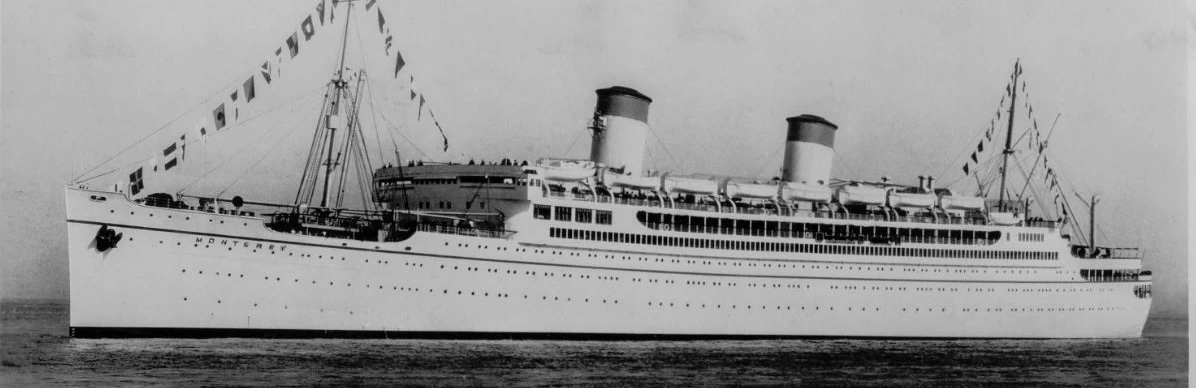
SS Monterey
Matson Lines · 1932 · Ship Guide
Overview
SS Monterey was one of Matson Lines’ best-known interwar Pacific liners, built for fast and visually distinctive passenger service linking the American West Coast with Hawaii and onward South Pacific destinations. She belonged to Matson’s celebrated “white fleet” tradition, where the ship itself functioned as both transport and advertisement for tropical and Pacific travel.
In collecting and interpretation, Monterey is especially important because her long life crossed several major identities: prewar Matson service as Monterey, wartime troop transport service, later Matson service under other names, and finally Chandris service as Britanis. Artifacts should therefore be cataloged under the printed ship name and date actually shown on the piece, not under a single simplified biography of the hull.
Key Facts
Length, tonnage, and passenger totals are generally consistent in standard summaries, but later-career sources may emphasize different figures depending on whether they describe the ship as Monterey, Matsonia, Lurline, or Britanis. For stricter catalog work, preserve the exact figures and identity used by the source or artifact being cited.
Design & Construction Context
Monterey belonged to a distinct Pacific liner world rather than to the standard Atlantic prestige hierarchy. Matson’s ships were designed not simply to move passengers, but to market a particular vision of travel: white-painted liners, tropical glamour, and a carefully staged route culture centered on Hawaii and the South Pacific.
This makes Monterey especially important for interpretation. She shows how liner identity could be built around destination branding as much as around onboard prestige. In that sense, she is central to understanding American interwar liner culture outside the Atlantic, and she helps explain why Matson material remains so visually and commercially distinctive in collecting circles.
Service History (Summary)
1931–1932: Built at Quincy by Bethlehem’s Fore River yard, launched in October 1931, and completed in April 1932 for Matson’s Pacific passenger services. Her official maiden voyage began from San Francisco on June 3, 1932.
1930s: Operated in Matson’s Pacific network linking the U.S. West Coast with Honolulu and onward South Pacific ports. This is the classic Monterey collecting era: brochures, passenger lists, menus, deck plans, and travel imagery from the ship’s white-fleet years.
Public image: Monterey was part of the same broader house style as Mariposa and Lurline, though she has her own route and documentary record. In practice, this means Matson visual style can be a clue, but never a sufficient identification on its own.
1941–1945: Entered wartime transport service and became a major troopship, operated under wartime government direction rather than as a normal passenger liner. This altered her documentary identity substantially.
Postwar: Returned to the long afterlife that makes the hull particularly important. She later sailed as Matsonia, then Lurline, and eventually, under Chandris, as Britanis. This unusually extended career means the same ship generated multiple distinct collecting categories over several decades.
Interpretive Notes
Name discipline is essential: a Matson-era Monterey menu, a wartime troopship image, a later Lurline brochure, and a Chandris Britanis sailing card may all belong to the same hull, but they do not belong to the same interpretive category.
Matson material has a strong visual identity: white-ship imagery, tropical route emphasis, and Pacific destination branding often make authentic material visually recognizable. Even so, attribution should rest on internal evidence such as printed ship name, route, voyage date, or deck-plan details.
Pacific liner glamour differs from Atlantic liner glamour: Monterey was not a lesser imitation of a North Atlantic express ship. She belonged to a different travel imagination altogether, one centered on leisure, climate, and destination sequence rather than on Atlantic passage prestige alone.
Long postwar life can distort collecting labels: because this hull survived under several later names, unattributed photographs and generic “Matson liner” descriptions can easily be misassigned. Good curator practice follows the evidence on the object, not the most famous or longest-lasting name in the hull’s biography.
Evidence-first ship guideSources (Selected)
- Ocean Liner Curator — Sources (master bibliography)
- SS Monterey — overview chronology, specifications, wartime service, and later name changes
- SS Maritime — Matson Monterey and Mariposa service context, route pattern, and white-fleet background
- Cruise Line History — concise Monterey narrative and Pacific route emphasis
- Matson company history — broader corporate context for the liner era