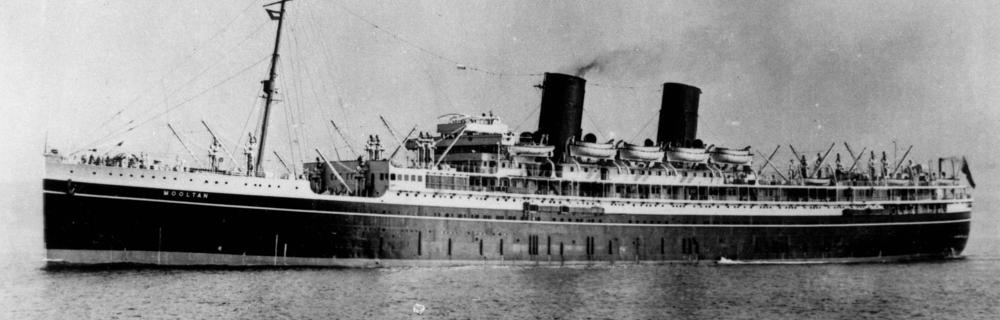
RMS Mooltan (1923)
P&O · entered service 1923 · Ship Guide
Overview
SS Mooltan was one of P&O’s major interwar liners on the Britain–Australia route, built at Belfast as a large and comfortable long-distance passenger ship for service via Suez. She was the first of P&O’s paired 20,000-ton Mooltan/Maloja liners, deliberately sized for the canal and built around reliable long-route machinery. She was notable as the first P&O ship to exceed 20,000 gross tons, and in design terms she reflects the company’s preference for dependable long-range route service rather than Atlantic-style speed competition. Her career later expanded into wartime armed merchant-cruiser and troopship work before ending in a substantially altered postwar role carrying emigrants and tourist-class passengers.
In collecting and interpretation, Mooltan is best divided into four phases: pre-1929 liner service, post-1929 rebuilt liner service, wartime naval and troopship service, and post-1948 one-class tourist/emigrant service. Material from those phases can look related, but it belongs to different operating and social contexts.
Key Facts
Some figures vary by source depending on whether they describe the ship before or after the 1929 propulsion modification, or in peacetime versus wartime form. For cataloging purposes, preserve the exact wording and service phase used by the source or artifact being cited.
Design & Construction Context
Mooltan was part of P&O’s post-First World War fleet rebuilding for the long imperial route to Australia. She was conceived as a broad-decked, steady, and reliable passenger liner rather than as a speed champion. That distinction matters interpretively: her importance lies in comfort, scale, and route prestige within the Britain–India–Australia system, not in Atlantic record-chasing.
She is also technically interesting. As built, she relied on quadruple-expansion engines, but in 1929 P&O had her augmented with turbo-electric equipment to improve performance. This hybrid arrangement makes Mooltan a useful ship for interpreting the transitional machinery solutions of the interwar liner era.
Service History (Summary)
1918–1923: Ordered in 1918 and built by Harland & Wolff at Belfast, Mooltan was launched in February 1923 and completed that September. She entered service with her maiden voyage in October 1923.
1923–1929 early service: In her original form, Mooltan served P&O’s Tilbury–Australia route as a large two-class liner. She gained a reputation for steadiness and comfort, though not for exceptional speed or nimble handling.
1929 technical rebuild: In 1929, the ship received turbo-generators and electric propulsion motors in addition to her reciprocating engines. This increased her speed and marked an important dividing line between her early and mature prewar forms.
1930s prewar role: Through the 1930s she remained part of P&O’s Australia service. In this phase she belongs squarely to the long-distance imperial-route world rather than to any Atlantic prestige-race framework.
1939–1941 wartime naval phase: At the outbreak of the Second World War, Mooltan was requisitioned and commissioned as the armed merchant cruiser HMS Mooltan (F75). In this period she was armed and operated under naval control rather than as a civilian passenger liner.
1941–1947 troopship phase: After her time as an armed merchant cruiser, she was used as a troopship. This wartime identity is historically significant and should be treated separately from her commercial passenger career.
1948 postwar return: After reconditioning, Mooltan returned to service on 26 August 1948. She now carried about 1,030 tourist-class passengers, much of the outward traffic consisting of assisted emigrants to Australia under the “Ten Pound Pom” scheme.
1949 quarantine episode: In April 1949 the ship was quarantined at Tilbury after a passenger death from smallpox was discovered on arrival, with further deaths occurring before disembarkation was allowed. This is a notable incident in her late civilian career, though not the defining feature of her identity.
1953–1954 end of career: Mooltan left Brisbane on her final voyage in November 1953 and reached Tilbury in January 1954. She was then sold for scrapping and broken up at Faslane.
Interpretive Notes
A Britain–Australia route liner first: Mooltan should be understood within the P&O imperial-route system via Suez, not as a North Atlantic prestige liner.
The 1929 machinery change matters: pre-1929 and post-1929 technical descriptions are not describing quite the same ship. For specifications and interpretive notes, the phase should always be stated clearly.
Wartime and peacetime material belong to different worlds: naval records for HMS Mooltan and troopship references should not be collapsed into the same category as passenger lists, route brochures, and peacetime onboard ephemera.
Late-career material reflects postwar migration rather than interwar luxury: after 1948, Mooltan was no longer operating in the same social or class structure as in the 1920s and 1930s. Postwar brochures and passenger records belong to a changed world of assisted migration and tourist-class travel.
Evidence-first ship guide