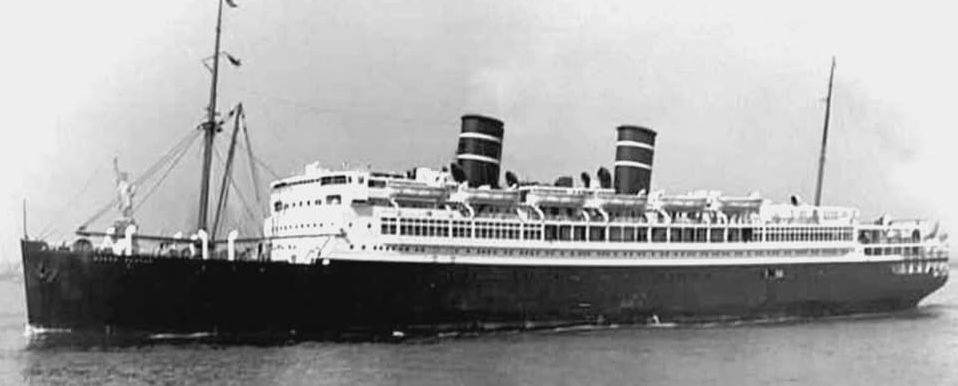
SS Morro Castle
Ward Line · entered service 1930 · Ship Guide
Overview
SS Morro Castle was a U.S.-built passenger liner completed in 1930 for the Ward Line’s New York–Havana service, conceived as a modern, leisure-forward ship in the interwar “short cruise / warm-weather” market. In collecting terms, her peacetime career tends to surface through Cuba-route ephemera—sailing cards, tourist programs, shipboard stationery, menus, and souvenir views—often rich in graphic design but not always ship-specific.
Her historical identity is dominated by a single, date-specific disaster: on 8 September 1934, while returning from Havana to New York, she caught fire off the New Jersey coast; the burned hulk ultimately ran aground near Asbury Park. Reported loss figures commonly cite 137 deaths among passengers and crew, and the event generated extensive contemporary press coverage and later commemorative material.
Evidence-first note: objects labeled “Ward Line” or “New York–Cuba” are often not automatically ship-specific. For publish-ready attribution, prioritize printed ship name, sailing date, route callouts (Havana / New York), or a deck plan/photograph that matches the vessel.
Key Facts
Design & Construction (Context)
Morro Castle was part of a Ward Line modernization push enabled by U.S. government-backed financing for new merchant ships in the late 1920s, resulting in two near-sister passenger liners built at Newport News. Unlike the North Atlantic “race” ships, these were purpose-designed for a warm-weather route with a strong leisure pitch—meaning the ship’s print culture often reads more like resort marketing than traditional liner “mail and prestige” imagery.
The ship is commonly described as turbo-electric, a machinery choice that appears frequently in period write-ups as a selling point of modernity. When you find brochures or onboard publications emphasizing “electric drive,” treat that language as a dating cue rather than a proof of ship identity: verify the ship name or route before locking the attribution.
Service History (Summary)
1930–1934: New York–Havana passenger service. From her 1930 entry into service, Morro Castle operated the Ward Line’s New York–Havana run, an itinerary that produced a large volume of printed ephemera. Many surviving items are richly illustrated but may only say “Ward Line” or “Havana,” requiring careful handling in catalog records.
8 September 1934: Fire and grounding. In the early hours of 8 September 1934, the ship caught fire off the New Jersey coast while northbound from Havana. The burned vessel ultimately grounded near the shore, and the disaster became one of the best-remembered U.S. passenger-ship tragedies of the interwar period.
Aftermath: Investigation and scrapping. The wreck was later towed off and sold for breaking up. In collecting terms, later “memento” items (photos, postcards, clippings, memorial ephemera) often derive from post-disaster circulation rather than shipboard use.
Interpretive Notes
For collectors, Morro Castle is a ship where “story gravity” can overwhelm evidence. The safest curatorial approach is to separate objects into two documentary families: (1) ship-in-service (menus, passenger lists, stationery, deck plans, baggage labels) and (2) disaster/aftermath (press coverage, memorial items, wreck photographs, later retellings). Both are legitimate, but they should be cataloged differently.
High-confidence shipboard attribution usually requires at least one hard anchor: printed ship name, a dated sailing (or itinerary), a labeled deck plan, or an image clearly identifiable to the vessel. If an item only says “Ward Line” and “Havana,” treat ship attribution as possible rather than certain.
Practical tip: if the object’s value claim depends on “from the Morro Castle,” ask what the object itself shows. A caption card, press clipping, or later souvenir photo can be historically meaningful without being “from onboard.”
Disaster history requires source discipline: the 1934 Morro Castle fire is remembered through dramatic photographs, survivor accounts, official investigations, and later safety commentary, but even official historical summaries do not always agree on the exact death toll. Preserving that disagreement is more responsible than selecting one number and presenting it as uncontested precision.
The ship’s importance extends beyond the casualty count. Rescue efforts, questions about command and fire response, and the disaster’s influence on public discussion of passenger-ship fire safety form part of the historical record. For comparative context, see Safety, Regulation and the Changing Ocean Liner. Ordinary pre-disaster cruise and passenger material should still be distinguished from artifacts or documents directly tied to the final voyage.
Evidence-first ship guide