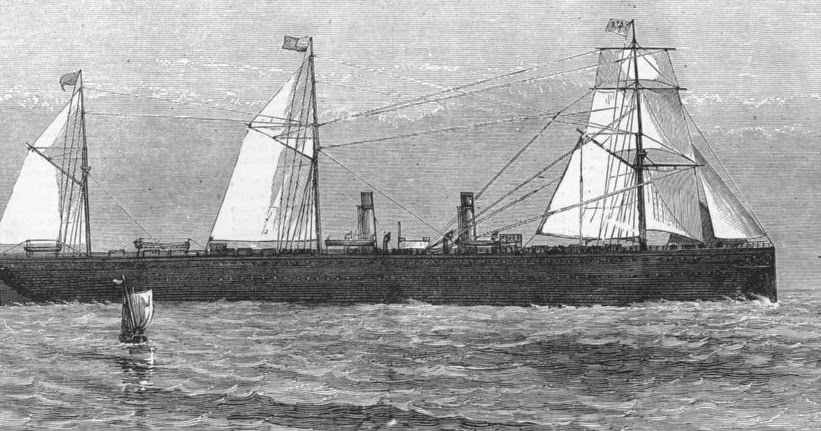
SS Napoleon III
French Line / C.G.T. · 1865 · Ship Guide
Overview
SS Napoleon III was an early iron transatlantic steamship built for the Compagnie Générale Transatlantique, better known in English-language contexts as the French Line. Built in London in 1865, she belongs to the first generation of French Line North Atlantic steamers that helped establish regular Le Havre–New York service before the better-remembered French liners of the late nineteenth and twentieth centuries.
Her story is unusually important because the same vessel later became Ville du Havre. After conversion from paddle propulsion to screw propulsion and a lengthening rebuild, she returned to the North Atlantic under that new name and was lost in the catastrophic 1873 collision with the British clipper Loch Earn. For curatorial purposes, material should be separated carefully between the ship’s original Napoleon III period and her later Ville du Havre identity.
This page treats Napoleon III as the French Line steamship built in 1865 and later renamed Ville du Havre. The name “Napoleon III” can also refer to the French emperor and to unrelated historical material, so line, date, builder, route, and later name should always be checked before attribution.
Key Facts
Note on figures: nineteenth-century ship references often mix burden, register tonnage, rebuilt tonnage, and rounded dimensions. Treat these numbers as context clues and verify against the source type before using them for firm identification.
Design & Construction Context
Napoleon III was not a “floating palace” in the later French Line sense. She was a practical early transatlantic steamer, built at a time when iron construction, paddle propulsion, auxiliary sail, and scheduled mail-and-passenger service were still being integrated into a reliable ocean route system.
Her London construction is also worth noting. Later French Line prestige became closely associated with French shipbuilding and the great Saint-Nazaire liners, but the company’s early North Atlantic fleet drew on British industrial capacity as well. That makes Napoleon III a useful example of the international technical foundations behind national liner identity.
Service History (Summary)
Napoleon III entered service from Le Havre via Brest to New York in 1866. In that role she helped support the French Line’s early North Atlantic presence, carrying passengers, mail, and cargo between France and the United States during the formative years of the company’s transatlantic operation.
Her original career under the name Napoleon III was comparatively short. After the fall of the Second Empire, the imperial name was no longer politically suitable, and the ship was rebuilt and renamed Ville du Havre. This change was not merely cosmetic: the vessel’s propulsion and dimensions were altered, creating two distinct documentary phases for the same hull.
Conversion to Ville du Havre
In the early 1870s, the vessel was lengthened and converted from paddle propulsion to single-screw propulsion. After this work she re-entered service as Ville du Havre, named for the French port that anchored the line’s North Atlantic identity.
This rebuild is central to attribution. A photograph, passenger list, article, or model labeled Ville du Havre may depict the same original ship, but it does not necessarily document her Napoleon III period. The safest catalog wording is usually “built as Napoleon III, later Ville du Havre” when the object or source spans the transition.
Disaster as Ville du Havre
On November 22, 1873, while operating as Ville du Havre, the ship collided in the North Atlantic with the British iron clipper Loch Earn and sank rapidly. Contemporary and compiled accounts commonly state that the ship went down in about twelve minutes, with heavy loss of life and a comparatively small number of survivors rescued first by Loch Earn and then by the American vessel Tremountain or Trimountain, depending on source spelling.
The disaster became part of wider nineteenth-century Atlantic memory, including religious and family-history narratives connected with the Spafford family and the hymn “It Is Well with My Soul.” For a ship guide, however, those later associations should be handled as documented reception history rather than allowed to overwhelm the vessel’s technical and commercial identity.
Passenger Lists & Migration Evidence
Records connected with Napoleon III and Ville du Havre can be especially useful because they anchor the ship to specific voyages, passenger communities, and route patterns. A manifest or newspaper sailing notice may provide stronger evidence than a broad fleet summary because it places the vessel in motion on a dated crossing.
When using passenger material, preserve the document’s own name for the ship. A record under Napoleon III belongs to the ship’s imperial-name phase; a record under Ville du Havre belongs to the rebuilt and renamed phase, even though the underlying vessel was historically continuous.
Collecting Profile
Collectible material is likely to be documentary rather than decorative: passenger lists, sailing notices, newspaper accounts, stereoviews, engravings, wreck reports, and French Line fleet references. Because the ship is remembered largely through her later sinking, disaster-related material should be cataloged with particular care.
A generic French Line item from the 1860s or early 1870s should not be assigned to Napoleon III unless the ship is named or the route, date, and source trail make the connection clear. Claims of wreck recovery or personal association with the 1873 loss require stronger provenance than ordinary ephemera.
The Rebuild and Political Renaming
The fall of the Second French Empire made the name Napoleon III politically awkward, but the change to Ville du Havre coincided with far more than a cosmetic renaming. The ship was lengthened and converted from paddle propulsion to screw propulsion, giving the same hull a materially different machinery arrangement and external appearance.
This creates an important curatorial dividing line. Material from the Napoleon III period documents an early iron paddle steamer; material from the Ville du Havre period belongs to the rebuilt screw liner. Treating the two configurations as visually interchangeable can produce misidentifications even when the underlying hull is the same.
The 1873 Loss as Ville du Havre
On 22 November 1873, while eastbound from New York, Ville du Havre collided in the North Atlantic with the British sailing ship Loch Earn. The damage was catastrophic and the French liner sank rapidly. Of 313 passengers and crew aboard, 87 survived and 226 died.
The speed of the sinking, the destruction of lifeboats by falling masts, and the subsequent rescue by Loch Earn made the disaster one of the major Atlantic passenger-ship losses of the nineteenth century. Because the casualty occurred after the rebuild, it should not be used to retroactively describe the ship's original paddle-steamer configuration.
Interpretive Notes
Napoleon III is valuable because she sits at the intersection of technology, politics, and memory. She began as an imperially named French Line paddle steamer, was transformed into a screw steamer under a republican-era name, and ended as one of the remembered tragedies of the nineteenth-century Atlantic. Her history is therefore best read in layers rather than reduced to a single disaster narrative.
Evidence-first ship guideSources (Selected)
This list is intentionally conservative.
- Ocean Liner Curator — Sources (master bibliography)
- Norway Heritage — S/S Napoleon III, C.G.T. / French Line
- Gjenvick-Gjønvik Archives — C.G.T. French Line archival collection
- Wikipedia — SS Ville du Havre (broad orientation; verify ship-specific claims against stronger sources)
- The National Archives — Passenger lists research guide
- Wikipedia — Compagnie Générale Transatlantique (broad company context; verify ship-specific claims elsewhere)
- Library of Congress — contemporary reporting on the loss of Ville du Havre