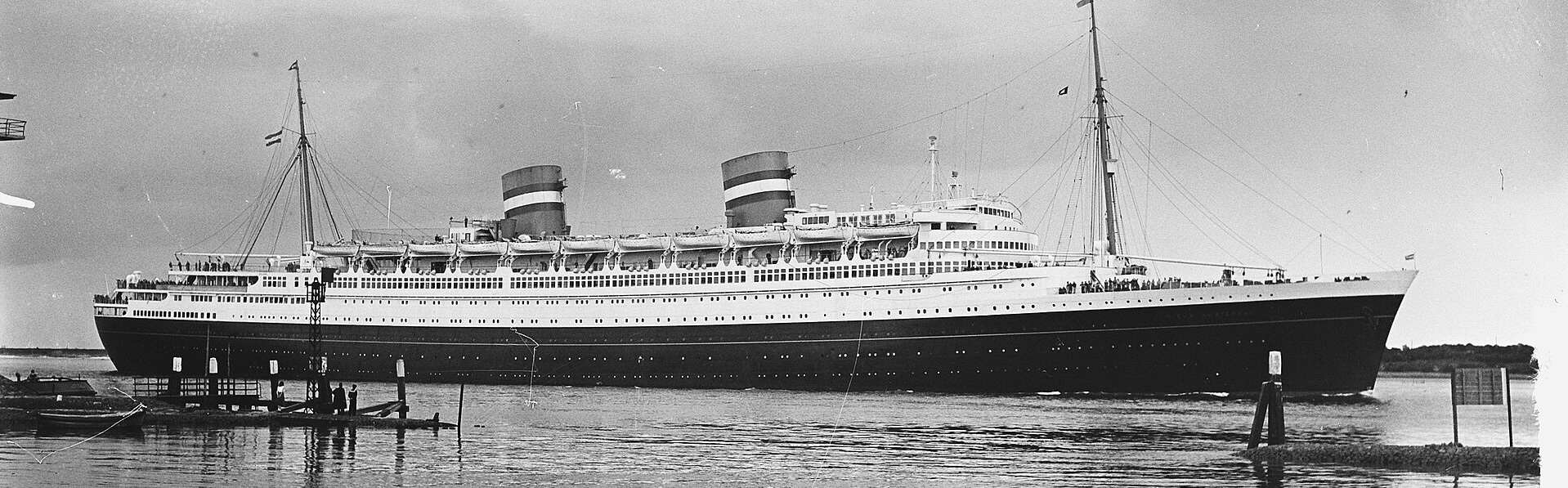
SS Nieuw Amsterdam
Holland America Line · entered service 1938 · Ship Guide
Overview
SS Nieuw Amsterdam (launched 1937; entered service 1938) was Holland America Line’s prewar flagship for the Rotterdam–New York trade, introduced at the end of the “classic” express-liner era but designed with thoroughly modern sensibilities. She revived a name previously carried by the company’s 1906 Nieuw Amsterdam, making date and visual-era discipline essential when attributing material. In contemporary and later summaries, she is closely associated with Dutch Art Deco and an intentionally “clean” modern interior aesthetic—important context because it shapes what onboard printed material looks like (typography, logos, and decorative motifs) compared with earlier Edwardian liners.
Her wartime story is central to evidence-first interpretation. Converted to a troopship during World War II, Nieuw Amsterdam became a high-utilization transport: Holland America’s own anniversary timeline summarizes her wartime mileage and troop totals at a scale that dwarfs her peacetime passenger service. This shift creates a predictable collecting problem: objects are frequently attributed to the ship without clarifying whether they are prewar passenger-era, wartime troop-era, or later postwar/cruise-era items.
This page summarizes widely published reference facts and keeps interpretation clearly separate. When figures vary by source or definition (especially tonnage), phrasing is kept conservative.
Key Facts
Design & “Modern Dutch” Identity (Context)
In most overviews, Nieuw Amsterdam is treated as a “modern” liner in both engineering and presentation: a late-1930s flagship that reads differently from the heavy Victorian/Edwardian interiors of earlier North Atlantic giants. For collecting and attribution work, that context matters: shipboard printed matter, menus, and stationery often reflect contemporary graphic language (clean geometry, restrained ornament, and crisp house branding), making it easier to spot anachronisms when something is misdated or “made to look old.”
Curatorial phrasing that stays safe: describe the style as “Art Deco / modernist” only when the object itself supports it (fonts, motifs, layout), rather than relying on seller descriptions.
Service History (Summary)
Nieuw Amsterdam entered service in 1938 on Holland America’s Rotterdam–New York run, arriving as European conditions deteriorated and the North Atlantic began to feel politically unstable. After the outbreak of war, she is widely described as shifting into cruising and then being taken up for wartime conversion.
During World War II, she served as a troopship on Allied service. Holland America’s anniversary timeline provides high-level scale: hundreds of thousands of troops carried across more than half a million miles of voyages. After the war, she returned to passenger service and continued a long second career that included North Atlantic crossings and cruise service, before withdrawal in the early 1970s.
WWII Troopship Conversion (Evidence-First Note)
Wartime conversions typically removed or simplified passenger fittings, reconfigured accommodation for high-density berthing, and introduced defensive features. That means many “wartime” objects attributed to the ship are better understood as generic troopship-era material unless the ship name, date, and chain of custody are solid. A ship-name mention in a later caption, dealer tag, or family story is not the same thing as a contemporary onboard imprint.
Collector caution: “carried on Nieuw Amsterdam in WWII” is a stronger and usually more supportable claim than “from the ship” unless the object is a named, ship-issued piece (printed stationery, company forms, tickets, crew documents) or has tight supporting documentation.
Collecting Profile (What Tends to Survive)
Material most often encountered in the market includes: (1) Holland America Line passenger stationery and lettercards (sometimes voyage-dated via postmarks), (2) menus, deck plans, and onboard programs (often undated—date by format and address lines), (3) luggage labels and sailing lists, (4) postcards and press photographs, and (5) later cruise-era ephemera that is visually distinct from prewar pieces.
Practical method: separate by era first (prewar passenger / wartime troopship / postwar passenger / cruise service), then by “name presence.” If the ship’s name is printed as part of the original design, attribution is generally stronger than when the name appears only in handwriting or later mounting.
Flagship and troopship are separate histories: Nieuw Amsterdam entered service as Holland America’s great late-1930s flagship, with interiors and passenger expectations rooted in peacetime Atlantic travel. Wartime requisition transformed the same hull into a high-capacity transport operating on a scale very different from ordinary liner service.
Holland America’s own wartime totals are especially valuable because they let the troopship phase be described from company documentation rather than vague retrospective shorthand. At the same time, those figures should not overwhelm the ship’s prewar and postwar identities. Menus, cabin plans, and publicity from passenger service belong to a different onboard environment than wartime movement records, and postwar rebuilding again altered how the ship functioned and appeared.
Her postwar return to passenger service also matters because it restored a civilian identity after years of mass transport. Refit work, renewed interiors, and peacetime schedules should therefore be treated as a separate phase rather than assumed to continue unchanged from 1938. That layered chronology is essential when dating photographs, brochures, cabin plans, and personal travel records.
That makes wartime and civilian material fundamentally different evidence categories for careful historical interpretation.
Interpretive Notes
Date and visual-era discipline are essential: this 1937/38 Nieuw Amsterdam must be separated from the 1906 ship of the same name, especially when attributing photographs and printed material.
Troopship and passenger configurations are distinct: wartime transport material should not be read as evidence of the prewar or postwar passenger arrangement without corroboration.
Evidence-first ship guide