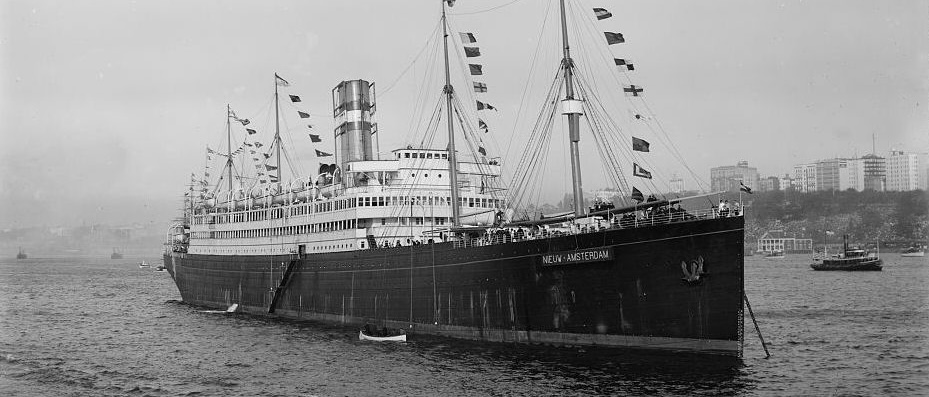
SS Nieuw Amsterdam (1906)
Holland America Line · 1906 · Ship Guide
Overview
SS Nieuw Amsterdam (1906) was one of the great early-20th-century liners of the Holland America Line and a defining ship of the company’s prewar North Atlantic identity. Built by Harland & Wolff and entering service in 1906, she gave the line a large, modern, and highly recognizable flagship-type vessel for the Rotterdam–New York route at a moment when transatlantic passenger traffic remained commercially and culturally central. Two years later, Holland America’s Rotterdam (1908) expanded that same prewar flagship presence on the route.
In collecting and interpretation, Nieuw Amsterdam is especially important because the name recurred later in the Holland America fleet, most famously with the 1938 liner. Material from the 1906 ship should therefore be cataloged with year, route, and period company style rather than under the name alone.
Key Facts
Tonnage, overall length, and route shorthand vary slightly across quick-reference summaries depending on measurement convention and service phase. For stricter catalog work, preserve the exact form used by the source or artifact being cited.
Design & Construction Context
Nieuw Amsterdam belonged to the generation of large pre-First World War liners that combined prestige, scale, and heavy emigrant-carrying utility. She was not built as a speed-record challenger in the Cunard or German express-liner manner. Instead, she represented a highly capable and commercially important continental-European liner designed to serve a wide passenger mix under the strong national identity of the Holland America Line.
That makes her especially useful interpretively. She shows how a major line could build a flagship-type reputation without centering everything on Blue Riband competition. In the Holland America context, steadiness, route reliability, and a strong Rotterdam–New York identity were at least as important as absolute speed.
Service History (Summary)
1905–1906: Built by Harland & Wolff at Belfast and completed for Holland America Line service. She entered service with her maiden voyage from Rotterdam to New York via Boulogne on April 7, 1906.
1906–1914: Served as one of the line’s principal North Atlantic passenger liners. This is the main prewar commercial phase and the period to which most classic ship-specific passenger lists, brochures, menus, and route ephemera belong.
First World War: Nieuw Amsterdam is especially noted in later summaries for maintaining regular transatlantic sailings through the war years. That continuity gives the ship a distinctive place in liner history and makes wartime-dated material particularly interesting interpretively.
Postwar years: After 1918 she remained a significant Holland America vessel, continuing Atlantic service and later appearing in broader long-distance passenger patterns, including world-cruise associations in the 1920s. This phase extends her documentary life beyond the classic emigrant-era context.
End of career: By the early 1930s she belonged to an older generation of liners and was ultimately withdrawn and scrapped in 1932. Her importance lies less in any disaster narrative than in the length, continuity, and representative power of her service.
A New Holland America Flagship
Holland America Line's own historical timeline identifies Nieuw Amsterdam as joining the fleet in 1906. At nearly 17,000 gross tons she ranked among the world's larger merchant ships and gave the company a major new presence on the Rotterdam–New York route.
The company records accommodation for 440 first-class, 246 second-class, and 1,078 third-class passengers, plus substantial tweendeck capacity. That mix reflects the dual nature of the North Atlantic business: prestige accommodation above and mass migration traffic on a much larger scale.
Migration, Cargo, and Scheduled Service
Nieuw Amsterdam should not be read simply as a prestige flagship. Her commercial purpose combined emigrant traffic, higher-fare passengers, cargo, and mail within a regular Holland America schedule.
This makes passenger lists and route documents especially valuable: they preserve the social scale of a ship whose historical importance lies as much in sustained migration service as in size or decoration.
Identity Boundary: Nieuw Amsterdam I
Holland America later reused the name repeatedly, most famously for the 1938 liner. For cataloging, this 1906 vessel is best treated explicitly as the first Nieuw Amsterdam; date, silhouette, route, and company-era typography should all be checked before attribution.
Interpretive Notes
Name discipline is essential: “Nieuw Amsterdam” is one of Holland America’s major recurring ship names. Material from the 1906 ship should not be confused with the 1938 Nieuw Amsterdam, whose scale, styling, and era are very different.
Route context matters: Rotterdam and Boulogne associations are central to the 1906 ship’s identity. A Holland America artifact should be read through printed route and date evidence, not just through company branding.
Wartime continuity is a major interpretive point: the ship’s continued regular service during the First World War is not just a trivia note; it shapes how surviving wartime passenger documents should be understood within broader liner history.
This is a flagship-type Holland America liner, but not a speed icon: collectors and summaries sometimes flatten all major liners into the same prestige framework. Nieuw Amsterdam is better understood as a high-capacity, long-serving, nationally important Atlantic liner whose significance rests on continuity and representative value as much as on display.
Evidence-first ship guideSources (Selected)
- Ocean Liner Curator — Sources (master bibliography)
- GG Archives — SS Nieuw Amsterdam (1906) specifications, maiden voyage, and service summary
- Norway Heritage — Nieuw Amsterdam (1) principal particulars and service context
- GG Archives — passenger-list archive for the 1906 and 1938 Nieuw Amsterdam ships
- Norway Heritage — Holland America Line fleet context
- Holland America Line — historical timeline and Nieuw Amsterdam (I) fleet context